

Option A
Handheld Phone Use While Driving
The visibly risky choice - and the one most regulated.
Best for: No driving scenario - widely illegal and consistently shown to impair reaction time and vehicle control.
Option B
Hands-Free Phone Use While Driving
Perceived as safer, but research challenges that assumption.
Best for: Drivers in jurisdictions where handheld use is banned and a call is unavoidable - but it still carries cognitive risk.
How Each Type of Distraction Works
Distracted driving is typically broken into three categories: visual (eyes off the road), manual (hands off the wheel), and cognitive (mind off the task of driving). Handheld phone use involves all three simultaneously, which is why it is treated as a serious hazard and is banned in most states.
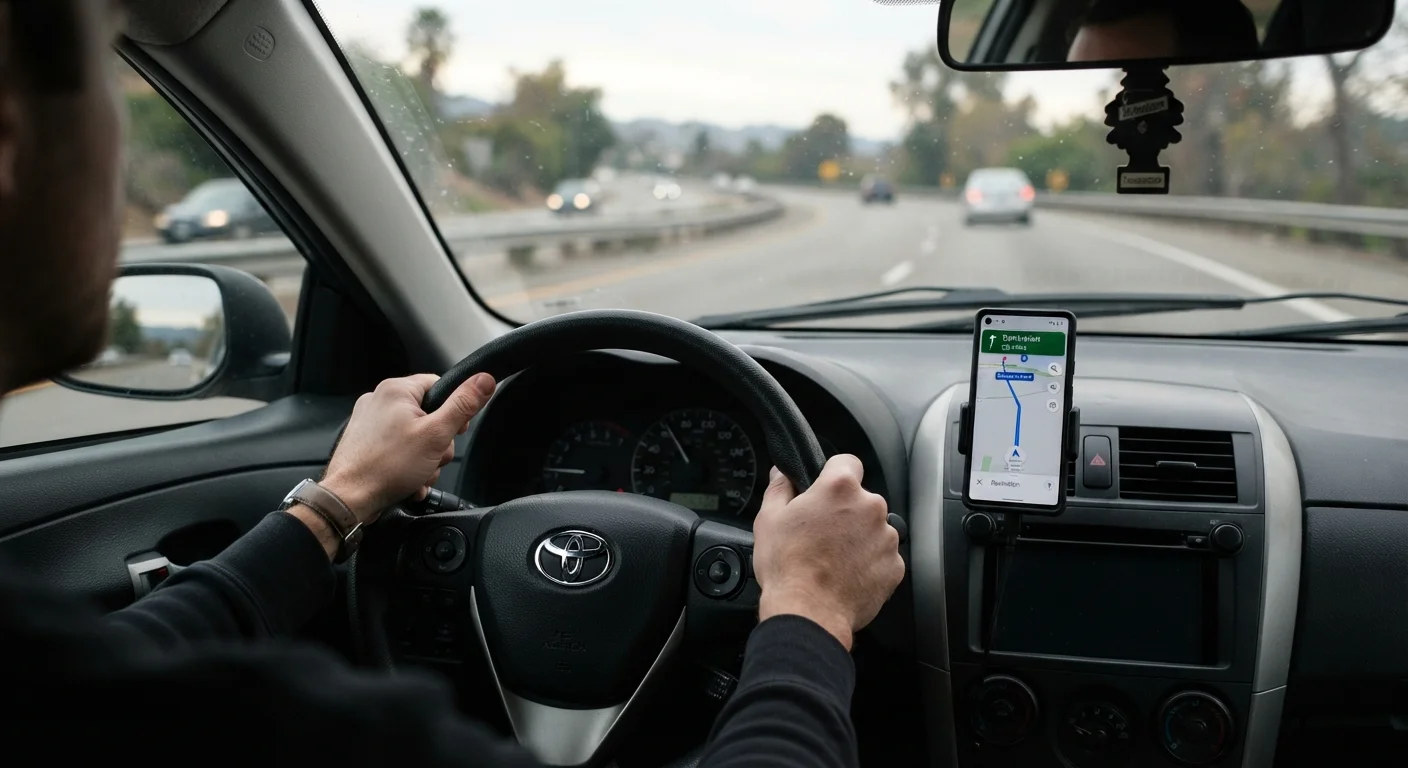
Hands-free calling eliminates the visual and manual components - your eyes stay forward and your hands remain on the wheel. That distinction matters legally and physically. But it does not remove the cognitive load. When you are engaged in a phone conversation, your brain is dividing attention between processing speech, formulating responses, and monitoring the road. Research has shown this split attention can cause drivers to miss visual cues they would otherwise notice - a phenomenon sometimes called inattention blindness.
The National Safety Council has published analysis indicating that hands-free phone conversations can reduce a driver's field of active attention significantly, even when both hands are on the wheel. This is a meaningful finding because most drivers assume that keeping hands free is sufficient to stay safe.
| Criterion | Handheld Phone Use | Hands-Free Phone Use |
|---|---|---|
| Visual distraction | High - eyes frequently leave road | Low - eyes remain forward |
| Manual distraction | High - one hand off wheel | Minimal - both hands free |
| Cognitive distraction | High | Moderate to high |
| Legal status (most U.S. states) | Banned for all drivers | Permitted for most adult drivers |
| Crash risk vs. no phone | Significantly elevated | Still elevated above baseline |
| Reaction time impact | Substantially impaired | Measurably impaired |
What the Research Actually Shows
Studies comparing handheld and hands-free phone use behind the wheel generally find that handheld use is worse across most performance measures - braking reaction time, lane-keeping, and gap acceptance when merging. That part of the conventional wisdom holds up.
Where research gets more nuanced is in the comparison between hands-free calling and no phone use at all. Multiple controlled studies, including work published through the University of Utah's applied cognition lab, have found that talking on a hands-free device produces driving impairments similar in some ways to driving with a blood-alcohol concentration at or near the legal limit of 0.08%. Importantly, this comparison refers to specific impairment patterns - not that the overall risk profiles are identical - but it illustrates how significant cognitive distraction can be.
Conversation with a passenger tends to produce less impairment than a phone call. Researchers suggest this is partly because a co-present passenger can observe traffic conditions and naturally pause the conversation during demanding moments. A phone caller has no such awareness and maintains the same conversational pace regardless of road conditions.
Understanding how your attention and following distance interact is another layer of the same picture - cognitive distraction affects how quickly you perceive the need to brake, compressing the time available to stop safely.
The Legal Landscape in the U.S.
As of recent years, the majority of U.S. states have laws banning handheld phone use while driving. A smaller but growing number restrict all phone use - handheld or hands-free - for certain driver categories, particularly new drivers and school bus operators. A handful of states have enacted broader bans that apply to all drivers.
Laws change, and enforcement approaches vary considerably. Drivers should verify their own state's current statute rather than relying on general summaries. The Governors Highway Safety Association (GHSA) publishes a regularly updated state-by-state distracted driving law summary that is a reliable starting point.
It is also worth noting that even where hands-free use is legal, a driver involved in a crash while on a call - hands-free or not - may face civil liability questions depending on the circumstances. Legal frameworks around distracted driving continue to evolve.
This article provides general educational information about road safety research and regulations. It is not legal advice. Consult official state sources or a qualified attorney for guidance specific to your situation.
The content on this site is for informational purposes only and is not a substitute for professional advice. Always consult a qualified professional for guidance specific to your situation.