

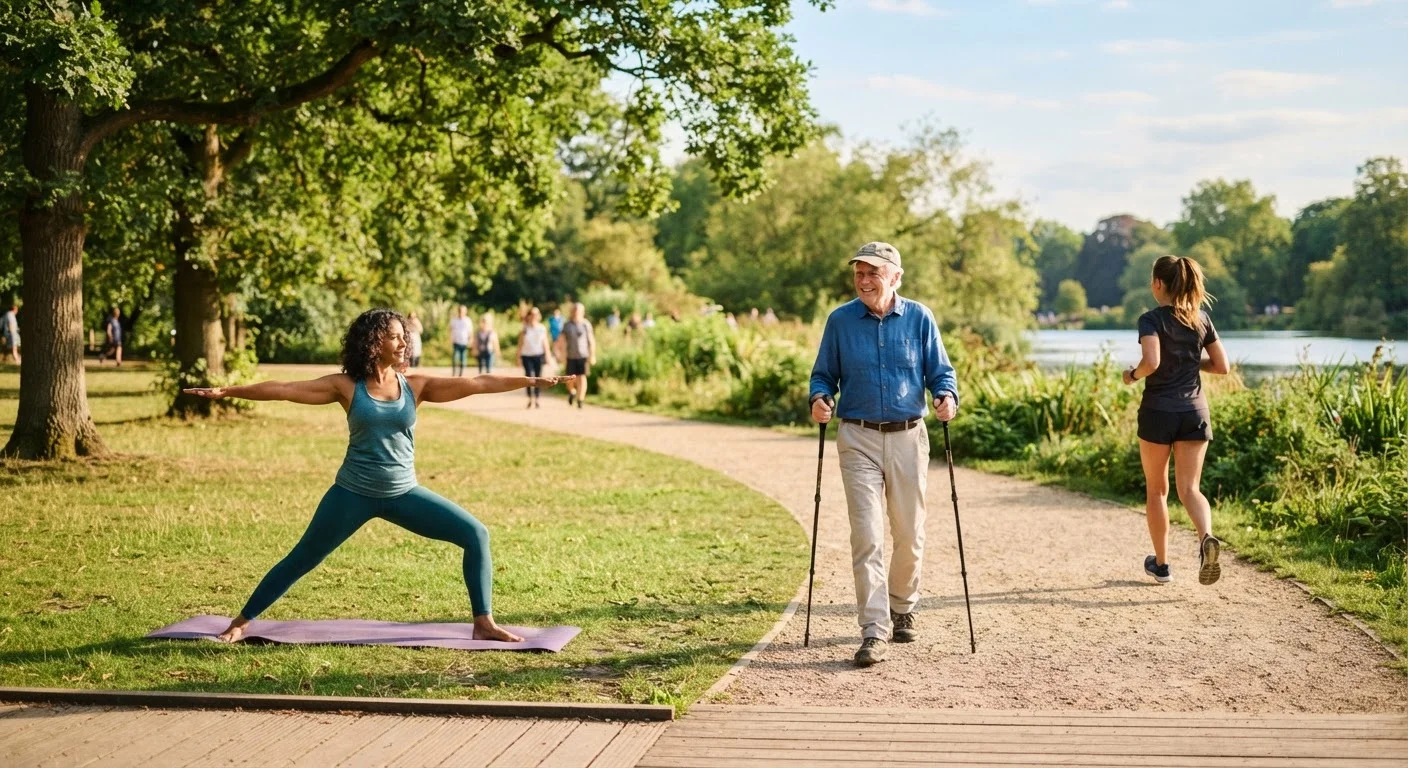
Why Exercise Needs Change as You Age
Physical activity is not one-size-fits-all. While the fundamental benefits of movement - cardiovascular health, muscle function, mood regulation, and metabolic support - remain consistent throughout life, the type, emphasis, and context of exercise that best supports your body shifts decade by decade. These changes are driven by real physiological shifts: how efficiently your heart and lungs work, how quickly muscle tissue repairs itself, and how bones respond to load all evolve with age.
Understanding these shifts helps you exercise smarter rather than harder. The U.S. Department of Health and Human Services Physical Activity Guidelines for Americans provide a consistent baseline for adults - 150 to 300 minutes of moderate-intensity aerobic activity per week, plus muscle-strengthening activities on two or more days. For a plain-language breakdown of those guidelines and what terms like "moderate intensity" actually mean, see Physical Activity for Adults: Key Terms and Guidelines Decoded.
This article walks through how exercise priorities evolve from your 20s through your later decades, and what that means practically for how you move.
Your 20s and 30s: Building the Foundation
Young adulthood is the body's prime window for building capacity. Peak bone density is typically reached in the late 20s, and muscle mass tends to be at its highest in the late 20s to early 30s. This makes these decades an ideal time to establish habits that will pay dividends for life.
The priority at this stage is building a broad aerobic and strength base. Cardiovascular fitness established in early adulthood correlates with lower cardiovascular disease risk in later life. Strength training during this window doesn't just build muscle - it stimulates bone remodeling, laying down density that acts as a buffer against age-related loss later on.
In your 20s and 30s, prioritize building movement habits over chasing performance metrics. The routines you establish now are far more valuable than any single fitness milestone.
Behavioral research shows that exercise habits formed in early adulthood are significantly more likely to persist through midlife, creating a compounding health benefit over time.
From your 40s onward, treat rest and recovery as a deliberate training component rather than lost time. Adequate sleep and recovery days are when adaptation actually happens.
Recovery capacity decreases with age due to hormonal and cellular changes; under-recovery is a leading cause of overuse injury in active middle-aged adults.
Lifestyle factors often make consistency the biggest challenge in this age group. Careers, young families, and irregular schedules compete for time. Research consistently shows that brief, moderate bouts of exercise - even 10-minute segments - contribute meaningfully to weekly totals, making this an effective strategy for busy adults. It also helps to understand the difference between being sedentary and being inactive, two separate concerns addressed in our companion piece on sedentary behaviour versus inactivity.
Your 40s and 50s: Preserving What You've Built
Starting around age 40, the body's physiology begins shifting in ways that make intentional exercise choices more important. Sarcopenia - the gradual, age-related loss of muscle mass - begins in earnest, with adults losing roughly 3 to 8 percent of muscle mass per decade after 30, and the rate accelerating after 60. Bone density also declines, particularly in women approaching and moving through menopause. Metabolic rate slows, and recovery from intense exercise takes longer.
The practical response to these changes is to maintain or increase resistance training frequency while moderating the assumption that more intensity always equals more benefit. Compound movements that load multiple muscle groups - think squats, rows, and hinges - are particularly efficient at preserving functional strength. Cardiovascular training remains important for heart health and weight management, and moderate-intensity steady-state exercise tends to be more sustainable and joint-friendly than high-impact alternatives for many people at this stage.
Hormonal changes during perimenopause and menopause can also affect how women respond to exercise, including shifts in recovery time and body composition. Consulting a healthcare provider about how these changes interact with an exercise program is worthwhile, particularly when starting something new.
Your 60s and Beyond: Movement as Medicine
In later adulthood, the goals of exercise expand beyond fitness to include functional independence, fall prevention, and quality of life. Falls are a leading cause of injury among older adults in the U.S., and regular balance and strength training are among the most evidence-supported interventions for reducing fall risk.
Balance exercises - such as single-leg stands, heel-to-toe walking, and tai chi - become as important as cardiovascular and strength work at this stage. Flexibility and mobility training support the range of motion needed for everyday tasks, from getting up from a chair to reaching overhead safely.
The good news is that the body remains highly adaptable. Research shows that adults who begin or resume strength training in their 60s and 70s can make meaningful gains in muscle strength and functional capacity. If you're returning to activity after a gap, Getting Moving Again After a Long Break from Exercise provides practical, safe guidance on rebuilding gradually.
Note: Older adults managing chronic conditions such as arthritis, osteoporosis, or heart disease should consult a qualified healthcare professional before significantly changing their exercise routine.
The Exercise Types That Matter at Every Age
Across all decades, four categories of physical activity contribute distinct benefits. Understanding what each does helps you make deliberate choices rather than defaulting to only what's familiar.
- Aerobic exercise supports heart and lung health, mood, and metabolic function. It forms the backbone of public health guidelines at every age.
- Resistance training preserves and builds muscle mass and bone density. Its importance grows with each decade.
- Balance training protects against falls and supports coordination. Often overlooked until later adulthood, it benefits all ages.
- Flexibility and mobility work maintains range of motion and reduces injury risk, becoming increasingly important as connective tissue stiffens with age.
For a more detailed breakdown of how each movement category contributes to overall wellbeing, see Types of Physical Activity and What Each Contributes to Overall Health. Physical activity also interacts with nutritional needs - both shift across the decades in related ways, explored in Eating Patterns Through the Decades.
Adapting When Life Gets in the Way
No exercise plan survives contact with real life unchanged. Injury, illness, job transitions, caregiving demands, and periods of grief or stress can all disrupt consistent activity. The most important principle in those moments is to avoid treating a pause as a failure - and to re-enter activity gradually rather than trying to pick up at the same intensity.
Research on habit formation consistently shows that consistency over time matters more than any single session's intensity. A 20-minute walk three times a week, maintained across years, delivers far greater long-term benefit than sporadic high-intensity periods followed by long gaps.
It's also worth remembering that exercise goals are allowed to change. The performance benchmarks that motivated you at 28 may not serve you at 55 - and that's not a setback, it's an appropriate recalibration. Movement that feels meaningful and sustainable is the movement that actually continues.
This article is for general informational and educational purposes only and does not constitute medical advice. Always consult a qualified healthcare professional before starting, changing, or stopping any exercise program, especially if you have an existing health condition.
The content on this site is for informational purposes only and is not a substitute for professional advice. Always consult a qualified professional for guidance specific to your situation.