

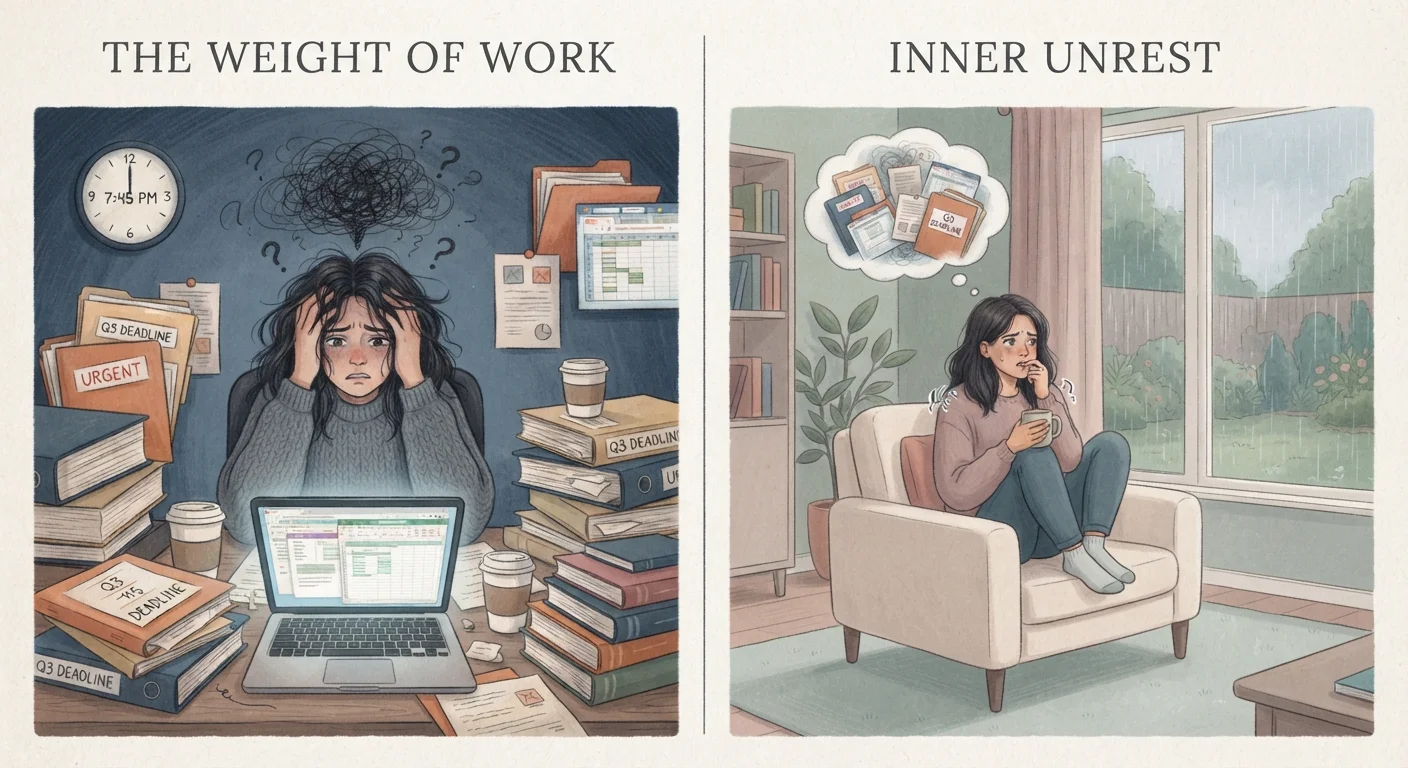
Option A
Stress
The identifiable, external pressure response.
Best for: Understanding a reaction tied to a specific, real-world demand or threat - one that typically eases when the situation resolves.
Option B
Anxiety
The internal, persistent worry that outlasts its trigger.
Best for: Recognising a pattern of worry or apprehension that persists even when no immediate stressor is present.
Why They're So Easy to Confuse
Stress and anxiety feel remarkably similar in the moment. Both can trigger a racing heart, shallow breathing, disrupted sleep, and a sense that something is wrong. That overlap exists because both conditions activate the same underlying biological mechanism - the body's autonomic stress response, sometimes called the fight-or-flight system.
The distinction lies not in the symptoms themselves but in what drives them, how long they last, and whether a clear external cause can be identified. Understanding that difference matters: while some coping tools overlap, the two experiences often call for different approaches.
This article is for general informational purposes only and does not constitute medical or mental health advice. If you're concerned about your mental health, please consult a qualified healthcare professional.
Stress: A Response to Real, Present Demands
Stress is fundamentally a reaction to something identifiable - a work deadline, a difficult relationship conversation, a financial shortfall, or a health scare. It is the body and mind signalling that demands are outpacing available resources. In this sense, stress is functional: it can sharpen focus, raise energy, and motivate action.
Once the stressor is addressed or removed, stress typically recedes. This is its defining characteristic. A student who feels pressure before an exam and relaxes once it's done is experiencing stress, not anxiety. Stress can be acute (a one-off event) or chronic (ongoing pressure from work or caregiving), but there is nearly always a traceable source.
Chronic stress, if left unaddressed, can contribute to a range of physical and mental health concerns - which is one reason the line between long-term stress and anxiety can blur. For a deeper look at how stress patterns connect to deeper exhaustion, see how burnout differs from everyday tiredness.
| Criterion | Stress | Anxiety |
|---|---|---|
| Primary trigger | Identifiable external stressor | Internal or anticipated threat |
| Duration | Resolves when stressor passes | Can persist without a clear cause |
| Physical symptoms | Tension, fatigue, disrupted sleep | Similar, plus can occur unpredictably |
| Cognitive pattern | Focused on real, present demands | Repetitive worry, future-oriented |
| Primary coping approach | Address or remove the source | Reframe thought patterns, seek support |
| When professional help is advisable | If chronic or affecting functioning | If persistent, intense, or limiting daily life |
Anxiety: When the Warning System Stays On
Anxiety shares many of the same physical sensations as stress, but its relationship to cause and timeline is different. Anxiety tends to be more internal - driven by anticipated or imagined threats rather than concrete ones. It can emerge seemingly without a trigger, or persist long after a stressor has passed.
This is what clinicians sometimes describe as the warning system staying switched on. The brain continues scanning for danger even when none is present, generating worry, dread, or unease that can feel disproportionate to the actual situation. Anxiety also has a cognitive dimension that stress typically does not: it often involves repetitive thought cycles, difficulty redirecting attention, and a sense that something bad is likely to happen.
Anxiety exists on a spectrum. Everyday worry - about an upcoming event or an uncertain outcome - is a normal part of life. Anxiety disorders, which include generalised anxiety disorder, panic disorder, and social anxiety disorder, are diagnosable conditions that significantly impact daily functioning. According to the National Institute of Mental Health, anxiety disorders are the most common mental health conditions in the United States. For a fuller picture of how anxiety presents across different people, explore what anxiety actually feels like.
Key Differences That Shape Your Response
Knowing which experience you're navigating helps you choose strategies that are more likely to be useful. Stress often responds well to practical problem-solving: breaking a large task into smaller steps, delegating, or simply getting through the source of pressure. Rest and recovery after the fact tend to restore equilibrium.
Anxiety, by contrast, doesn't always respond to problem-solving because the threat isn't always concrete. Approaches commonly used in anxiety management - such as cognitive-behavioural techniques, mindfulness-based practices, and in some cases professional treatment - work by changing the relationship between thoughts and the body's alarm response, not by resolving an external situation.
That said, many everyday practices support both states: consistent sleep, physical movement, limiting stimulants, and spending time in low-pressure social settings are generally helpful regardless of which experience is dominant. If you're unsure whether what you're experiencing might warrant professional support, understanding the differences between therapy, counselling, and psychotherapy can be a helpful starting point.
When to Seek Professional Guidance
If feelings of worry, dread, or physical tension are frequent, intense, or interfering with work, relationships, or daily activities, it's worth speaking with a qualified mental health professional. A licensed therapist, psychologist, or your primary care provider can help you understand what you're experiencing and explore appropriate options. You don't need to have a diagnosable disorder to benefit from professional support.
The content on this site is for informational purposes only and is not a substitute for professional advice. Always consult a qualified professional for guidance specific to your situation.