

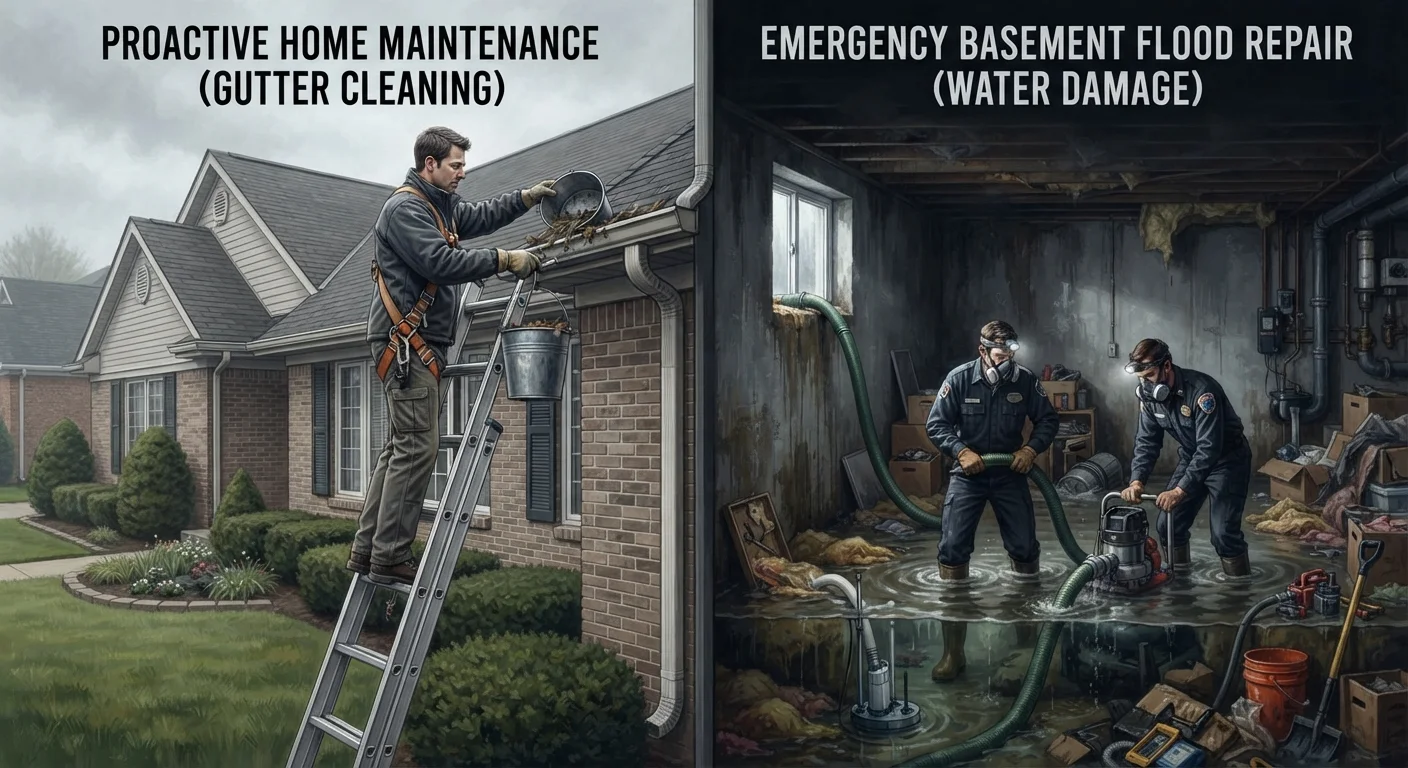
Option A
Preventive Maintenance
The proactive, cost-controlled approach to home care.
Best for: Homeowners who want predictable costs and want to avoid sudden, high-ticket emergencies.
Option B
Reactive Repairs
The after-the-fact response when something has already failed.
Best for: Situations where a failure is truly unforeseeable - though most common home failures are not.
The Core Difference in Approach
Preventive maintenance means performing scheduled inspections and servicing on home systems before problems develop. Reactive repairs happen after something has already broken, leaked, or failed - often under urgent or emergency conditions. The distinction matters because the context of a repair dramatically affects its cost.
When a plumber responds to a burst pipe at 2 a.m. on a weekend, you're paying emergency rates, water extraction fees, and likely drywall replacement on top of the actual pipe fix. When that same plumber inspects your pipes during a routine service call and replaces a corroded fitting, the bill is a fraction of that total. The underlying work is similar; the circumstances drive the difference.
For a broader view of how this dynamic plays out in a different context, see our guide to balancing routine car care and reactive repairs - the same logic applies.
| Criterion | Preventive Maintenance | Reactive Repairs |
|---|---|---|
| Cost predictability | Planned, budgetable expenses | Sudden, often higher costs |
| Timing | Scheduled at your convenience | Forced by failure, often urgent |
| Scope of damage | Issue addressed before it spreads | Often involves secondary damage |
| Contractor rates | Standard service rates | Emergency rates may apply |
| Typical HVAC example cost | $80-$150 annual tune-up | $1,500-$8,000+ system repair/replace |
| Impact on home value | Supports value with documented upkeep | Deferred issues may lower appraisal |
| Safety risk | Lower - issues caught early | Higher - failures can cascade |
What the Numbers Look Like Across Common Home Systems
Cost comparisons vary by region, home age, and contractor, but general patterns are consistent enough to be instructive. Here's how preventive versus reactive costs typically stack up across the most common home systems:
- HVAC: An annual furnace tune-up runs roughly $80-$150. Replacing a heat exchanger that cracked because it was never serviced can cost $1,500-$4,000 - and a full system replacement due to neglect can exceed $8,000.
- Roofing: Resealing flashing and clearing debris costs a few hundred dollars per visit. Repairing interior water damage caused by a neglected roof leak - including insulation, drywall, and potential mold remediation - commonly runs $3,000-$10,000 or more.
- Plumbing: A professional drain cleaning or water heater flush costs $100-$300. Emergency pipe burst repairs, including water extraction and damage restoration, frequently exceed $5,000.
- Gutters: Cleaning twice a year costs $150-$300. Foundation damage from years of misdirected water can cost $5,000-$15,000 to remediate.
These are general ranges for educational purposes - actual costs will depend on your location, home specifics, and the professionals you hire. The pattern, however, holds broadly.
1%
Annual home value recommended for maintenance spending
A widely cited rule of thumb among housing professionals suggests setting aside roughly 1% of a home's value per year for maintenance - proactively.
$3,000-$10,000+
Typical cost of reactive water damage repair
Water intrusion from a neglected roof or plumbing failure commonly generates repair bills in this range once extraction, drywall, and mold remediation are included.
Up to 90%
Home failures attributed to deferred maintenance
Industry estimates from home inspection associations suggest the large majority of home system failures stem from skipped or delayed routine upkeep rather than unpredictable events.
Our seasonal home maintenance calendar breaks down which tasks to prioritize each month so nothing gets overlooked.
Why Reactive Costs Compound
One of the most important - and least visible - aspects of reactive repair costs is that they rarely stop at fixing the original failure. A single failed component almost always affects adjacent materials and systems:
- A leaking roof damages attic insulation, then the ceiling below, then triggers mold if not caught quickly.
- An overloaded, aging electrical panel that trips repeatedly may eventually cause an arc fault - leading to fire damage and the need for complete rewiring.
- A cracked HVAC heat exchanger can allow combustion gases to circulate through the home - a safety issue that compounds into a health concern, not just a cost concern.
Preventive maintenance interrupts these chains before they start. It's not that routine maintenance eliminates all risk - some failures are genuinely unforeseeable - but it dramatically reduces the probability of the cascading failures that inflate reactive repair bills. See also our common home maintenance myths for misconceptions that lead homeowners to skip critical upkeep.
Building a Preventive Mindset Without Overextending
Preventive maintenance doesn't mean inspecting everything constantly - it means being strategic. A few principles help homeowners prioritize:
- Focus on water, heat, and structure first. These three categories cause the most expensive damage when they fail. Roof, plumbing, HVAC, and foundation checks should be the core of any maintenance schedule.
- Know what you can safely DIY and what requires a licensed professional. Cleaning gutters and replacing air filters are typically homeowner tasks. Gas appliance servicing, electrical panel work, and anything requiring permits should involve licensed tradespeople. Our honest look at DIY maintenance covers where the line sits.
- Keep a simple maintenance log. Knowing when a water heater was last flushed or a roof was last inspected helps you spot when something is overdue - and provides documentation useful if you sell the home.
The goal is not to spend money constantly, but to spend it intentionally on terms you control - rather than reactively, under pressure, at emergency rates.
Cost figures cited in this article are general estimates for educational purposes only and will vary based on location, home condition, contractor rates, and scope of work. Always obtain multiple professional assessments before undertaking significant home repairs or maintenance.
The content on this site is for informational purposes only and is not a substitute for professional advice. Always consult a qualified professional for guidance specific to your situation.