

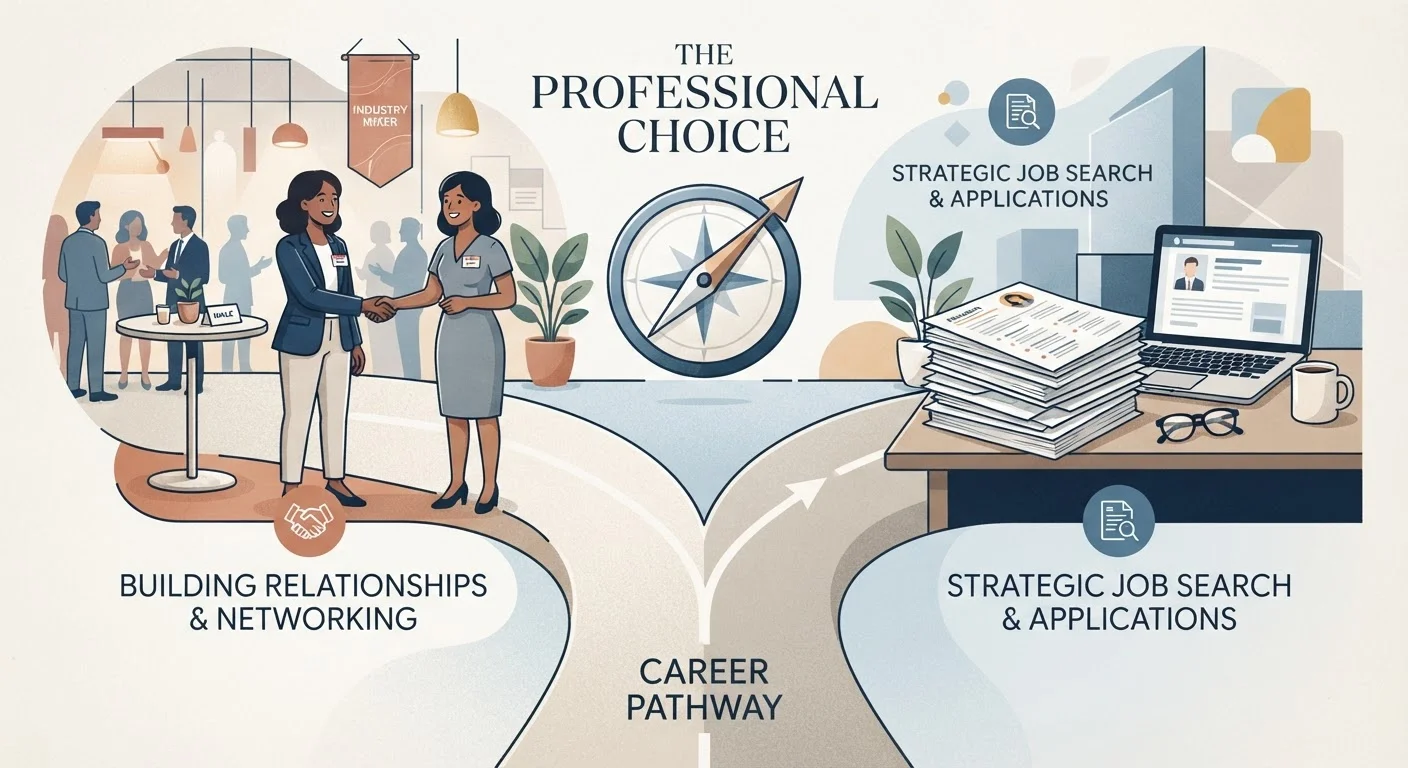
Option A
Networking
The relationship-driven, long-game approach.
Best for: Candidates who want to access unadvertised roles and build lasting career capital through professional relationships.
Option B
Cold Applying
The direct, scalable approach to visible openings.
Best for: Job seekers who need immediate visibility in structured hiring pipelines and can tailor applications to specific postings.
What Each Strategy Actually Involves
Networking and cold applying are often presented as opposites, but they operate on fundamentally different mechanics. Understanding each clearly is the first step toward using them well.
Networking means building and activating professional relationships - through informational interviews, industry events, LinkedIn conversations, alumni connections, or introductions through mutual contacts. The goal is to make yourself known and trusted within a professional community before a formal job opening exists. See our guide to what a strong professional network looks like to assess where yours currently stands.
Cold applying means submitting a resume and, often, a cover letter through a job board, applicant tracking system (ATS), or company careers page in response to a posted opening - typically without a prior relationship at the organization. It is the most familiar job search activity, but familiarity does not equal effectiveness on its own.
Both strategies target the same outcome: getting an interview. They simply approach it from different angles - one builds social capital, the other delivers credentials directly into an employer's review process.
| Criterion | Networking | Cold Applying |
|---|---|---|
| Primary mechanism | Relationship and referral | Direct application submission |
| Access to unadvertised roles | High | None - requires a posted opening |
| Time to first result | Weeks to months | Days to weeks |
| Scalability | Low - depth over volume | High - can apply to many roles |
| Competition level | Lower - referrals reduce the field | Higher - open to all applicants |
| Suitability for entry-level candidates | Moderate - network is smaller | High - structured entry point |
| Long-term career value | High - builds lasting capital | Low - transactional by nature |
| Effort required per opportunity | High - relationship investment | Moderate - tailoring per application |
The Case for Networking: Access, Referrals, and Reduced Competition
The single most compelling argument for networking is access to roles that are never publicly posted. Researchers and career practitioners have long noted that many positions - particularly senior, specialized, or newly created ones - are filled through referrals or internal conversations before an employer decides whether to advertise at all. While specific figures vary across studies and industries, the pattern is well established: your professional relationships function as an early-warning system for opportunities that the open job market never surfaces.
Beyond access, referrals change the hiring math. When an internal contact puts your name forward, you enter the process with a built-in credibility signal. Hiring managers often prioritize referred candidates precisely because the personal vouching reduces perceived risk. This does not guarantee an offer, but it frequently means your application receives closer attention.
Networking also builds compounding career capital over time. A contact made today may not lead to a role for two years - but when it does, the relationship's depth makes the introduction far warmer than a cold message could produce. For more on how relationship investment shapes long-term career trajectory, see our comparison of mentorship and sponsorship.
The practical limitation is time. Meaningful networking cannot be rushed without becoming transactional - which tends to backfire. If you reach out to contacts only when you need something, the relationship feels extractive and people disengage. Sustainable networking requires consistent, reciprocal investment.
The Case for Cold Applying: Scalability, Structure, and Speed
Cold applying has real advantages that networking cannot replicate. Job postings represent concrete, current demand: an employer has identified a need, allocated budget, and created a formal process. Applying directly puts your candidacy into that process immediately - no prior relationship required.
This approach also scales. Within a dedicated search period, a candidate can apply to dozens of relevant roles, which is practically impossible through networking alone. For entry-level candidates or those entering a new market without existing contacts, cold applying provides a starting point while relationship-building develops alongside it.
The challenge is volume versus quality. Sending more applications rarely translates to more interviews unless each application is genuinely tailored to the specific role. Generic submissions - the same resume and boilerplate cover letter sent to 50 postings - produce very low return rates. The ATS filters that most large employers use are designed to screen for keyword alignment and relevance, not effort.
Cold applying also offers transparency: you can track what you applied for, when, and what happened. This structured visibility is harder to achieve with networking, where opportunities emerge unpredictably. For guidance on what to do after you've submitted, see our advice on following up after an application.
Combining Both: A More Realistic Job Search Strategy
For most job seekers, the productive question is not which approach to choose but how to proportion them given your timeline, industry, seniority level, and current network strength.
A practical framework used by many career coaches: spend roughly 70-80% of active search time on networking and relationship-building activities, and 20-30% on targeted, high-quality cold applications. This ratio reflects where interview conversions actually come from for mid-career and senior candidates - but it should shift if you are entry-level, in a high-volume field, or facing urgent financial pressure.
You can also use the two strategies in tandem for any single target employer: apply cold through the careers page, then separately reach out to a contact at that company to let them know you've applied. This combines the speed and structure of formal applications with the credibility boost that internal visibility provides.
The hidden job market is real but not mysterious - it is simply the set of roles filled before they are ever advertised, and networking is the primary means of accessing it. Understanding how much of your target market operates that way is essential context for planning how you spend your search time.
Neither approach works in isolation. The most effective job searches treat networking and cold applying as complementary tools, deployed strategically depending on the role, organization, and moment in the search process.
70-80%
Roles reportedly filled via relationships
Career development researchers and practitioners frequently cite this range when estimating how many positions are filled through referrals or internal channels rather than open postings - though exact figures vary by industry and role level.
~2%
Typical cold application response rate
HR industry analyses suggest the average unsolicited application to a posted role converts to an interview at a low single-digit rate, underscoring the value of personalization and referrals.
5-10×
Referral applicant interview likelihood
Studies of large employer hiring data have found referred candidates are substantially more likely to be interviewed than non-referred applicants to the same role.
The content on this site is for informational purposes only and is not a substitute for professional advice. Always consult a qualified professional for guidance specific to your situation.