

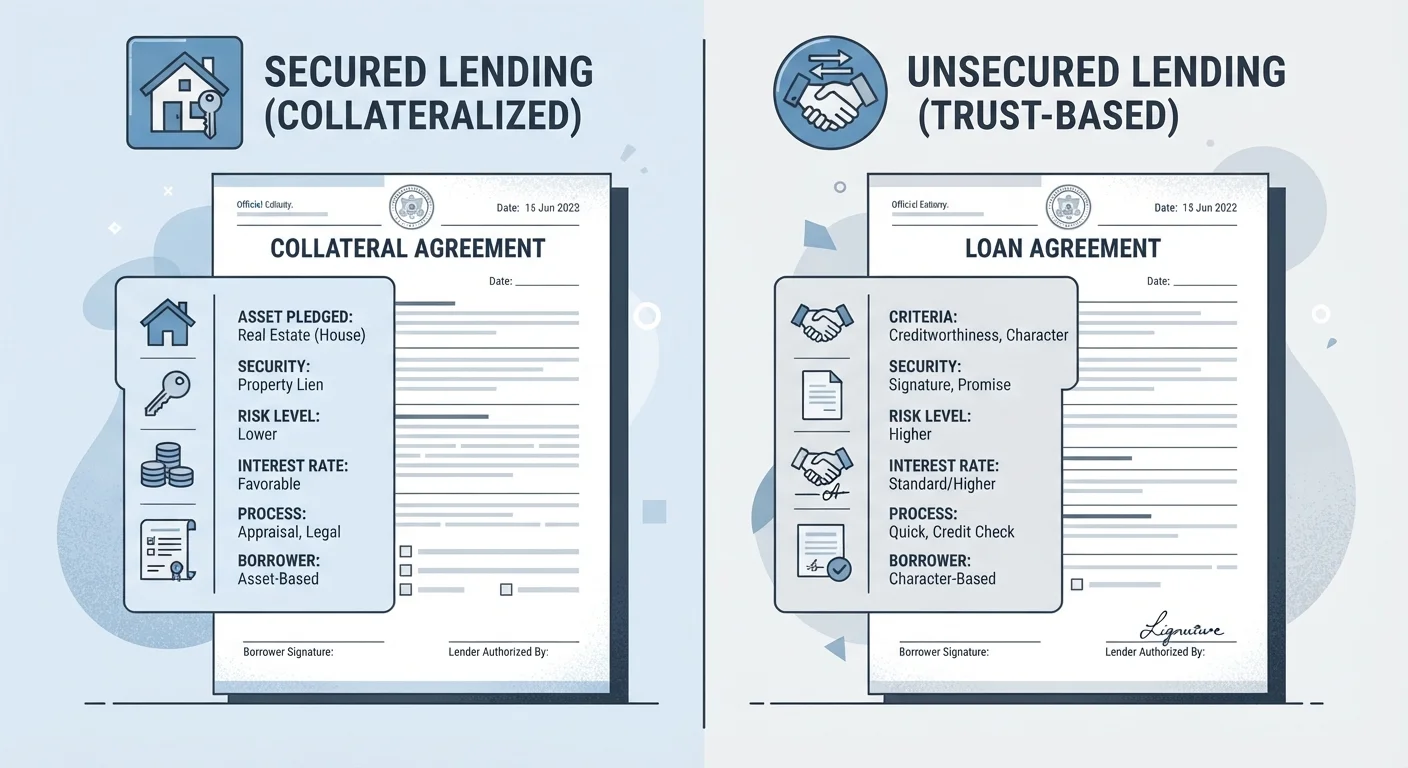
Option A
Secured Debt
Borrowing backed by an asset the lender can claim.
Best for: Borrowers seeking larger loan amounts or lower interest rates who are comfortable pledging an asset as collateral.
Option B
Unsecured Debt
Borrowing based on creditworthiness alone.
Best for: Borrowers who need flexibility without tying a specific asset to the loan, and who have sufficient credit history to qualify.
The Core Distinction: Collateral vs. Creditworthiness
At its simplest, the difference between secured and unsecured debt comes down to one question: is there an asset backing the loan? With secured debt, the borrower pledges a specific asset - known as collateral - as a guarantee. If they stop making payments, the lender has a legal right to take that asset to recover what they're owed. With unsecured debt, no such pledge exists; the lender extends credit based primarily on the borrower's credit history, income, and overall financial profile.
If you're new to how borrowing works, Credit and Debt from the Ground Up provides a clear foundation before diving deeper into specific debt types.
Common examples of secured debt include mortgages (secured by the home), auto loans (secured by the vehicle), and home equity loans. Unsecured debt covers credit cards, personal loans, medical bills, and most student loans. Both types appear on your credit report and affect your credit score, but they carry meaningfully different risk profiles for both lender and borrower.
| Criterion | Secured Debt | Unsecured Debt |
|---|---|---|
| Collateral required | Yes - specific asset pledged | No - based on creditworthiness |
| Typical interest rates | Generally lower | Generally higher |
| Common examples | Mortgage, auto loan, home equity loan | Credit card, personal loan, student loan |
| Approval factors | Asset value + credit profile | Credit history + income |
| Default consequence | Collateral seizure (foreclosure, repossession) | Collections, credit damage, possible court judgment |
| Loan amounts available | Typically higher | Often lower |
| Repayment terms | Often longer (e.g., 15-30 years for mortgages) | Often shorter (months to several years) |
Interest Rates, Terms, and Approval Criteria
Because secured loans give lenders a fallback - the collateral - they typically come with lower interest rates and longer repayment terms compared to equivalent unsecured products. A mortgage might carry an interest rate far below what a personal loan of the same size would command. The reduced rate reflects the reduced risk to the lender, not a reward for the borrower per se.
Unsecured debt, by contrast, is priced to reflect that the lender has no asset to recover if things go wrong. That's why credit card APRs and personal loan rates tend to be substantially higher. Lenders compensate for greater risk by charging more for it. For a plain-English breakdown of terms like APR and utilization, see our Credit & Debt Glossary.
Approval for secured debt often hinges on the value of the asset being pledged as much as the borrower's credit score - which is why someone with imperfect credit may still qualify for a secured auto loan. Unsecured lending places far more weight on credit history, debt-to-income ratio, and payment track record.
What Happens When Repayments Go Wrong
The consequences of default differ significantly between the two debt types, and understanding this distinction matters when assessing your personal risk.
Defaulting on secured debt gives the lender the right to seize the collateral. Miss enough mortgage payments and foreclosure proceedings can begin. Stop paying an auto loan and repossession is a legal avenue for the lender. The timeline and process vary by state, loan agreement, and lender policy, but the potential loss of a significant asset is real and direct.
Defaulting on unsecured debt does not trigger direct asset seizure - because no specific asset was pledged. However, the consequences remain serious: the account may be charged off, sold to a collections agency, and reported negatively to the credit bureaus. A lender or collector can also pursue a court judgment, which in some cases may enable wage garnishment or bank account levies, depending on state law. None of these outcomes are harmless - they simply follow a different path.
If you're managing repayment challenges across multiple accounts, Debt Repayment Strategies and Managing Debt Responsibly Over the Long Term offer structured approaches worth understanding.
State Laws Affect Your Rights in Default
The rules governing repossession, foreclosure timelines, wage garnishment, and debt collection vary considerably by state. What a lender can do - and how quickly - depends on local law as well as your specific loan agreement. If you're facing default on any type of debt, consulting a nonprofit credit counselor or a licensed attorney in your state can help clarify your options and protections.
Making Sense of Your Own Debt Mix
Most borrowers carry a mix of secured and unsecured debt simultaneously - a mortgage, a car payment, and a credit card balance, for instance. Recognizing which is which helps you make more deliberate decisions about prioritization, refinancing, and risk.
For example, when cash flow tightens, the consequences of missing a secured payment (potential loss of your home or vehicle) are often more immediate and severe than missing an unsecured payment. That doesn't mean unsecured defaults are consequence-free, but the nature of the harm differs. Common borrowing pitfalls often stem from not fully understanding the terms attached to each debt type before signing.
If you're considering rolling multiple debts into one, Debt Consolidation: How It Works and When It Makes Sense explains how consolidation can affect the secured or unsecured nature of what you owe - a detail that deserves careful attention.
This article is for general informational and educational purposes only and does not constitute personalized financial, legal, or investment advice. Consult a qualified financial professional regarding your specific circumstances.
The content on this site is for informational purposes only and is not a substitute for professional advice. Always consult a qualified professional for guidance specific to your situation.