

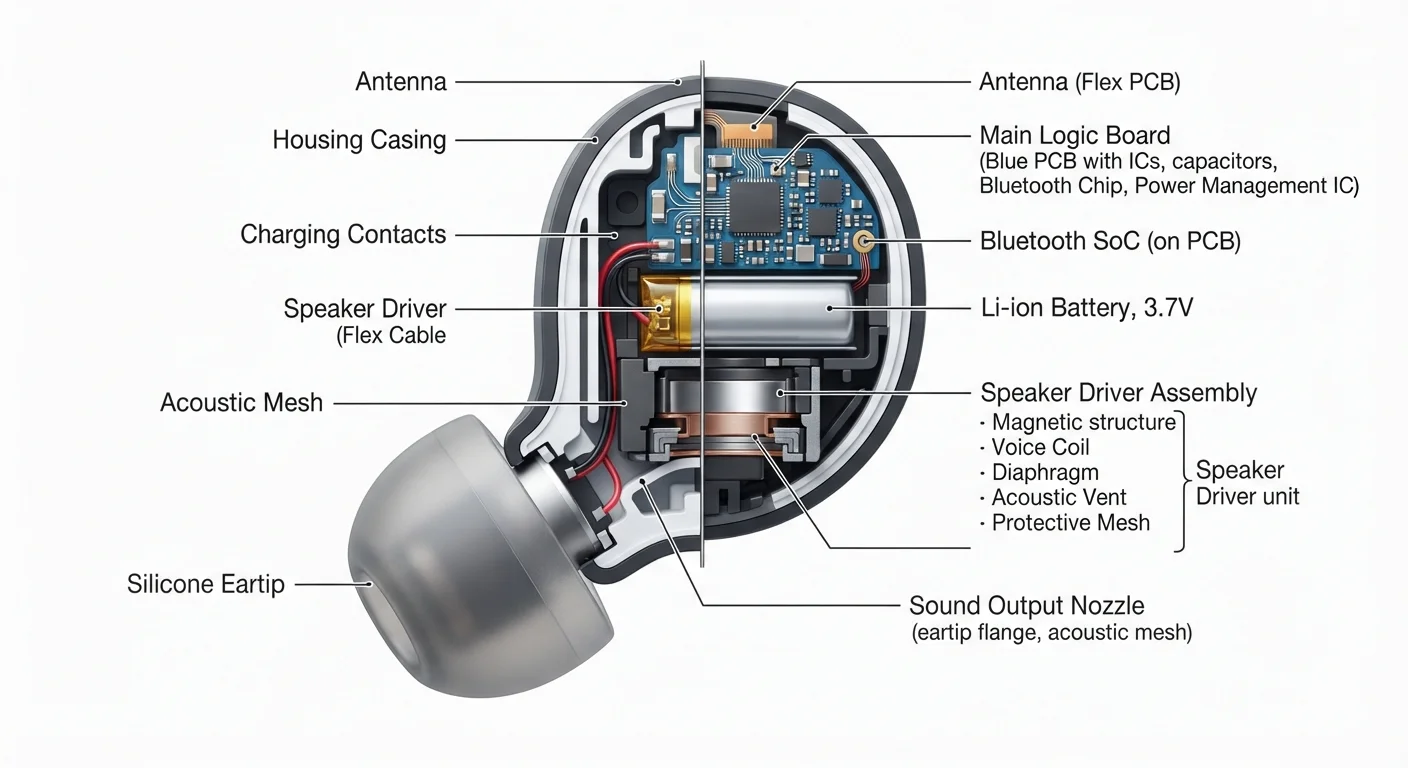
The Driver: Where Sound Is Actually Made
Every earbud contains at least one driver — a miniaturized transducer that converts an electrical signal into physical sound waves. Understanding driver types is the starting point for understanding why earbuds sound the way they do.
Dynamic drivers are the most common. They work like a tiny loudspeaker: a voice coil sits in a magnetic field, and when current flows through it, a diaphragm moves back and forth to push air. This mechanism is efficient at producing the pressure waves associated with bass frequencies, which is why dynamic-driver earbuds often feel fuller in the low end.
Balanced armature (BA) drivers were first developed for hearing aids and are now common in premium earbuds, particularly in-ear monitors used by musicians. A BA driver moves a tiny armature balanced between magnets, which vibrates a diaphragm. The design is mechanically precise and compact, making it well-suited to reproducing midrange and treble detail — but less naturally extended in the bass.
Planar magnetic drivers are newer to the earbud space. They use a thin membrane embedded with a flat conductor suspended between magnets. Because the force is applied evenly across the membrane rather than at a single point, distortion at higher volumes can be lower. They tend to require more power than dynamic drivers.
Many earbuds combine multiple driver types — a hybrid configuration, such as one dynamic driver for bass and one or two BA drivers for higher frequencies — to capture the strengths of each approach.
Match Your Ear Tips Before Judging Sound Quality
Before concluding that a pair of earbuds sounds thin or bass-light, try a different ear tip size or material. A proper seal between the tip and your ear canal is fundamental to how the acoustic design performs as intended. Most manufacturers include at least three tip sizes for this reason — testing all of them takes only a few minutes and can make a significant audible difference.
Codecs: The Digital Pipeline Between Your Phone and Your Ears
When audio travels wirelessly over Bluetooth, it must be compressed for transmission and then decoded by the earbuds. The algorithm that handles this is called a codec (short for coder-decoder). The codec determines how much audio data survives the wireless journey intact.
The default Bluetooth audio codec, SBC, is universally supported but uses relatively aggressive compression. For most casual listening, audible differences are subtle, but listeners sensitive to detail may notice reduced clarity or a slightly flattened soundstage.
AAC (Advanced Audio Coding) is widely used and performs well with Apple devices, though its behavior can vary depending on the transmitting device's implementation. aptX and its variants (aptX HD, aptX Adaptive) are Qualcomm-developed codecs that increase bandwidth and reduce latency. LDAC, developed by Sony, transmits up to three times more data per second than SBC at its highest setting, making it suitable for high-resolution audio files.
A critical point: both your source device (phone, tablet) and your earbuds must support the same codec for it to be used. If there is a mismatch, the connection falls back to a mutually supported codec — often SBC. Checking codec compatibility between your device and earbuds before purchase is a practical step often overlooked.
990 kbps
LDAC maximum transmission bitrate
Sony's LDAC codec can transmit up to 990 kbps at its highest quality setting, compared to SBC's typical ceiling of around 328 kbps.
3–13 mm
Typical dynamic driver diameter range in earbuds
Driver diameter influences diaphragm surface area, which in turn affects bass reproduction capability — larger drivers can generally move more air.
20 Hz – 20 kHz
Human audible frequency range
This is the generally accepted range of human hearing; earbud drivers and acoustic design are tuned to reproduce frequencies within or near this window.
Acoustic Design: How the Housing Shapes What You Hear
Even with identical drivers and codecs, earbuds can sound very different based on how the physical housing is engineered. This is acoustic design — the deliberate shaping of sound through the geometry of chambers, vents, and the materials used.
Inside an earbud, the space behind the driver (the back volume) affects bass extension and resonance. Manufacturers tune this cavity to complement the driver's natural characteristics. Small vents or bass ports can be added to bleed air pressure and extend low-frequency output, similar in principle to a ported speaker enclosure.
The nozzle — the narrow tube that directs sound into your ear canal — affects frequency delivery. A shorter, wider nozzle sounds different from a longer, narrower one even with the same driver behind it.
Ear tips (usually silicone or foam) are a surprisingly large variable. A proper seal between the tip and your ear canal is essential: a broken seal leaks bass energy and lets in ambient noise, effectively retuning the earbud's sound profile. Foam tips tend to seal better for more ear shapes, while silicone tips offer more hygiene-friendly reuse. Manufacturers often supply multiple tip sizes for this reason — experimenting with fit is genuinely worthwhile.
Some earbuds also incorporate a tuning filter over the driver nozzle — a fine mesh or acoustically resistive material that damps certain frequencies. This is a common tool manufacturers use to achieve a target frequency response without changing the driver itself.
Frequently Asked Questions
There is no single most important factor — driver quality, codec, and acoustic design all contribute. However, driver engineering and acoustic chamber tuning tend to have the most direct impact on tonal character, while codecs matter more when listening to high-resolution audio over Bluetooth.
Yes, but the effect depends on your source audio and listener sensitivity. Codecs like SBC use heavier compression, which can introduce subtle artifacts. Higher-bandwidth codecs like LDAC or aptX Lossless preserve more detail, but both your source device and earbuds must support the same codec for it to apply.
Dynamic drivers use a moving diaphragm powered by a magnetic coil — similar in principle to a traditional speaker — and typically produce fuller bass. Balanced armature drivers are smaller, more precise transducers originally developed for hearing aids, and tend to reproduce midrange and treble detail with high accuracy.
Ear canal shape, size, and depth vary significantly between individuals, which changes how sound waves propagate and how well the ear tip seals. A poor seal reduces bass and isolation, while a well-fitted tip dramatically improves perceived sound quality even without changing the hardware.
Acoustic tuning refers to deliberate design choices in the internal chamber, vent placement, and ear tip geometry that shape the frequency response — how much bass, midrange, and treble the earbud emphasizes. It is how manufacturers give earbuds a distinct sonic character beyond the driver's raw output.
The content on this site is for informational purposes only and is not a substitute for professional advice. Always consult a qualified professional for guidance specific to your situation.