

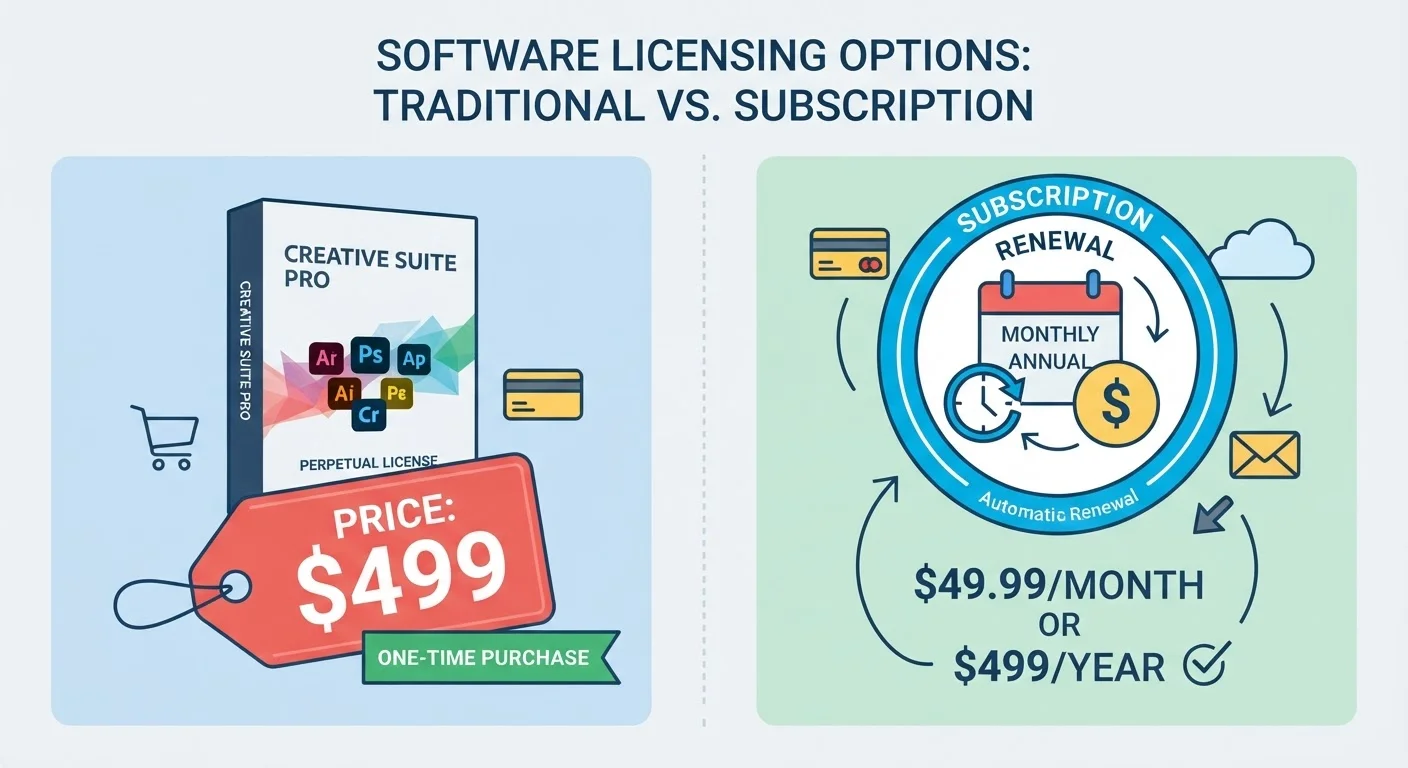
Option A
Subscription Licensing
The ongoing-access model — pay regularly, always stay current.
Best for: Users who need continuous updates, multi-device flexibility, or want to spread costs over time.
Option B
Perpetual (One-Time) Licensing
The traditional own-it-forever model — pay once, use indefinitely.
Best for: Users with stable, long-term needs who prefer a fixed upfront cost and no recurring obligation.
What You're Actually Paying For
When you pay for software, you are not buying code the way you buy a book. You are buying a licence — a legal permission to use that software under specific conditions. The two dominant licence structures are subscription (also called SaaS, or Software as a Service, in cloud-delivered contexts) and perpetual (often called a one-time purchase). They differ not just in payment schedule but in what rights you hold and what happens if you stop paying.
A subscription licence is time-bound by design. Access is tied to an active payment. The moment billing stops — whether you cancel or your card lapses — the software typically becomes inaccessible or reverts to a limited free tier. In exchange, the vendor continuously updates the product, often adding features, security patches, and cloud-based functionality throughout the subscription period.
A perpetual licence grants you the right to use a specific version of the software indefinitely. You own nothing in the intellectual-property sense — the vendor still owns the code — but your usage rights do not expire. Many perpetual licences also offer an optional maintenance and support agreement (sometimes called an annual upgrade plan), sold separately, which covers updates for an additional recurring fee.
| Criterion | Subscription Licensing | Perpetual Licensing |
|---|---|---|
| Payment structure | Recurring (monthly or annual) | Single upfront payment |
| Access if you stop paying | Access ends or is restricted | Retained indefinitely |
| Software updates included | Yes, continuously | Version-locked; upgrades cost extra |
| Multi-device use | Often included in licence terms | Typically limited to one device |
| Cloud features | Usually bundled | Rarely included |
| Long-term cost (5+ years) | Higher cumulative spend | Lower if upgrades are infrequent |
| Vendor risk exposure | High — access tied to vendor viability | Lower — version retained regardless |
The Real Cost Over Time
Neither model is automatically cheaper. The comparison depends on how long you use the software and how much you value staying on the latest version. Consider a professional application priced at $300 as a perpetual licence or $15 per month as a subscription. At the subscription rate, you reach $300 — the perpetual equivalent — after roughly 20 months. After three years you will have spent approximately $540 on the subscription versus the one-time $300 for the perpetual version. The perpetual purchase becomes more economical over time, assuming the version you bought still meets your needs.
The calculation shifts when you factor in upgrade pricing. Vendors who sell perpetual licences often charge 50–70% of the full price to upgrade to a major new version. If the software releases a significant new version every two to three years, the effective annual cost of staying current can approach subscription pricing.
This dynamic — comparing cumulative recurring payments to upfront plus periodic upgrade costs — has a structural parallel in other domains. The trade-offs between locking in a fixed expenditure versus ongoing variable commitments appear in the leasing versus buying decision in the auto world, where total-cost analysis similarly depends on usage duration and how much you value having the latest version of something.
~20 months
Typical subscription break-even vs. perpetual
Based on a common pricing ratio of roughly $15/month subscription versus $300 perpetual licence — widely seen across professional software categories.
50–70%
Typical perpetual upgrade discount off full price
Many vendors offer existing perpetual licence holders reduced pricing on major version upgrades, making upgrade cost a critical variable in long-term comparisons.
2–3 years
Average major version release cadence
For many established desktop applications, significant paid upgrades have historically arrived on a two-to-three-year cycle, affecting perpetual licence total-cost calculations.
Ownership, Access, and What Happens at the Edge Cases
The practical consequences of each model become clearest at the extremes. Imagine a vendor discontinues a subscription product or raises prices dramatically. With a subscription, your only option is to accept the new terms or lose access — including access to files stored in proprietary formats. With a perpetual licence, you retain the version you purchased regardless of what the vendor does next.
This is not a hypothetical concern. Companies restructure, get acquired, or pivot their pricing models. Understanding this risk is part of evaluating the total value proposition, not just the monthly or upfront price. It is worth noting that free software carries its own set of trade-offs — including data monetisation and uncertain longevity — that compound this consideration.
On the other side, subscriptions are not without structural advantages at the margins. They typically include:
- Automatic security patches — vendors push fixes without requiring user action
- Cross-device licensing — many subscriptions allow installation on several devices under one account
- Cloud storage and sync — often bundled, providing continuity across machines
- Lower entry cost — useful when evaluating a tool before a long-term commitment
For perpetual buyers, the absence of these bundled features is the trade-off for long-term cost predictability. Many users find the perpetual model works well when their tools are stable and mature — word processors, certain creative applications, or utilities with low feature-churn — and subscriptions make more sense where the product evolves rapidly, such as security software or collaborative platforms.
The content on this site is for informational purposes only and is not a substitute for professional advice. Always consult a qualified professional for guidance specific to your situation.