

Understanding Canada's Most-Visited Cities
Canada spans six time zones and contains cities that feel worlds apart—not just geographically but culturally, linguistically, and climatically. Before you commit to a destination, a side-by-side comparison of Vancouver, Toronto, Montreal, and Quebec City helps you match your expectations to what each place actually delivers.
These four cities attract the largest share of international visitors and represent the country's main cultural corridors: the Pacific coast, the central economic hub, the bilingual creative capital, and the historic French heartland. Each rewards different types of travellers.
Vancouver: Mountains, Ocean, and Outdoor Access
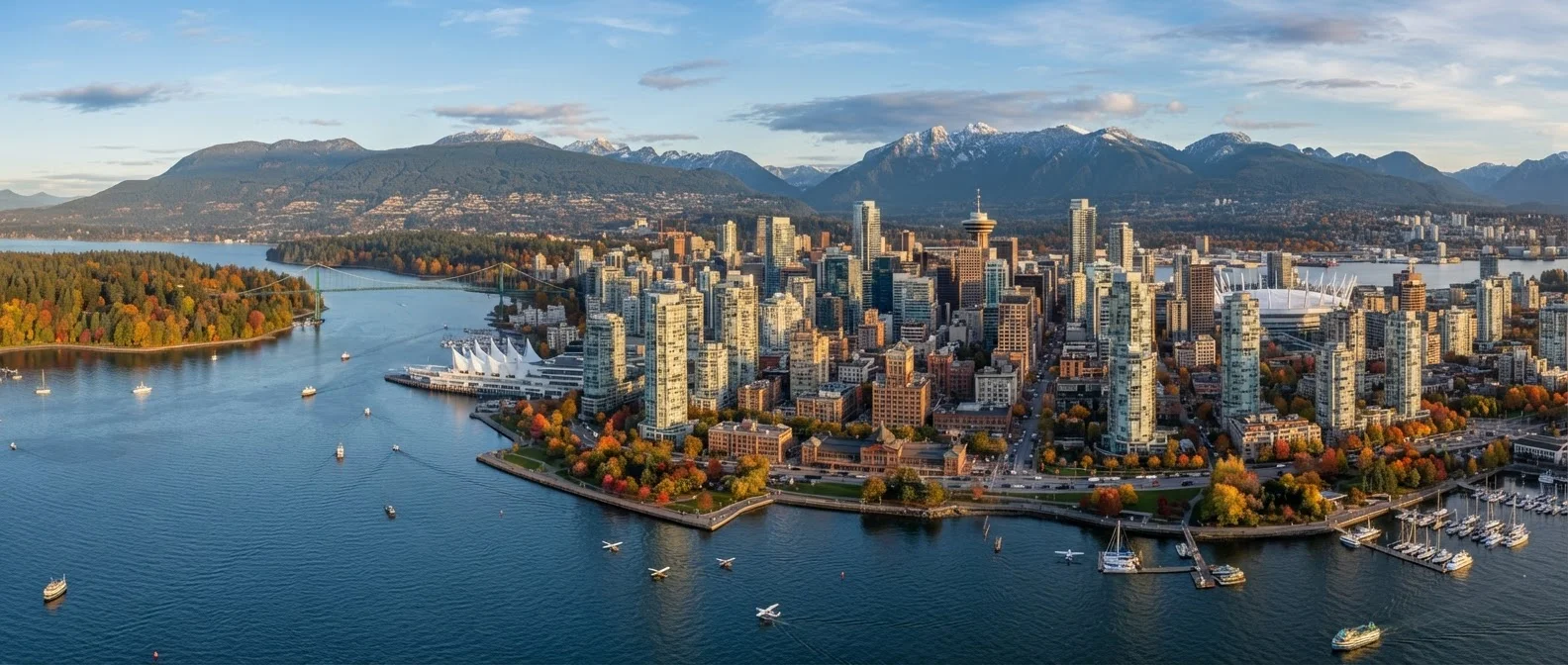
Situated on British Columbia's Pacific coast, Vancouver sits between the Coast Mountains and the Strait of Georgia—a geography that shapes daily life as much as tourism. The city is consistently ranked among the world's most livable urban centres, largely because outdoor recreation is woven into the urban fabric: skiing at nearby Whistler, hiking in Garibaldi Provincial Park, and kayaking in Indian Arm are realistic day-trip options.
Vancouver's climate is mild by Canadian standards—rarely freezing in winter—but notably rainy from October through March. Summers are warm, relatively dry, and ideal for exploring Stanley Park, the Seawall, or Granville Island's public market. The city's population is among the most ethnically diverse in Canada, reflected in its food scene, particularly its concentration of Asian cuisines. Travellers who prioritize outdoor access alongside a cosmopolitan urban experience tend to find Vancouver a natural fit.
Toronto: Scale, Diversity, and Cultural Range
Toronto is Canada's largest city and its primary financial and media centre. With a population exceeding three million in the city proper—and more than six million in the Greater Toronto Area—it offers scale that few Canadian cities match. Neighbourhoods shift character block by block: Kensington Market's bohemian density, the Distillery District's Victorian industrial architecture, and Yorkville's upscale gallery corridor exist within a short transit ride of each other.
The city hosts major international film, music, and arts festivals throughout the year, and its museum density—including the Royal Ontario Museum and the Art Gallery of Ontario—is significant. Toronto's climate features cold winters with reliable snowfall and warm, humid summers. Lake Ontario moderates temperatures slightly but also produces lake-effect weather patterns. For travellers who want maximum variety of things to do in a concentrated urban environment, Toronto's size is a genuine advantage.
Montreal: Bilingual Character and a Deep Arts Culture
Montreal occupies an island in the St. Lawrence River and operates as Canada's primary French-language metropolis, though roughly half the population speaks both English and French fluently. This bilingualism gives the city an unusual cultural texture—European café culture and North American urban energy coexist visibly. The historic district of Old Montreal (Vieux-Montréal) features 17th- and 18th-century stone architecture along the waterfront, while the Plateau-Mont-Royal neighbourhood is known for its vibrant street art, local restaurants, and independent boutiques.
Montreal winters are genuine—colder and snowier than Vancouver or Toronto on average—but the city has adapted with an underground pedestrian network called the RÉSO (or Underground City), linking transit, shopping, and services across downtown. Summers draw visitors to an exceptional calendar of festivals, including international jazz and comedy events. Travellers drawn to food, nightlife, and arts culture frequently find Montreal punches above its population weight.
Quebec City: North America's Most European Urban Experience
Quebec City is the only walled city north of Mexico in North America, and its fortified Old Town (Vieux-Québec) is a UNESCO World Heritage Site. The scale is intimate compared to the other three cities: the historic core is walkable in a day, and much of the appeal lies in its preserved streetscapes, stone buildings, and commanding position atop Cap Diamant overlooking the St. Lawrence River.
The city is overwhelmingly francophone, and while tourism infrastructure accommodates English speakers, French fluency or basic phrases go further here than in Montreal. Winter Carnival (Carnaval de Québec) is one of the world's largest winter festivals and draws visitors specifically for the cold-weather programming. Summers are pleasant and the Plains of Abraham—site of a pivotal 1759 battle—functions as a major urban park. Quebec City is the clearest choice for travellers whose priority is historic atmosphere over metropolitan scale.
The content on this site is for informational purposes only and is not a substitute for professional advice. Always consult a qualified professional for guidance specific to your situation.