

Start here
How Airports Are Divided Into Terminals
Next
Reading the Signs: What the Wayfinding System Is Telling You
Then
Transit Zones, Sterile Corridors, and Security Boundaries
When you're ready
Connecting Flights: What Happens Between Two Legs
Before you go
Common Mistakes and How to Avoid Them
How Airports Are Divided Into Terminals
Large airports are rarely a single building. Most are organized into multiple terminals — separate structures, each serving different airlines, alliances, or flight types (domestic vs. international). Some airports use letters (Terminal A, B, C), others use numbers or names. Which terminal applies to you is determined by your airline and printed on your boarding pass or booking confirmation.
Within each terminal, you may find one or more concourses (also called piers or gates areas) — the long corridors lined with departure gates. You generally clear security at the terminal level, then walk or take an internal shuttle to your concourse. Understanding this two-layer structure — terminal, then concourse — prevents the common mistake of heading to the right gate number but the wrong building.
Terminal
A self-contained airport building that houses check-in counters, security checkpoints, and sometimes baggage claim. Large airports typically have more than one terminal.
Concourse
A corridor or wing within a terminal that leads to a group of departure gates. You usually reach a concourse after passing through security.
Sterile corridor
The secure zone beyond the security checkpoint, accessible only to ticketed passengers and airport staff. This area is called 'airside.'
International transit zone
A designated airside area at international airports where connecting passengers can wait between flights without formally entering the country.
Minimum connection time (MCT)
The shortest connection window an airline considers operationally viable at a given airport. It is an operational estimate, not a comfort guarantee.
Landside
The publicly accessible part of an airport, before the security checkpoint. Anyone — ticketed or not — can access this area.
For a broader orientation to pre-trip logistics, see our trip planning starting point guide, which covers the full sequence from booking to departure day.
Reading the Signs: What the Wayfinding System Is Telling You
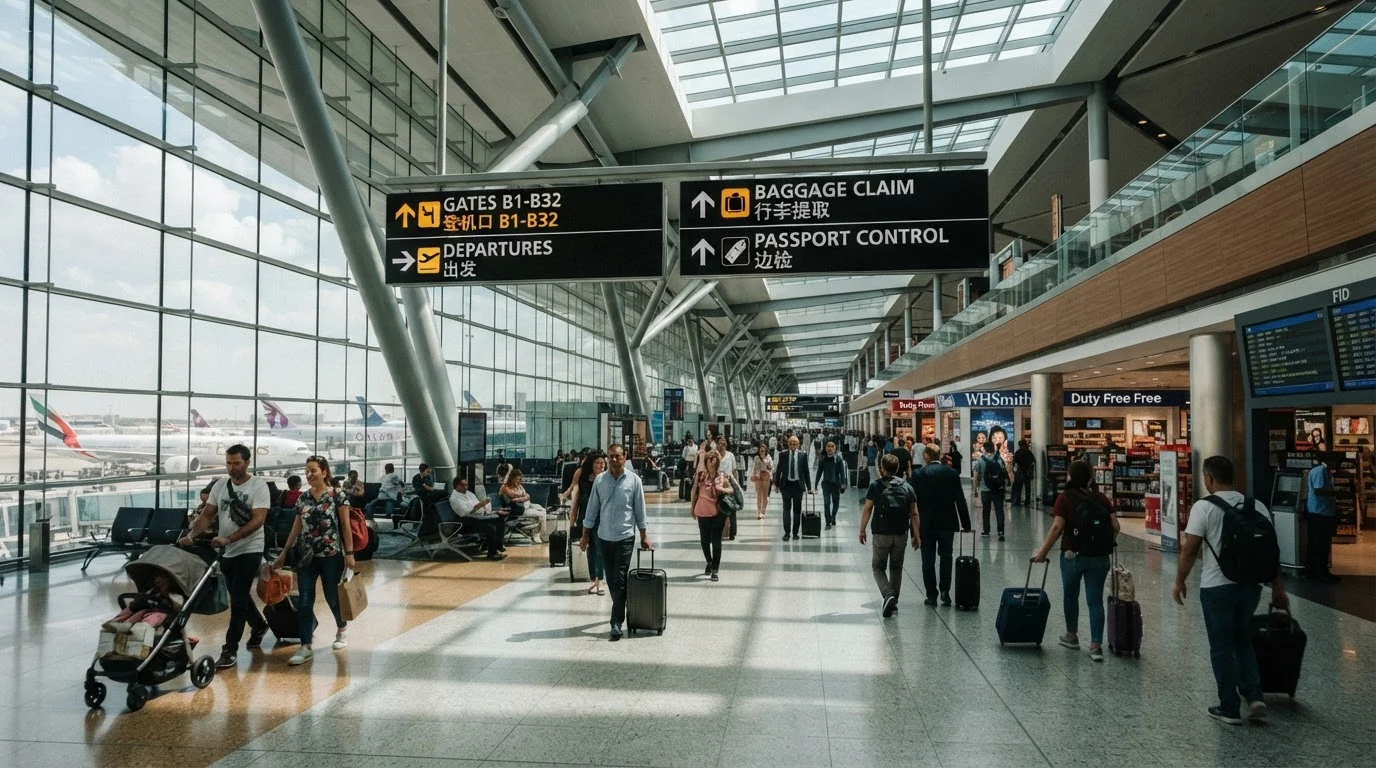
Airport signage follows a logic that, once recognized, becomes intuitive across most major hubs worldwide. Signs are typically organized by phase of travel and displayed in a consistent hierarchy:
- Arrivals / Baggage Claim — for passengers who have just landed and are exiting the airport.
- Departures / Gates — directing ticketed passengers toward security and their boarding areas.
- Connections / Transfer — guiding passengers who are staying airside to catch another flight.
- Ground Transportation / Exit — pointing toward taxis, rail, and car pickups outside.
Color coding varies by airport but is consistent within any single facility. Yellow or amber often signals warnings or caution zones; blue or green typically marks general directions; red usually indicates restricted or prohibited areas. Look at the top of any large sign cluster — the broader category is always listed first, with specifics beneath.
Symbols supplement text, particularly useful in international terminals where passengers may not read the local language. A luggage carousel icon means baggage claim; a seated figure with a coffee cup indicates a waiting or lounge area.
Transit Zones, Sterile Corridors, and Security Boundaries
The most consequential invisible line in any airport is the security boundary — the divide between the public landside area and the secure airside zone. Once you pass through security screening, you are in the sterile corridor: a controlled environment accessible only to ticketed passengers and credentialed staff.
International airports add another layer: the international transit zone. This is the airside area designated for passengers connecting between international flights. If your layover is in this zone and you never formally enter the country, you are considered to be in transit. Some countries permit this without a local visa; others do not. Requirements depend on your passport nationality and the country in question — always verify with official government immigration sources before travel. Our guide on how travellers misread visa requirements covers the common assumptions that lead to confusion here.
Download the airport map before you fly
Most major airports publish detailed terminal and concourse maps on their official websites. Downloading one before your trip — not just searching for it when you land — lets you pre-plan your route between terminals and identify where security re-entry points are. A few minutes of preparation at home can save significant stress at the airport.
If you need to move between terminals and they are not connected airside, you will exit the sterile corridor, travel landside (by shuttle or walkway), and re-enter security in the new terminal. This takes time — factor it into any tight connection.
Connecting Flights: What Happens Between Two Legs
A connection means your journey involves at least two flights, with a stop in between. What you must do during that stop depends on the type of connection:
- Domestic-to-domestic: In most cases you remain airside and walk or shuttle to your next gate. No customs or immigration is involved.
- International-to-international (same transit zone): You typically stay in the international transit area and follow 'Connections' signs to your next gate.
- International arrival into the US with a domestic onward flight: You must clear US Customs and Border Protection, collect your checked bags, re-check them, and then go through domestic security. This is a well-known source of delayed connections for first-time international travellers.
Airlines publish minimum connection times (MCTs) for each airport — the shortest interval they consider operationally viable. These are guidelines based on average conditions, not guarantees. Factors like delays, terminal changes, or high traffic can make a technically sufficient connection very stressful in practice.
For more on structuring your travel days to account for transit realities, see our piece on organizing a well-structured trip itinerary.
Common Mistakes and How to Avoid Them
Even experienced travellers run into avoidable confusion at airports. The most frequent issues tend to cluster around a few predictable misunderstandings:
- Assuming terminals are connected airside. Always check the airport's official map before your travel date, not just on the day itself.
- Relying on the gate printed at check-in. Gate assignments change. Always confirm at an information screen once you are inside the terminal.
- Underestimating customs clearance time. At busy US international gateways, customs lines during peak periods can extend well beyond an hour. Build in time accordingly.
- Missing the 'Connections' vs. 'Exit' fork. After landing on a connection, watch for the transfer/connections signs immediately as you deplane. Taking the exit signs by mistake means leaving the secure area — and re-entering takes time you may not have.
These insights connect directly to the broader lessons covered in our guide for first-time international travellers, which addresses airport navigation alongside money, communication, and safety considerations.
Airports reward preparation. Reviewing the terminal map, confirming your gate on arrival, and giving yourself realistic connection buffers are low-effort steps that consistently reduce the stress of any layover.
Frequently Asked Questions
A terminal is a self-contained building with check-in, security, and sometimes baggage claim. A concourse (or pier) is an arm or wing within a terminal that houses a set of gates. You may clear security once at the terminal level, then walk to the correct concourse to reach your gate.
It depends on whether the terminals are connected airside (beyond security) or only landside (before security). If they are not connected airside, you will exit the secure zone, move between terminals, and re-enter security. Always check your airport's terminal map in advance.
Some countries allow travellers to pass through their airport between flights without obtaining a full entry visa, provided they remain in the international transit zone. Rules vary significantly by passport and destination, so verify with the relevant government immigration authority before travel.
Airlines publish minimum connection times, but these assume smooth operations. Most experienced travellers add a comfortable buffer — especially at large airports with multiple terminals or when an international-to-domestic connection requires clearing customs. Verify the minimum for your specific airport before booking.
Gate assignments can change, especially close to departure. Always cross-check the departure boards at the airport rather than relying solely on the gate printed on your boarding pass, which is assigned at check-in time and may have since moved.
On arrival into the US from an international flight, you follow signs to 'Immigration' or 'US Customs and Border Protection.' After clearing immigration, you collect checked bags, pass through customs inspection, and then re-check bags if you have a connecting domestic flight.
The content on this site is for informational purposes only and is not a substitute for professional advice. Always consult a qualified professional for guidance specific to your situation.