

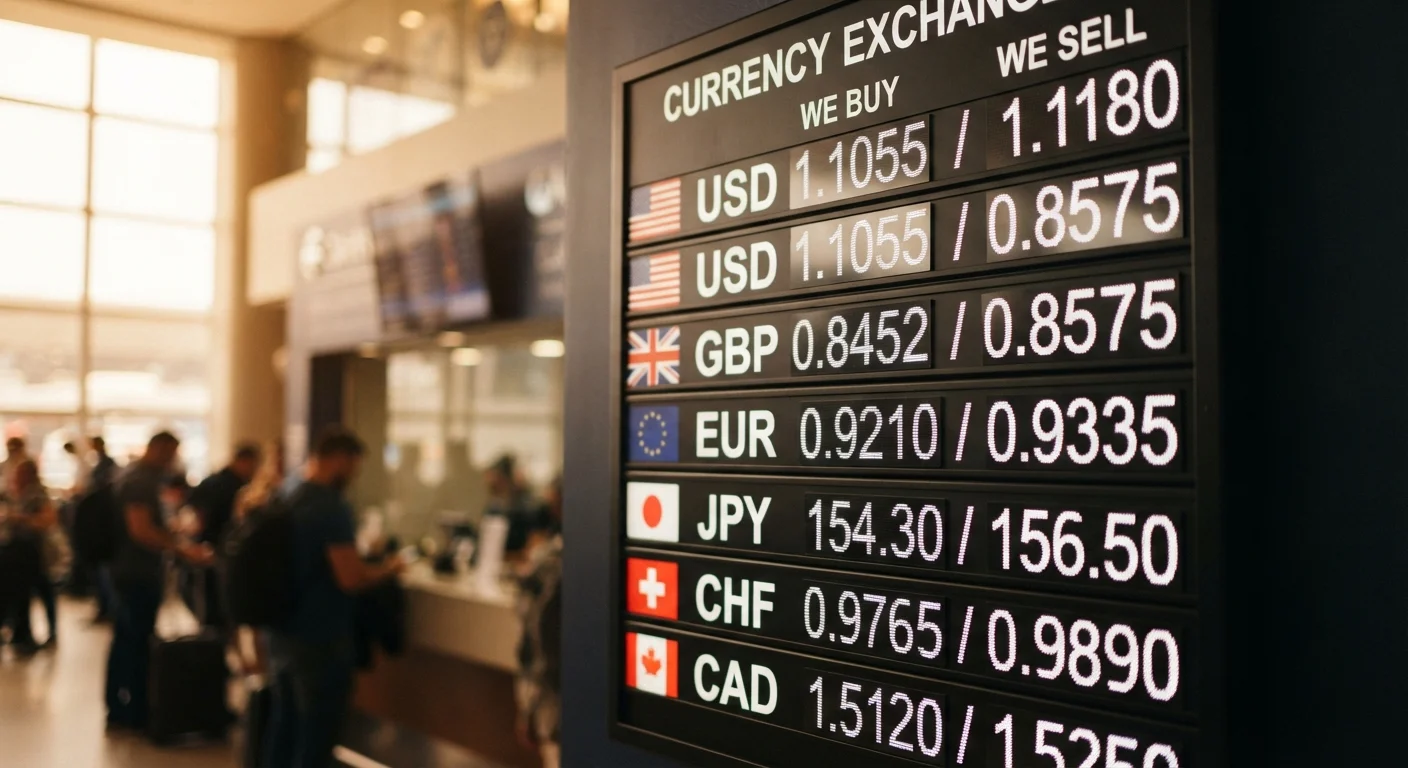
How a Currency Pair Actually Works
An exchange rate is always expressed as a pair of currencies. The notation USD/MXN 17.20, for instance, means one US dollar purchases 17.20 Mexican pesos. The currency on the left — called the base currency — is the one you are spending. The currency on the right — the quote currency — is what you receive.
This directionality matters. Reversing a rate changes its meaning entirely: USD/EUR 0.92 is not the same as EUR/USD 0.92. Before any transaction, confirm which direction the rate applies to your situation — are you converting dollars into euros, or euros into dollars?
Rates fluctuate continuously throughout each trading day. A rate you see on a financial news site reflects a snapshot in time; by the time you reach an exchange counter, it may have shifted. For trip planning, treat published rates as directional guidance rather than guaranteed figures.
The Gap Between the Market Rate and Your Rate
The rate shown on financial data sites is the mid-market rate — the midpoint between the prices at which currencies are bought and sold on wholesale markets. No retail provider passes this rate on to consumers. Every provider — bank, airport kiosk, hotel desk, or card network — builds in a margin.
That margin is how they earn revenue. It might appear as:
- A spread — the difference between the mid-market rate and the rate offered to you, invisible in the headline number
- A flat commission fee — charged per transaction regardless of amount
- A percentage fee — a stated surcharge on the converted amount
- A combination — spread plus a fee layered on top
To evaluate any offer accurately, calculate how many units of the destination currency you actually receive after all charges, then compare that to what the mid-market rate would have delivered on the same amount. That gap is your true cost. This kind of careful reading applies in other financial contexts too — much like reading an insurance policy carefully before you sign.
1–3%
Typical retail markup over mid-market rate
Competitive retail currency providers generally add a margin in this range; less competitive options, including many airport counters, can charge significantly more.
Up to 12%
DCC markup reported in consumer studies
Research from consumer advocacy groups and payment industry analyses has found dynamic currency conversion markups ranging from 3% to over 10% above the mid-market rate.
3%
Common foreign transaction fee on credit cards
Many standard credit cards charge a foreign transaction fee of around 3% on purchases made in a foreign currency, according to general card fee disclosures.
Dynamic Currency Conversion: A Common Trap
At many ATMs and retail terminals abroad, you will encounter a prompt offering to charge your card in your home currency — say, US dollars — rather than the local currency. This is called dynamic currency conversion (DCC), and it is almost universally unfavorable for the traveller.
When you accept DCC, the merchant's payment processor applies its own exchange rate, which typically carries a markup significantly above the mid-market rate. Your card's own network rate — generally more competitive — is bypassed entirely. Always select "pay in local currency" and allow your card issuer to handle the conversion.
This is one of the hidden costs that catches travellers off guard even when the headline exchange rate looks reasonable.
Building a Simple Pre-Trip Check Habit
Before any currency exchange — at a counter, online, or at an ATM abroad — a brief check can sharpen your judgment considerably:
- Look up the current mid-market rate for your currency pair using a reputable financial data source.
- Calculate what you should receive at that rate for the amount you plan to convert.
- Compare the actual offer — what you will receive after all fees and the applied rate.
- Express the difference as a percentage. This is your real cost.
Rates and fees vary substantially by provider and location. Airport counters typically sit at the less competitive end; some in-city exchange offices or ATM networks abroad can offer tighter margins. Verifying before you commit — rather than after — is the practical discipline that protects your budget.
The same principle of reading the numbers carefully before committing applies across many pre-trip decisions. For example, visa requirements are frequently misread in ways that create real problems at the border. Developing the habit of checking primary sources — official rates, official entry rules — before travel pays dividends across every aspect of trip planning.
Use the Mid-Market Rate as Your Benchmark
Before exchanging any money, look up the mid-market rate for your currency pair on a reputable financial data source. Write down what that rate implies you should receive for your planned amount. Any offer you get should be measured against that figure — the gap tells you exactly what you're paying for the convenience or provider. This one step turns a confusing number into a clear cost.
Frequently Asked Questions
USD/EUR means you are spending US dollars to receive euros. The number shown is how many euros one dollar buys. If the rate is 0.92, one dollar gets you 0.92 euros. The first currency listed is called the base currency and the second is the quote currency.
The mid-market rate is the midpoint between the wholesale buying and selling prices banks use when trading currencies with each other. Retail providers — including banks, airport kiosks, and card networks — add a margin above this rate to cover costs and generate profit. You can use it as a benchmark to measure how much any given offer is costing you in markup.
There is no single answer that applies universally — it depends on the destination, the provider, and the amounts involved. As a general principle, airport exchange counters at home and abroad tend to offer less competitive rates than in-city exchange offices or using a no-foreign-transaction-fee bank card at a local ATM. Always check total costs including fees.
Dynamic currency conversion (DCC) is when a foreign merchant or ATM offers to charge you in your home currency instead of the local one. While it sounds convenient, the conversion rate applied is typically set by the merchant's processor and carries a significant markup. Paying in the local currency and letting your own bank handle the conversion is generally the more cost-effective approach.
Look up the current mid-market rate on a financial data source before any transaction. Compare it to the rate being quoted to you — the difference is the effective markup. A margin of 1–3% is common with competitive providers; margins above 5% are a signal that the rate is unfavorable.
Cards that charge no foreign transaction fee and use the network's exchange rate (typically close to the mid-market rate) are often competitive options. However, some cards add a foreign transaction fee of 1–3%, which can negate the rate advantage. Checking your card's specific fee structure before travel is worth doing.
The content on this site is for informational purposes only and is not a substitute for professional advice. Always consult a qualified professional for guidance specific to your situation.