

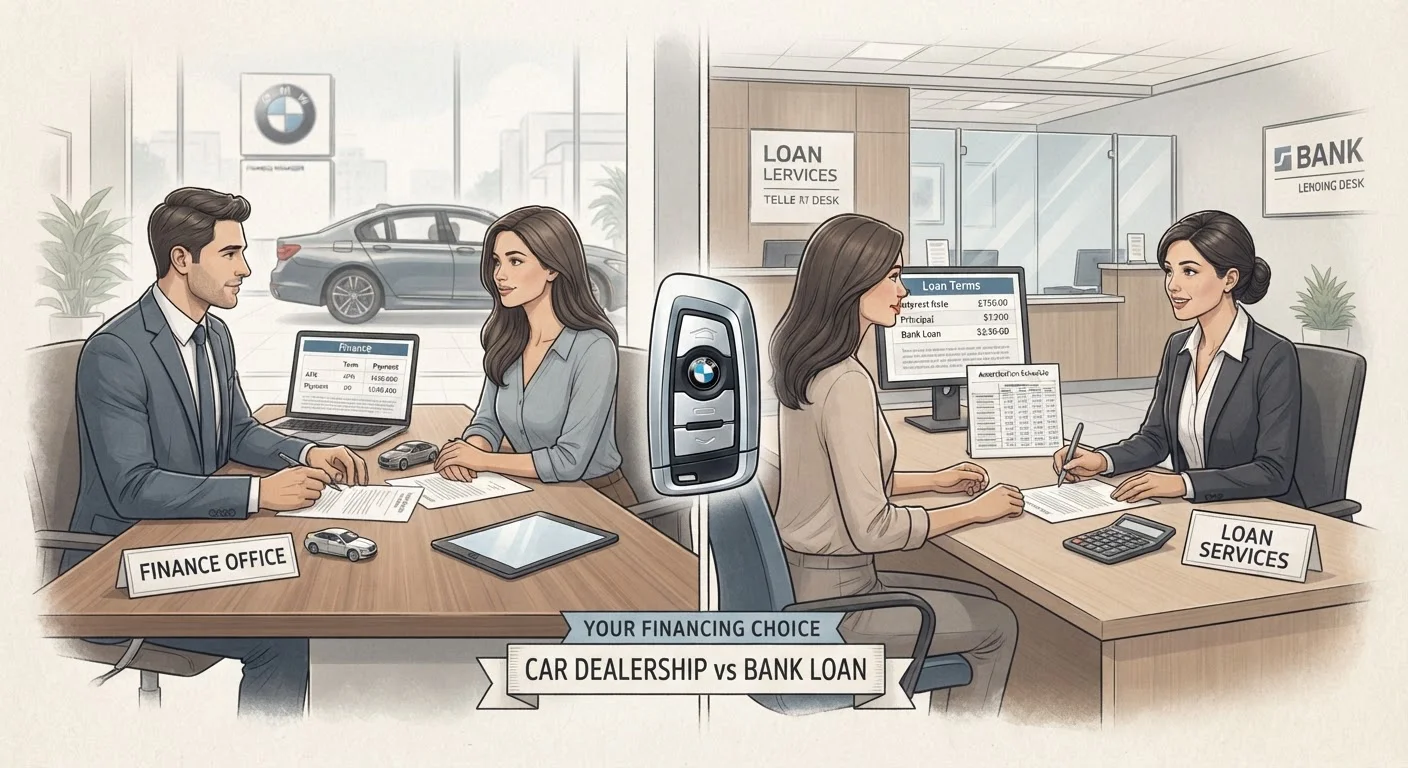
Option A
Dealer Financing
The one-stop, in-house lending option at the point of sale.
Best for: Shoppers who value convenience, want manufacturer incentive rates, or are buying from a dealership that works with many lenders.
Option B
Bank or Credit Union Financing
The pre-arranged loan you bring to the table before negotiating.
Best for: Buyers who want a firm rate benchmark, existing banking relationships, or the negotiating leverage of a pre-approval letter.
How Each Financing Path Actually Works
When you finance through a dealership, the dealer typically acts as an intermediary - it submits your application to one or more lenders in its network and presents you with an offer. This is called indirect lending. The lender sets a base rate, and the dealer may mark it up within limits set by the lender. That markup, sometimes called a dealer reserve, is a source of profit for the dealership.
When you go directly to a bank, credit union, or online lender before visiting the dealership, you receive a pre-approval - a conditional loan commitment at a stated APR and loan amount. You then bring that offer to the dealership like cash. The dealer can still try to beat your rate through its network, but you have a firm benchmark. Understanding APR and loan term length is essential before comparing any offers side by side.
Both paths result in the same basic structure: you borrow money, pay interest over a set term, and the lender holds a lien on the vehicle until the loan is paid off. The difference lies in who sets the rate, how much transparency you have, and what leverage you bring to the negotiation table.
Side-by-Side: Key Differences at a Glance
The table below summarizes how dealer financing and direct lending typically compare across criteria that matter most to buyers. Individual results vary significantly based on credit profile, lender, and the specific vehicle.
| Criterion | Dealer Financing | Bank / Credit Union Financing |
|---|---|---|
| Rate transparency | Markup possible; rate may not be the lender's base rate | Rate quoted directly; no intermediary markup |
| Convenience | One-stop; handled at point of sale | Requires advance application before dealership visit |
| Lender competition | Dealer submits to multiple lenders on your behalf | You shop lenders yourself; may need multiple inquiries |
| Promotional rates | Manufacturer subsidized rates available here only | Not eligible for manufacturer APR promotions |
| Negotiating leverage | Rate and price often negotiated together | Pre-approval separates financing from price negotiation |
| Approval flexibility | Broader lender network; may help thin-credit applicants | Approval criteria set by one institution |
| Credit inquiry timing | Multiple hard pulls may occur across lender network | Single hard pull from the institution you apply to |
One factor not captured in the table: timing. A pre-approval from a bank or credit union typically takes one to three business days. Dealer financing is completed the same day but requires you to negotiate rate and price simultaneously - which can blur the financial picture. Understanding how monthly-payment framing can obscure total cost is worth reviewing before that conversation.
What the Numbers Can Mean for Total Cost
Even a half-percentage-point difference in APR adds up over a multi-year loan. On a $30,000 loan over 60 months, the difference between a 6.0% and a 6.5% APR is roughly $400 in additional interest over the life of the loan - not a trivial amount. Dealer reserve markups have historically ranged from 0.5 to 2 percentage points above the lender's buy rate, though regulations and lender policies vary.
~0.5-2%
Typical dealer reserve markup range
Lender agreements commonly allow dealerships to mark up the buy rate by this range, though caps vary by lender and regulatory environment.
~$400
Extra interest on a 0.5% APR difference
On a $30,000, 60-month loan, a half-point APR difference results in roughly this amount of additional interest over the full loan term.
45 days
Rate-shopping window for credit inquiries
Under FICO scoring models, multiple auto loan inquiries within a 45-day window are typically counted as a single hard inquiry, minimizing credit score impact.
Credit unions, in particular, are worth contacting early. As member-owned, nonprofit institutions, they often post competitive rates and may be more flexible on terms for members with established relationships. For a broader view of how credit and debt products interact with vehicle purchases, the Credit & Debt hub offers general context on how lending decisions are evaluated.
It's also worth separating the financing decision from related questions like whether to lease. Leasing vs. buying involves different financial trade-offs entirely, and the financing channel decision only applies when you're purchasing outright.
The Strategic Case for Getting Pre-Approved First
Most consumer finance experts recommend getting at least one pre-approval before entering a dealership, regardless of whether you ultimately use that loan. Here's why: it transforms the financing conversation from opaque to competitive. Instead of accepting or rejecting a single dealer offer, you have a reference point.
If the dealer's finance office presents a lower APR than your pre-approval, take it - you've benefited from the competition. If the dealer's rate is higher, you can decline and use your pre-arranged loan. Either way, you're making an informed choice rather than guessing. Several common car-buying assumptions - including the idea that dealer financing is always the path of least resistance - don't always hold up under scrutiny.
One exception: manufacturer promotional rates. If a carmaker is subsidizing financing at below-market APRs to move specific inventory, that rate is only available through the dealer's captive finance company. In those cases, the promotional offer may be worth taking even without comparison shopping, but read the terms carefully - these promotions sometimes require shorter loan terms or larger down payments. Before signing any contract, reviewing key purchase agreement terms can help you catch conditions you might otherwise miss.
This article is for general informational purposes only and does not constitute personalized financial or lending advice. Loan terms, rates, and availability vary by lender, credit profile, and region. Consult a licensed financial professional before making borrowing decisions.
The content on this site is for informational purposes only and is not a substitute for professional advice. Always consult a qualified professional for guidance specific to your situation.