

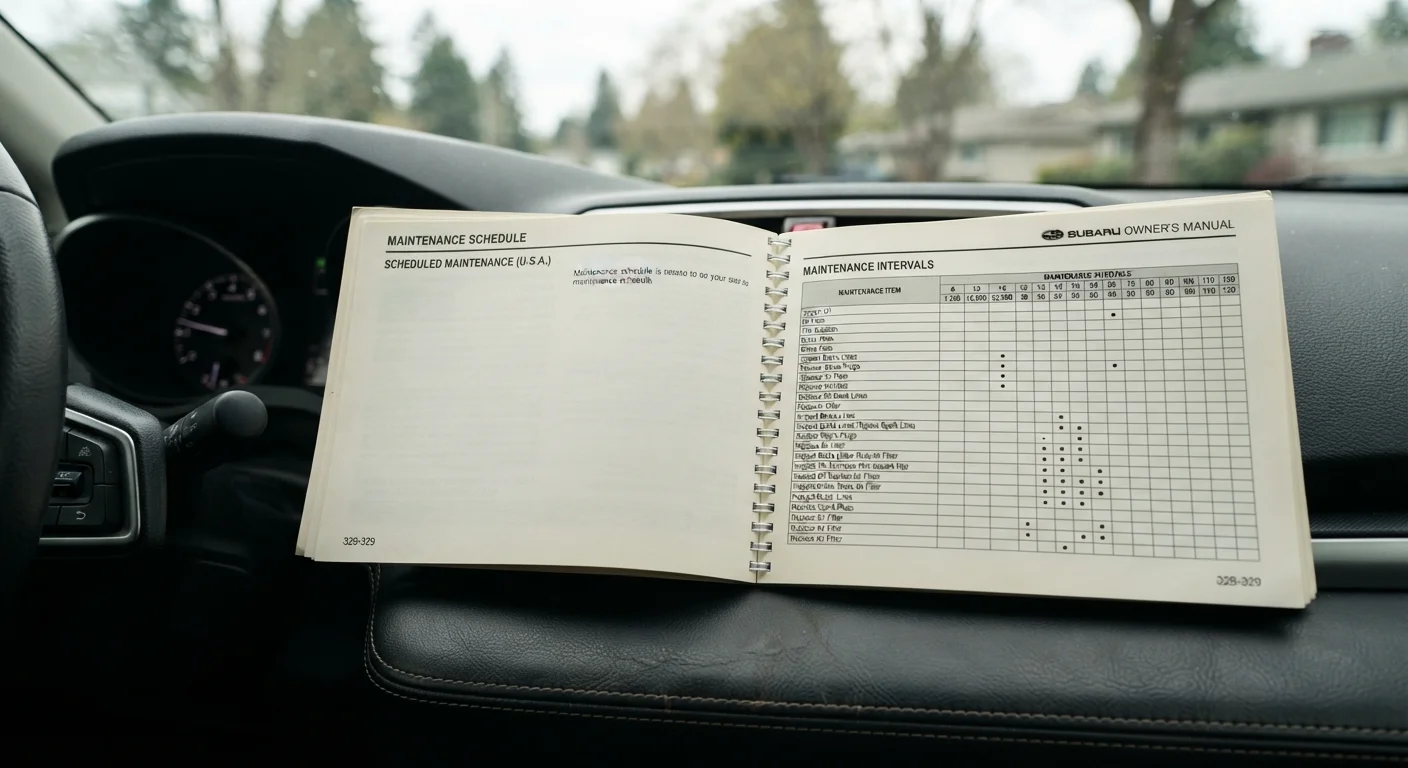
How a Service Schedule Is Structured
A manufacturer's service schedule is typically laid out as a grid or checklist, with maintenance tasks listed on one axis and mileage milestones - often 5,000, 10,000, 15,000, 30,000, and 60,000 miles - on the other. Each cell tells you whether a task is due at that point, and every interval also carries a time limit (commonly six months or one year) that applies regardless of how many miles you've driven.
The logic is straightforward: whichever threshold arrives first triggers the service. A driver who puts only 6,000 miles on their vehicle per year still needs an annual oil change if the manual calls for one every 12 months. Ignoring the time side of the equation is one of the most common mistakes low-mileage drivers make.
Most schedules distinguish between two types of items:
- Inspect and adjust - tasks like checking brake pad thickness, tire tread depth, and fluid levels. These may result in no action if everything looks good.
- Replace - items with a defined service life, such as engine air filters, spark plugs, timing belts, and coolant, that should be swapped out on schedule regardless of apparent condition.
For a look at which less-visible items deserve attention, see the overlooked maintenance tasks that quietly shorten a car's life.
Normal vs. Severe Driving Conditions
Most owner's manuals include two parallel schedules: one for normal driving and one for severe or special operating conditions. The severe schedule calls for more frequent service on oil, transmission fluid, air filters, and similar wear items.
What qualifies as severe driving may surprise you. Manufacturer definitions typically include:
- Frequent trips of five miles or less (engine never fully warms up)
- Sustained stop-and-go traffic
- Driving in extreme heat (above 90°F) or extreme cold
- Towing a trailer or carrying heavy loads regularly
- Driving on unpaved, dusty, or salted roads
If your daily commute involves a lot of short urban trips, you may qualify for the severe schedule even though your vehicle doesn't feel like it's being worked hard. Short trips are particularly hard on engine oil because the engine never reaches full operating temperature, leaving moisture and fuel byproducts in the oil longer than they should be.
Check Which Schedule Actually Applies to You
Before defaulting to the normal driving schedule, read your manual's definition of severe conditions carefully. Many everyday driving patterns - including short urban commutes and extreme seasonal temperatures - meet the manufacturer's definition of severe use. Identifying this early can prevent premature component wear.
When in doubt about which schedule applies to you, consult a qualified mechanic who can review your driving patterns and make a recommendation based on your specific vehicle and conditions.
What Happens When You Fall Behind
Missing a single service interval by a small margin is unlikely to cause immediate damage. However, the cumulative effect of consistently deferred maintenance is well-documented: accelerated engine wear, degraded transmission performance, brake system failures, and cooling system breakdowns are all connected to neglected schedules.
~$80-$150
Typical cost of a routine oil and filter service
Routine services are substantially less expensive than the repairs that deferred maintenance can cause, such as engine damage from oil starvation or transmission rebuilds.
30,000-60,000 mi
Typical interval for major scheduled services
Major service milestones - covering spark plugs, belts, and fluid flushes - are commonly scheduled between 30,000 and 60,000 miles, depending on manufacturer and vehicle type.
There's also a warranty dimension to consider. Under the federal Magnuson-Moss Warranty Act, manufacturers cannot void your entire warranty for using an independent shop, but they can deny warranty coverage for specific failures that are directly attributable to missed maintenance. Keeping dated receipts and service records is the practical safeguard here.
For drivers managing tighter budgets, running a car on a budget: the trade-offs between routine care and reactive repairs offers a candid look at where skipping services tends to cost more over time than staying current.
Using Your Owner's Manual (Not the Sticker)
The windshield reminder sticker left by a shop is a convenience tool based on the mileage at your last visit - it is not your service schedule. Some shops use conservative industry defaults that don't match your vehicle's actual manufacturer specifications. A reminder to return in 3,000 miles may be perfectly appropriate for some older vehicles but unnecessarily frequent for a modern car using full-synthetic oil rated for 7,500 or 10,000 miles. Common car maintenance myths, including outdated oil-change intervals are worth reviewing if you've been following generic advice.
Your owner's manual is the primary document. If you don't have a physical copy, most manufacturers make the schedule available through their official website using your vehicle's model year and VIN. Many modern vehicles also include a built-in maintenance reminder system that tracks oil life algorithmically and alerts you when service is due - a useful tool, but one that typically covers oil changes only, not the full breadth of scheduled tasks.
If you're evaluating a used vehicle's maintenance history or planning longer-term upkeep as mileage climbs, the guidance in keeping a high-mileage car on the road without expensive surprises covers how maintenance priorities shift with age.
Frequently Asked Questions
The definitive source is your vehicle's owner's manual, usually in a dedicated 'Maintenance' or 'Service Intervals' section. Many manufacturers also publish this information on their official websites by entering your vehicle's model year and trim. The reminder sticker a shop places on your windshield is a convenience tool, not an authoritative document.
Missing an interval occasionally by a small margin is unlikely to cause immediate damage, but consistently skipping services accelerates wear on components like oil-lubricated engine parts, brake pads, and transmission fluid. Over time, deferred maintenance costs significantly more to address than the services that were skipped, and it may affect warranty coverage.
Yes. Engine oil degrades chemically even when a vehicle sits idle, and rubber components like belts and hoses age regardless of mileage. Most manufacturers set annual or 12-month time limits alongside mileage thresholds for exactly this reason. Low-mileage drivers should still follow the time-based triggers.
For many everyday drivers, yes. Severe service includes frequent trips under five miles, repeated stop-and-go traffic, extreme heat or cold, unpaved roads, and regular towing or hauling. Under these conditions, fluids and components wear faster, so shortened intervals are warranted. Check your manual's definition - you may qualify without knowing it.
Modern oil life monitoring systems use algorithms based on driving patterns, temperature, and engine load to estimate remaining oil life - they are generally reliable tools. However, they typically track only oil change intervals, not the full range of maintenance items in your schedule. Use the monitor alongside your owner's manual, not as a replacement for it.
Under U.S. federal law (the Magnuson-Moss Warranty Act), a manufacturer cannot void your entire warranty simply because you used an independent shop. However, if a specific failure is directly linked to a skipped or improperly performed service, the manufacturer may deny that particular claim. Keep dated service records as documentation.
The content on this site is for informational purposes only and is not a substitute for professional advice. Always consult a qualified professional for guidance specific to your situation.