

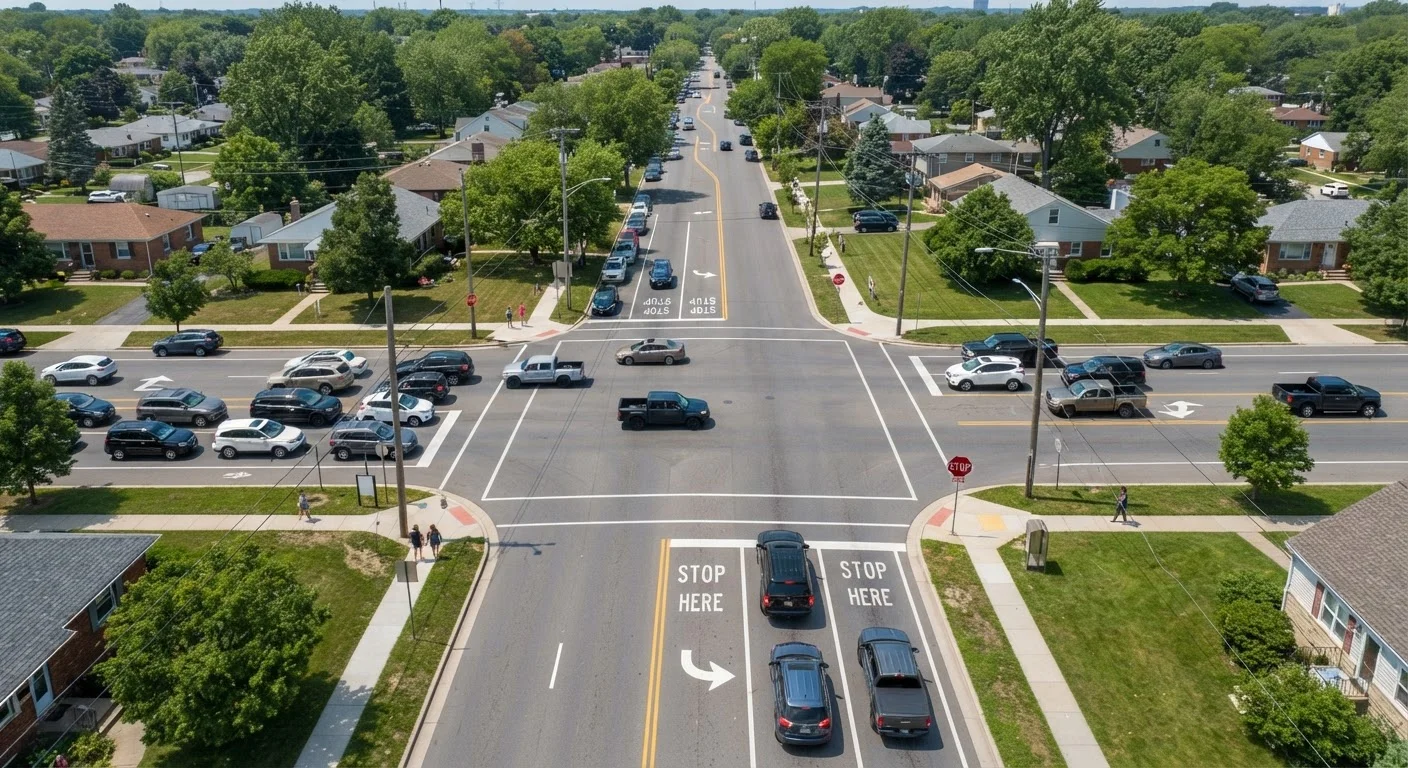
Why Right-of-Way Confusion Leads to Crashes
Right-of-way rules exist for one reason: to create a predictable order at conflict points on the road. When drivers misunderstand or ignore these rules, the result is often a crash at an intersection, merge point, or crosswalk - exactly the locations where vehicle paths cross. According to the Federal Highway Administration, intersections are the site of roughly 40% of all reported crashes in the US.
The problem isn't always recklessness. Many drivers learned right-of-way rules years ago and simply have gaps in their understanding - particularly for scenarios like roundabouts and zipper merges that weren't covered thoroughly in their driver's education. See our guide to commonly misunderstood US traffic laws for more rules that trip up experienced drivers.
The mistakes below are among the most frequent - and most consequential.
Assuming the vehicle on the right always goes first at a four-way stop.
Why it happens: The 'yield to the right' rule is real but only applies when two vehicles arrive at the same time. Drivers over-apply it to every four-way stop situation.
Believing that highway traffic must make room for merging vehicles.
Why it happens: Some drivers confuse the courtesy of cooperative merging with a legal obligation on through traffic. The merging driver bears full responsibility for entering safely.
Entering a roundabout without yielding to vehicles already circulating inside.
Why it happens: Roundabouts are less common in many parts of the US, so drivers often treat them like four-way stops and enter when they feel they've waited long enough.
Failing to yield to pedestrians in crosswalks, especially unmarked ones.
Why it happens: Drivers often look for a painted crosswalk and assume that without visible markings, they have right-of-way. In reality, most states require yielding to pedestrians at any intersection, whether marked or not.
Cutting off the zipper merge by refusing to let alternating traffic in during lane closures.
Why it happens: Drivers who merge early often feel that late-merging vehicles are cutting in line, leading them to close gaps aggressively. This misunderstanding disrupts the intended traffic flow.
Assuming a funeral procession must obey standard traffic signals.
Why it happens: Most drivers aren't taught procession etiquette in driver's ed, so they pull into gaps in the procession or block the lead vehicle at red lights.
Situations That Deserve Extra Attention
Beyond the common errors above, a few specific scenarios generate outsized confusion worth addressing directly.
The T-Intersection Default
At a T-intersection with no signage, drivers on the terminating road (the top of the T) must yield to traffic on the through road. Many drivers assume it's a first-come, first-served situation - it isn't.
Emergency Vehicles
When an emergency vehicle is approaching with lights or sirens active, drivers in all lanes must pull to the right and stop - even if that means pulling over on a one-way street. Continuing through an intersection ahead of an emergency vehicle is both illegal and dangerous in every state.
Left Turns at a Green Light
A green light does not grant right-of-way to a vehicle turning left. Left-turning drivers must wait until oncoming traffic and pedestrians have cleared before completing the turn. This is one of the most commonly misread signals on the road.
Aggressive Gap-Closing Is a Crash Risk
Intentionally blocking a merging driver or closing a gap in a construction zone to 'punish' late mergers is considered aggressive driving in many states and can result in a citation. Beyond the legal risk, it significantly increases the chance of a sideswipe or rear-end collision. Road frustration is understandable, but aggressive driving behaviors escalate danger for everyone on the road.
For guidance on how conditions like rain and fog affect these dynamics, see how right-of-way decisions change in adverse weather.
The content on this site is for informational purposes only and is not a substitute for professional advice. Always consult a qualified professional for guidance specific to your situation.