

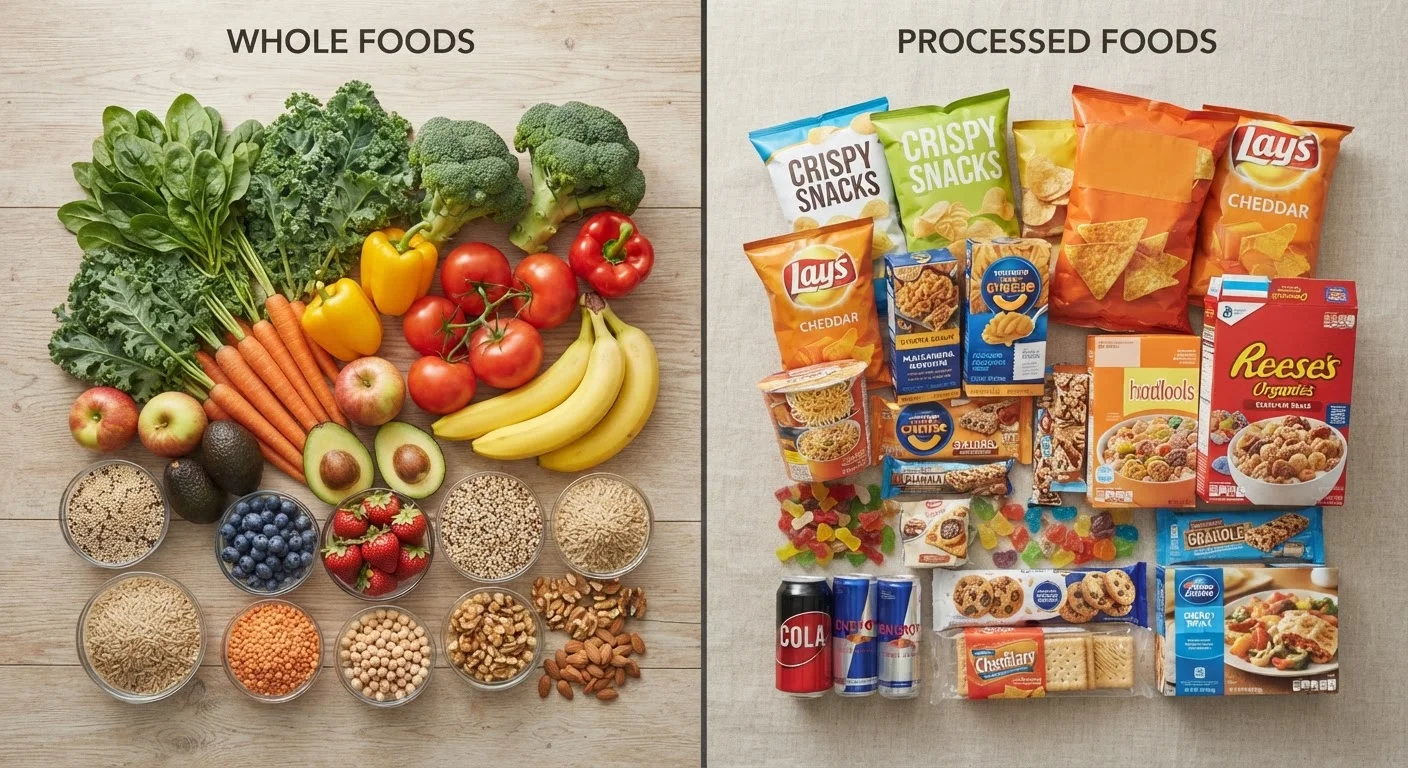
Option A
Whole Foods
Minimally processed, nutritionally intact foods closest to their natural state.
Best for: People seeking sustained energy, nutrient density, and dietary patterns supported by long-term health research.
Option B
Ultra-Processed Foods
Industrially formulated products engineered for convenience, shelf life, and palatability.
Best for: Understanding what to limit - and why the degree of processing matters more than any single ingredient.
Defining the Terms: What Do These Categories Actually Mean?
"Whole foods" refers to foods consumed in or near their natural form - fruits, vegetables, legumes, whole grains, nuts, seeds, eggs, and unprocessed meats or fish. Minimal processing, such as washing, cutting, or refrigerating, doesn't disqualify a food from this category. The defining characteristic is that the nutritional structure of the original ingredient remains largely intact.
"Ultra-processed foods" is a term drawn from the NOVA classification system, developed by nutrition researchers to categorize foods by the nature and extent of their industrial processing - not solely by nutrient content. NOVA Group 4 (ultra-processed) includes products formulated with ingredients rarely found in home kitchens: emulsifiers, artificial flavors, hydrogenated oils, color stabilizers, and sweeteners. Common examples include many packaged snacks, reconstituted meat products, flavored yogurts, soft drinks, and ready-to-eat meals.
The distinction matters because two foods can have similar calorie counts or macronutrient profiles yet differ substantially in how they interact with digestion, satiety hormones, and long-term health. For a deeper look at how individual nutrients signal the body, see how nutrients signal your body.
What the Research Actually Shows
The evidence base on ultra-processed food consumption has grown substantially over the past decade. Large prospective cohort studies - including analyses from the NutriNet-Santé study in France and UK Biobank data - have found associations between higher ultra-processed food intake and increased risks of cardiovascular disease, type 2 diabetes, colorectal cancer, depression, and all-cause mortality. Importantly, these associations often held after adjusting for overall nutrient quality, suggesting processing itself may contribute risk beyond what individual nutrients explain.
A landmark randomized controlled trial published in Cell Metabolism (Hall et al., 2019) provided direct experimental evidence: participants assigned to an ultra-processed diet consumed significantly more calories and gained weight compared to those on an unprocessed diet, even when both diets were matched for sugar, fat, fiber, and total macronutrients. This points to factors like food texture, eating rate, and satiety signaling as mechanisms worth investigating.
~57%
Share of US calories from ultra-processed foods
Research analyzing US dietary data estimated that ultra-processed foods account for more than half of daily calorie intake for many American adults.
+10%
Increase in calorie intake on ultra-processed diet
In the Hall et al. 2019 randomized controlled trial, participants on an ultra-processed diet consumed roughly 500 more calories per day than those on an unprocessed diet.
~9%
Higher all-cause mortality risk
A BMJ analysis of Spanish cohort data found approximately a 9% higher all-cause mortality risk associated with consuming 4 or more servings of ultra-processed foods daily.
It's important to acknowledge limitations. Most large studies are observational, meaning they can identify associations but not definitively establish causation. Dietary recall methods introduce measurement error, and ultra-processed food consumption often clusters with other lifestyle factors. Researchers continue to work on isolating the specific mechanisms at play.
The Nutritional Gap Between Whole and Processed
Beyond the research associations, there are well-documented nutritional differences between the two categories. Whole foods tend to deliver:
- Dietary fiber - which supports gut microbiome diversity, satiety, and blood glucose regulation
- Micronutrients - vitamins and minerals in forms the body recognizes and absorbs efficiently
- Phytonutrients - plant compounds such as polyphenols and carotenoids with antioxidant and anti-inflammatory properties
- Intact food matrix - the physical structure of food influences digestion rate and hormonal responses
Ultra-processed foods frequently replace or displace these elements. Refining grains removes the bran and germ, stripping fiber and B vitamins. High-heat manufacturing can degrade heat-sensitive nutrients. And because ultra-processed products are often energy-dense but lower in fiber and water, they may contribute to eating more before fullness signals register.
For a practical framework on evaluating food quality, our guide on nutrient density vs. calorie density offers a useful lens. Added sugars are also a key piece of this puzzle - see natural vs. added sugars for a closer look at where that distinction matters.
| Criterion | Whole Foods | Ultra-Processed Foods |
|---|---|---|
| Definition | Minimally processed, intact natural foods | Industrially formulated multi-ingredient products |
| Fiber content | Generally high and intact | Often stripped out during manufacturing |
| Micronutrient profile | Broad, naturally occurring vitamins and minerals | May be added back synthetically after processing |
| Satiety signaling | Food matrix supports gradual digestion and fullness | May promote faster eating and delayed satiety |
| Additive content | None or minimal | Emulsifiers, sweeteners, flavor enhancers common |
| Research association | Linked to lower chronic disease risk in observational studies | Associated with higher risk in multiple large cohort studies |
| Shelf life | Shorter, perishable | Extended through preservatives and packaging |
Practical Takeaways: Moving the Balance
Nutrition science doesn't demand dietary perfection, and framing food choices in all-or-nothing terms often backfires. Most public health guidance - including from the Dietary Guidelines for Americans - focuses on overall dietary patterns rather than eliminating individual foods. The actionable goal is to shift the proportion of what you eat toward less-processed options over time.
Some approaches that align with current evidence include:
- Building meals around whole or minimally processed ingredients as a foundation
- Using ingredient lists as a rough signal - shorter lists with recognizable ingredients generally indicate lower processing
- Choosing whole grains over refined grain products where feasible
- Treating ultra-processed items as occasional rather than routine parts of the diet
If navigating these choices feels overwhelming, you're not alone - why healthy eating feels so complicated breaks down how food marketing and conflicting headlines contribute to confusion. Dietary patterns like plant-forward eating also intersect with this topic; plant-based vs. omnivorous diets explores how different food frameworks compare nutritionally.
This article is for general informational and educational purposes only and is not a substitute for professional medical or nutritional advice. Please consult a qualified healthcare provider for guidance specific to your health needs.
The content on this site is for informational purposes only and is not a substitute for professional advice. Always consult a qualified professional for guidance specific to your situation.