

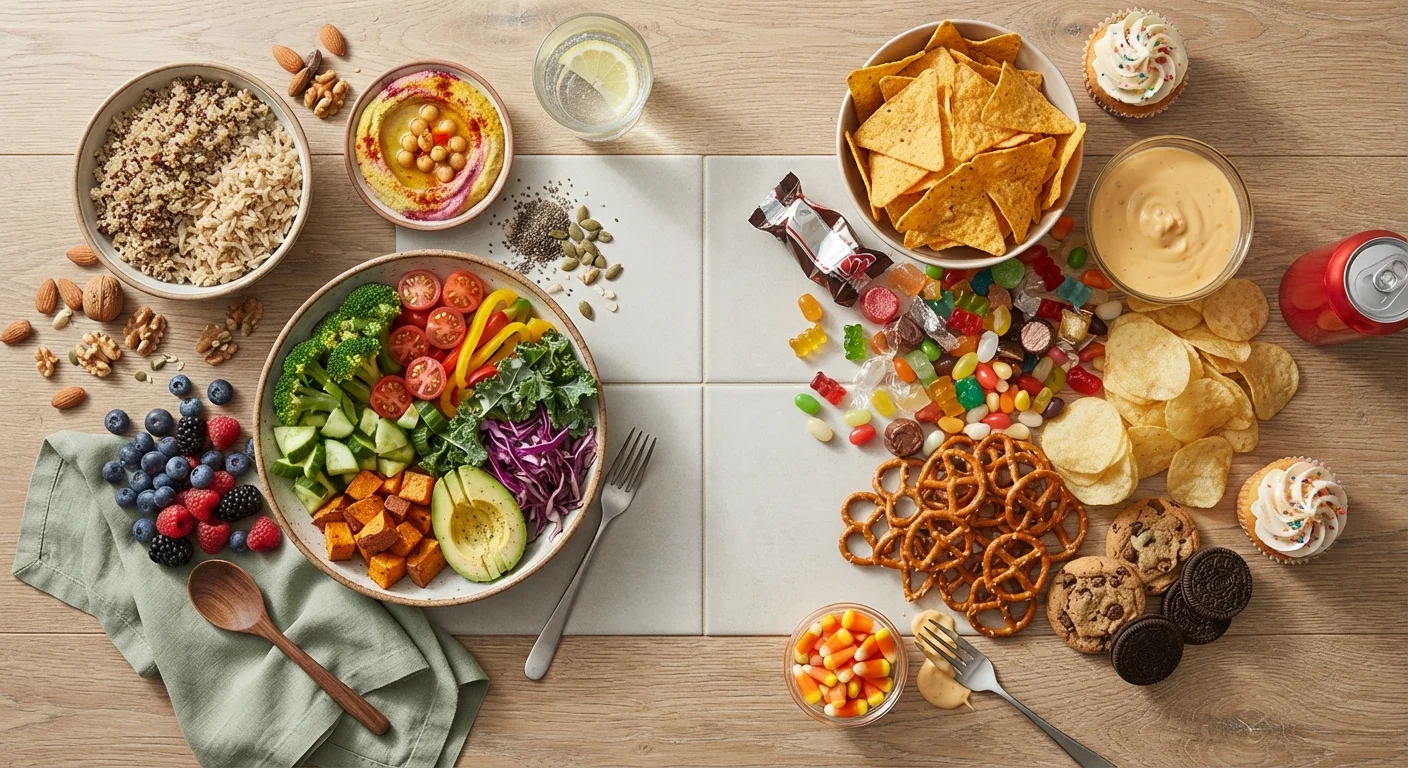
Option A
Nutrient Density
The measure of nutritional value relative to calorie content.
Best for: Evaluating how much vitamins, minerals, fiber, and beneficial compounds a food delivers per calorie consumed.
Option B
Calorie Density
The measure of energy content relative to food volume or weight.
Best for: Understanding how much energy a given portion of food provides, and how it affects satiety and total intake.
What These Two Concepts Actually Mean
When nutritionists and researchers talk about food quality, they often invoke two related but distinct ideas: nutrient density and calorie density. Both are ways of measuring what a food delivers - but they measure very different things.
Nutrient density refers to the concentration of beneficial nutrients - vitamins, minerals, dietary fiber, antioxidants, and other health-supporting compounds - relative to a food's calorie content. A food is considered nutrient-dense when it delivers a substantial amount of these compounds for relatively few calories. Think leafy greens, legumes, eggs, and whole grains.
Calorie density, by contrast, refers to how much energy (measured in calories) is contained in a given weight or volume of food - typically expressed per 100 grams. Foods with high calorie density pack a large number of calories into a small physical amount. Nuts, oils, and many ultra-processed snack foods fall into this category.
Importantly, these two qualities are independent. A food can be calorie-dense and nutrient-dense (such as almonds), calorie-sparse and nutrient-dense (such as spinach), or calorie-dense and nutrient-sparse (such as many refined snack foods). For a broader foundation on how these concepts fit within overall nutrition, see Nutrition Fundamentals: A Starting Point for Eating More Intentionally.
How Each Concept Shapes Food Choices
Understanding the practical difference between these two measures changes how you might approach a meal or a grocery run - not by demanding perfection, but by shifting your default lens.
| Criterion | Nutrient Density | Calorie Density |
|---|---|---|
| What it measures | Nutrients per calorie | Calories per gram or serving |
| Primary use | Assessing nutritional value | Estimating energy contribution |
| High-scoring example | Spinach, lentils, salmon | Oils, nuts, refined snacks |
| Low-scoring example | Refined sugars, soda | Lettuce, cucumber, broth |
| Satiety signal | Indirect (via fiber, protein) | Direct (via volume and weight) |
| Best for | Long-term diet quality | Managing total energy intake |
| Limitation | Doesn't capture energy needs | Ignores nutrient contribution |
When you use nutrient density as a guide, you naturally gravitate toward whole foods that deliver more for your nutritional dollar. You ask: what does this food contribute beyond energy? This framing is especially useful for building a dietary pattern that supports long-term health without obsessive tracking.
When you use calorie density as a guide, you are thinking more about volume and satiety - how food physically fills your stomach relative to the energy it provides. Research on satiety consistently shows that foods with lower calorie density (those high in water and fiber, like fruits and vegetables) tend to promote feelings of fullness more effectively per calorie consumed. This can be a useful tool for managing overall energy intake.
To understand how these numbers appear on packaging, Reading a Nutrition Label Without Getting Confused breaks down the key figures in practical terms.
Why Neither Metric Tells the Whole Story Alone
One of the most common misconceptions in popular nutrition is reducing food quality to a single number. Calorie density, used alone, can unfairly penalize foods like avocado or salmon - both of which are calorie-dense but rich in beneficial fats, protein, and micronutrients. Conversely, some low-calorie foods offer very little nutritional substance.
Nutrient density, while a more holistic metric, doesn't automatically account for a person's total energy needs. Someone with higher caloric requirements - an athlete, someone recovering from surgery, or an older adult with appetite challenges - may need to lean on some calorie-dense foods to meet their energy needs. For context on how these needs shift across life stages, see Eating Patterns Through the Decades.
The most useful approach is to hold both concepts together. A practical heuristic used by many nutrition researchers is to ask: Does this food deliver meaningful nutrients, and does its energy content fit my overall pattern? That framing sidesteps both calorie obsession and the reflexive labeling of foods as simply "good" or "bad."
Dietary Patterns Matter More Than Single Foods
No single food makes or breaks a healthy diet. Nutrition research consistently finds that the overall pattern of eating - across days and weeks - is more predictive of health outcomes than the presence or absence of any one food. Both nutrient density and calorie density are most useful when applied as pattern-level lenses, not as pass/fail judgments on individual meals.
Research on dietary patterns - rather than individual foods - consistently shows that overall diet quality predicts health outcomes more reliably than any single food choice. For a deeper look at how whole and processed foods compare within this framework, see Whole Foods vs. Ultra-Processed Foods.
This article is for general informational and educational purposes only and is not a substitute for professional medical or dietary advice. Consult a registered dietitian or qualified healthcare provider for guidance tailored to your individual needs.
The content on this site is for informational purposes only and is not a substitute for professional advice. Always consult a qualified professional for guidance specific to your situation.