

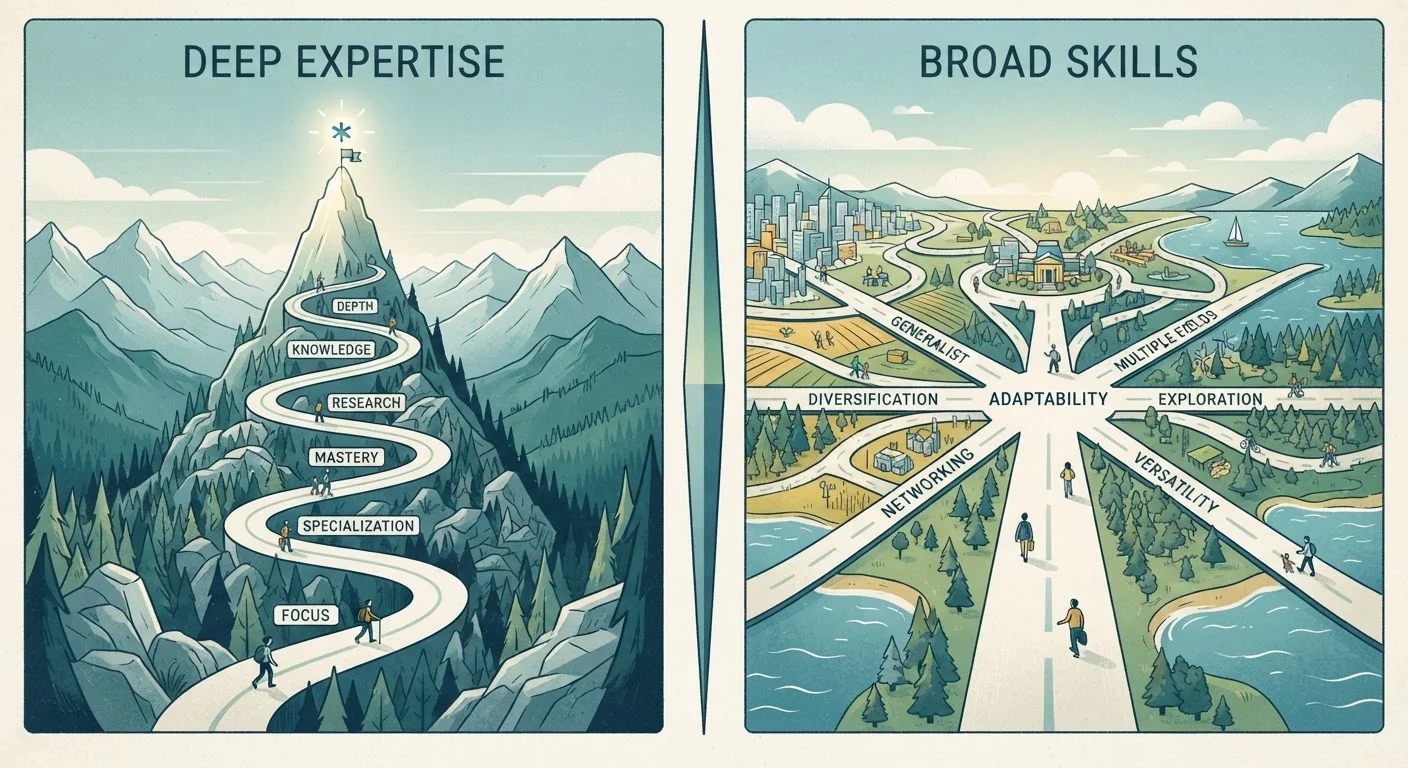
Option A
Generalist Career Path
The broad, adaptable professional who operates across disciplines.
Best for: Professionals who thrive on variety, want leadership optionality, or work in fast-changing or cross-functional environments.
Option B
Specialist Career Path
The deep-expertise professional who becomes the go-to authority in one domain.
Best for: Professionals who want clear technical identity, premium compensation for rare skills, or roles in highly credentialed fields.
What Each Path Actually Looks Like Day-to-Day
A generalist moves across functions, takes on varied projects, and accumulates a wide toolkit. Think of a marketing manager who also handles budget planning, coordinates with product, and occasionally steps into recruiting. Or a startup operations lead who owns everything from vendor contracts to HR onboarding. Their value comes from connecting dots across silos and filling gaps that specialists can't or won't.
A specialist goes deep in one clearly defined domain - a tax attorney focused on transfer pricing, a machine learning engineer who only works on recommendation systems, or a UX researcher specialising in accessibility. Their career progression typically follows a recognisable ladder: junior to senior to principal or staff level, with compensation often tied directly to the scarcity of their specific expertise.
The day-to-day reality matters: generalists often enjoy more variety but may feel pulled in too many directions. Specialists often have sharper focus but can feel siloed when broader organisational decisions are made without them.
Side-by-Side: Key Trade-offs
Before deciding which direction to invest in, it helps to see the structural differences laid out clearly. The table below compares generalist and specialist paths across the dimensions most likely to affect your career planning.
| Criterion | Generalist | Specialist |
|---|---|---|
| Core value proposition | Cross-functional adaptability | Deep domain authority |
| Typical compensation trajectory | Broad ceiling, slower early growth | Premium for rare expertise |
| Leadership readiness | High - breadth aids management | Lower unless paired with breadth |
| Vulnerability to disruption | Lower - skills transfer more easily | Higher if niche shrinks |
| Resume clarity | Can appear unfocused without framing | Clear, easy for recruiters to place |
| Freelance / consulting appeal | Moderate | High - clients hire for specific problems |
| Time to recognised expertise | Longer - breadth takes time | Faster within a defined domain |
One nuance the table can't fully capture: these trade-offs shift depending on where you are in your career. Early-career professionals often benefit most from breadth, while mid-to-late career pivots toward a specialty can significantly raise earning power. See our grounded guide to professional development for a framework on building skills intentionally at any stage.
The Risks Nobody Talks About
Both paths carry real downside risk that career conversations often gloss over.
For specialists: Niche expertise can become obsolete. A database administrator whose entire practice was built around one legacy platform faces genuine retraining pressure when that platform loses market share. The more narrowly defined a specialty, the more vulnerable it can be to automation, offshoring, or industry consolidation.
For generalists: Breadth without a clear narrative can look unfocused to hiring managers. In competitive applicant pools, a resume that spans five functions over ten years may raise questions rather than answer them. If you've built a varied career, knowing how to frame it is critical - our guide on presenting a non-linear career path covers exactly that challenge.
A useful hedge is the T-shaped professional model: broad working knowledge across adjacent areas, with genuine depth in at least one. This structure gives you specialist credibility while retaining the adaptability generalists depend on. It also tends to perform well in interviews, where you can speak specifically about one domain while demonstrating you understand the larger context.
How to Decide - and Revisit the Decision
This isn't a one-time choice. Many professionals shift between phases of generalism and specialisation throughout a working life - and that's strategically sound, not inconsistent. Some questions worth sitting with:
- What does your target industry reward? Some sectors (consulting, startups, nonprofits) prize adaptability. Others (finance, engineering, healthcare-adjacent roles) have clearly defined specialty tracks with structured credentialing.
- Where do you want to be in ten years? If your goal is a C-suite or senior leadership role, generalist breadth is typically essential. If it's becoming the definitive expert in a technical field, depth serves you better.
- What energises you? Sustained excellence in either path requires genuine interest. Specialists often describe a drive to understand something completely. Generalists often describe curiosity about how systems connect.
It's also worth considering how your path affects mobility inside your current organisation versus across employers. Our article on internal mobility vs. changing employers is a useful companion read if you're evaluating whether to deepen expertise where you are or leverage a specialty to move elsewhere.
T-shaped
Model used by many leading employers
The T-shaped skills framework - depth in one area, breadth across others - is cited by organisations including IDEO and various management consulting firms as a preferred hiring profile for collaborative, innovative roles.
~5 years
Typical time to recognised specialist status
Career development research broadly suggests that focused, deliberate practice over several years is a common threshold before professionals are consistently recognised as domain experts by peers and employers.
62%
Workers who have changed occupations or fields
According to Pew Research Center survey data, a majority of US workers report having shifted occupation or industry at some point in their career, underscoring how fluid these path decisions actually are in practice.
The content on this site is for informational purposes only and is not a substitute for professional advice. Always consult a qualified professional for guidance specific to your situation.