

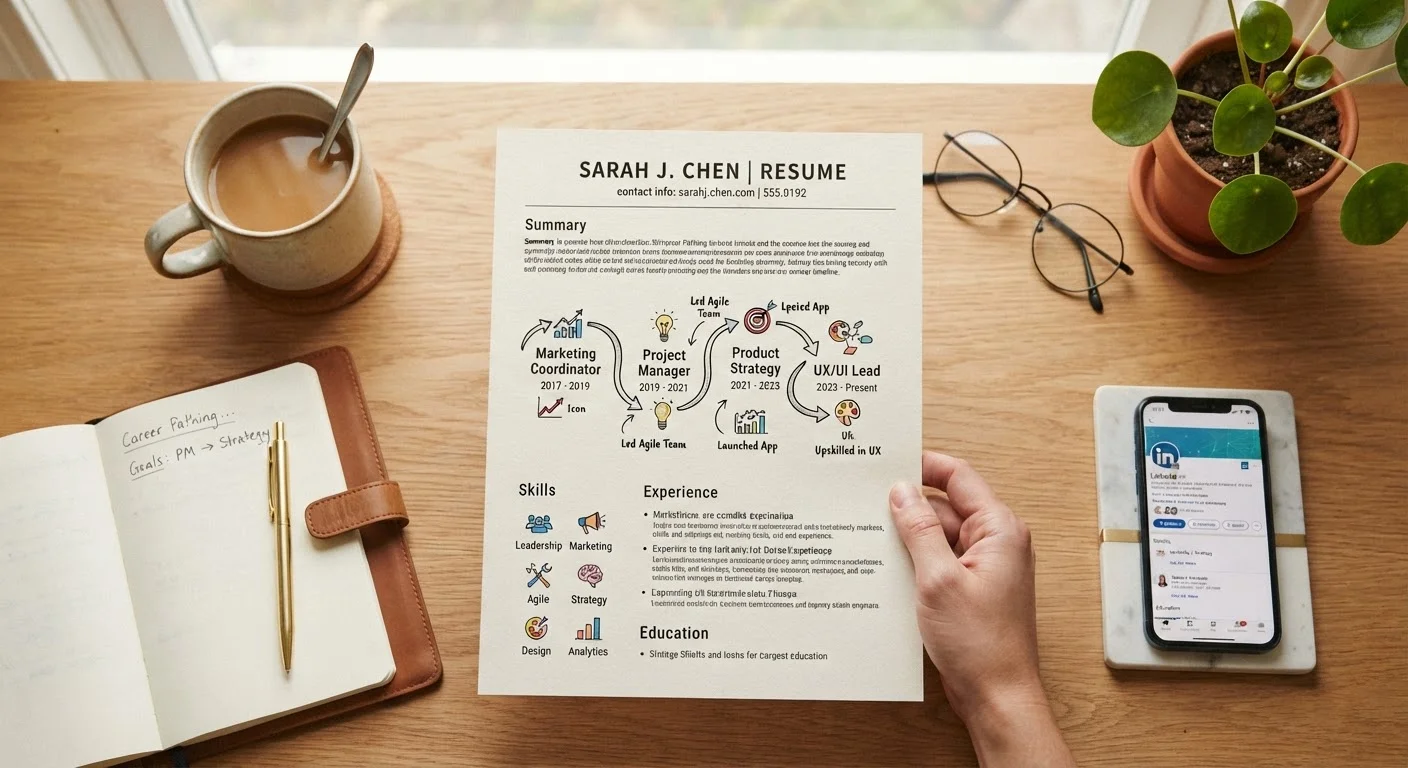
Why Non-Linear Careers Need a Different Resume Strategy
Most resume advice assumes a tidy, upward progression in one field. For a growing share of workers - those who've changed industries, freelanced, taken breaks, or pivoted mid-career - that template doesn't fit. A reverse-chronological list of jobs from different sectors can read as unfocused when, in reality, the experience is rich and transferable.
The goal isn't to hide your career history or pretend it's something it isn't. The goal is to organize it so that the skills and outcomes most relevant to your target role rise to the top. See our guide to choosing the right resume format for a full breakdown of how each structure serves different situations.
Best Practices for Framing a Varied Career History
The following practices give hiring managers a clear, confident picture of what you bring - regardless of the route you took to get here.
Lead with a targeted professional summary, not a job-title headline.
A summary lets you frame your identity around capabilities and direction rather than your most recent job title, which may be from a different field. It gives hiring managers immediate context for the varied roles that follow and signals that the career changes were purposeful.
Choose a hybrid or functional format when your most relevant experience isn't the most recent.
A strictly chronological format punishes career changers by leading with the least relevant role. A hybrid format opens with a skills or achievements section, then lists roles in reverse order - giving you control over what the reader sees first.
Consolidate freelance and contract work under a single entry when possible.
A string of short engagements can look like instability if each is listed separately. Grouping them under a single header - such as 'Independent Consultant, 2019-2023' - communicates self-directed professional activity and makes the timeline easier to read.
Name transferable skills explicitly and tie each to a measurable result.
Hiring managers reading a varied resume need help connecting past roles to present relevance. Labeling skills - project management, stakeholder communication, data analysis - and pairing them with outcomes removes the interpretive burden and makes your value concrete.
Tailor each version of your resume to a specific role, not a general career category.
A non-linear background gives you more material to draw from - but also more choices about what to emphasize. A resume aimed at a project management role should foreground planning and delivery experience; one aimed at a communications role should lead with writing, strategy, and audience work. Generic resumes dilute the narrative. See what tailoring a resume actually means for a practical approach.
Use brief role context lines to orient the reader quickly.
When employers span different industries or company sizes, a one-line descriptor under each role helps the reader understand the environment without needing to look it up. This prevents distraction and keeps attention on your contributions.
Quick Actions You Can Take Right Now
Before overhauling your entire resume, these targeted steps can immediately strengthen how your non-linear path reads to an employer.
Telling a Coherent Story Across Roles
A varied career becomes a liability only when the reader can't find the thread connecting it. Your job is to provide that thread explicitly - through your summary, through skill labels, and through the way you write each bullet point. Rather than listing duties, each role's description should highlight outcomes and the capabilities you exercised to achieve them.
If you've worked across industries, consider whether a theme ties your roles together: client relationship management, operational problem-solving, content strategy, or data analysis can all run through jobs with very different job titles. Naming that theme in your summary makes the whole resume cohere. For advice on aligning this narrative with a specific posting, see tailoring your resume to a job description.
If your path includes employment gaps alongside the career changes, address those directly and confidently. The article Gaps in Your Work History: What They Signal and How to Address Them covers exactly how to do that without over-explaining.
A non-linear career can be a genuine differentiator - especially for roles that value adaptability, cross-functional thinking, or breadth of perspective. The resume that gets you the interview is the one that makes the hiring manager see exactly why your particular path makes you the right fit for this particular role.
The content on this site is for informational purposes only and is not a substitute for professional advice. Always consult a qualified professional for guidance specific to your situation.