

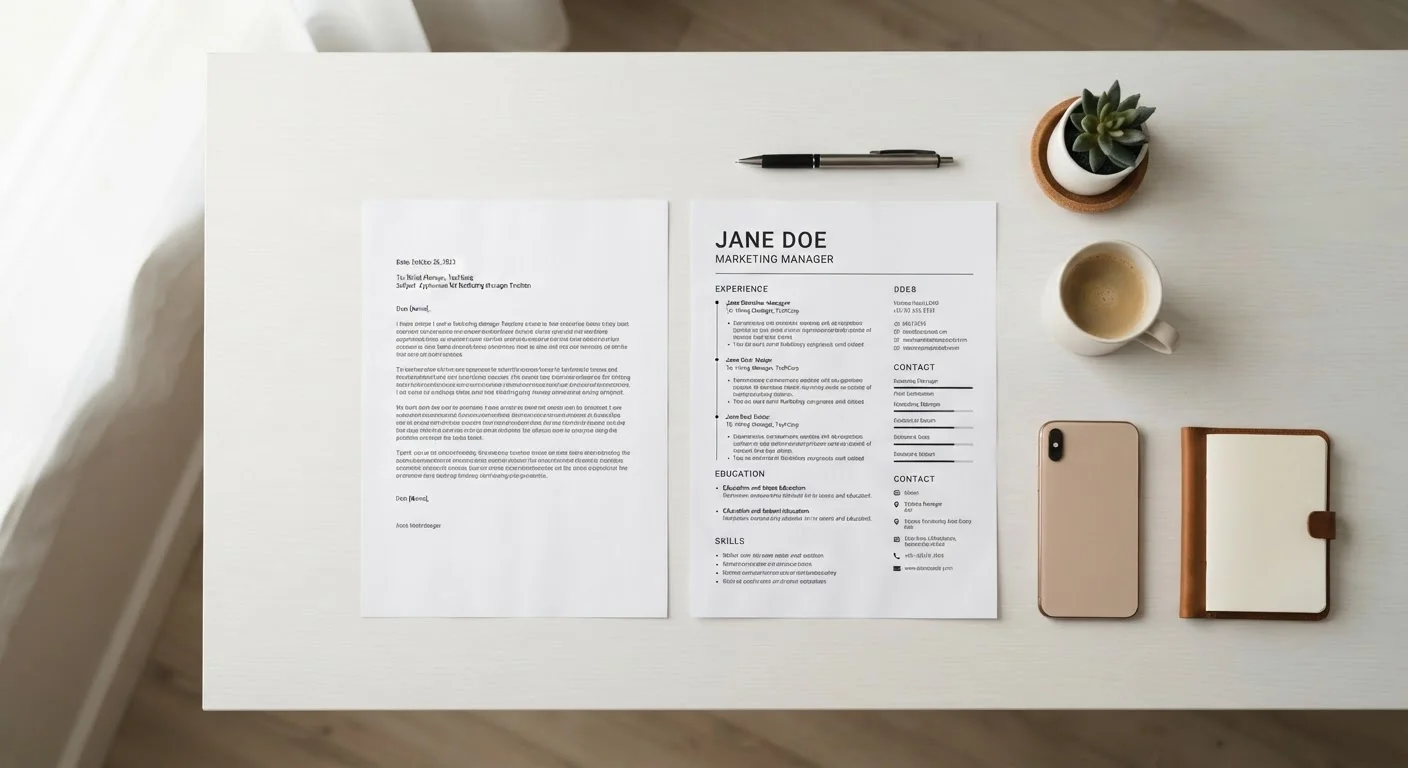
Option A
Submitting a Cover Letter
The strategic, relationship-building addition to your application.
Best for: Roles where human context, career pivots, or cultural fit are part of the hiring decision.
Option B
Skipping the Cover Letter
The efficient, friction-reducing approach for the right situations.
Best for: High-volume application portals, technical roles evaluated on demonstrated skills, or postings that explicitly make it optional.
Why This Decision Is More Nuanced Than It Looks
The question of whether to include a cover letter gets a surprising amount of confident, contradictory advice - some recruiters swear by them, others say they never read them. Both camps have valid points, which is exactly why context is everything.
The honest answer is that a cover letter's value depends on three variables: who reviews it, what it says, and what the situation calls for. Understanding those variables helps you make a deliberate choice rather than defaulting to habit.
It also helps to understand how most applications are processed. Large employers frequently use applicant tracking systems (ATS) to filter resumes before any human sees them. In many of those pipelines, cover letters are either uploaded separately or ignored entirely. This doesn't make cover letters obsolete - it means their impact is concentrated at the human review stage, which is exactly where nuanced storytelling pays off.
| Criterion | With Cover Letter | Without Cover Letter |
|---|---|---|
| Career pivot or gap explanation | Can contextualize clearly | Leaves gaps unexplained |
| ATS / automated screening | Often not read at this stage | No difference in outcome |
| Time investment | Higher; requires tailoring | Lower; faster submission |
| Cultural fit signaling | Strong when done well | Absent |
| Risk of weak execution | Generic letter can hurt | No letter, no penalty |
| Impact for technical roles | Low unless it adds context | Portfolio carries more weight |
| When referral exists | Reinforces the connection | Missed opportunity |
When a Cover Letter Genuinely Changes Your Odds
There are specific scenarios where a cover letter does measurable work that your resume simply cannot.
Career pivots and non-linear histories
If your resume shows a trajectory that doesn't obviously map to the role you're applying for, a cover letter is your opportunity to draw that connection explicitly. Gaps or shifts in your work history don't have to be liabilities - but left unexplained on a resume, they invite unfavorable assumptions. A concise, confident paragraph can reframe the narrative entirely.
Roles where culture fit is part of the criteria
Mission-driven organizations, small teams, and leadership roles often use cover letters to assess voice, clarity of thought, and genuine interest. A thoughtful letter signals that you researched the organization and made a deliberate choice - not just another mass application.
When the posting asks for one
This is the simplest case: if it's required, include one. Skipping it signals either carelessness or an inability to follow instructions - neither impression is useful early in a hiring process.
When Skipping the Cover Letter Is Perfectly Reasonable
Not every application warrants a cover letter, and submitting a weak one can actively work against you.
Highly automated, high-volume application systems
Many large employers and recruiting platforms funnel applications through ATS filters that score resumes against keyword criteria before a recruiter ever opens the file. In these contexts, cover letters may not be read in the early stages. Your energy is often better spent tailoring your resume to the specific job description.
When the posting explicitly says it's optional or unwanted
Take the instructions at face value. Employers who say cover letters are optional typically mean it. Submitting one anyway is low-risk, but only if it's genuinely strong - a generic, templated letter offers no advantage over a blank field.
Technical and skills-based roles with portfolio requirements
For roles in engineering, data, design, or development, demonstrated work - code repositories, portfolios, assessments - often carries more weight than written narrative. A cover letter here can feel like filler if it doesn't add something the portfolio doesn't already show.
What Actually Makes a Cover Letter Worth Reading
If you decide a cover letter is appropriate, the quality of what you write matters more than the fact that you included one. Hiring managers report that generic cover letters - those that restate the resume and open with "I am writing to apply for..." - are the norm, and that specificity is what stands out.
A useful cover letter does three things: it identifies the specific role and organization by name, it makes one or two concrete connections between your experience and the employer's actual needs, and it ends with a clear, confident expression of interest. That's it. Two to three focused paragraphs are more effective than a full page of general enthusiasm.
Before your next submission, consider whether your application strategy is as deliberate as it could be. A structured pre-application checklist can help you evaluate what each submission actually needs - and avoid the trap of treating every application identically.
Finally, a cover letter is not a substitute for a strong resume or a professional network. If you have a referral, networking connection, or a tightly tailored resume, those factors often do more heavy lifting than any letter. The cover letter, at its best, is a complement - not the anchor of your application strategy.
The content on this site is for informational purposes only and is not a substitute for professional advice. Always consult a qualified professional for guidance specific to your situation.