

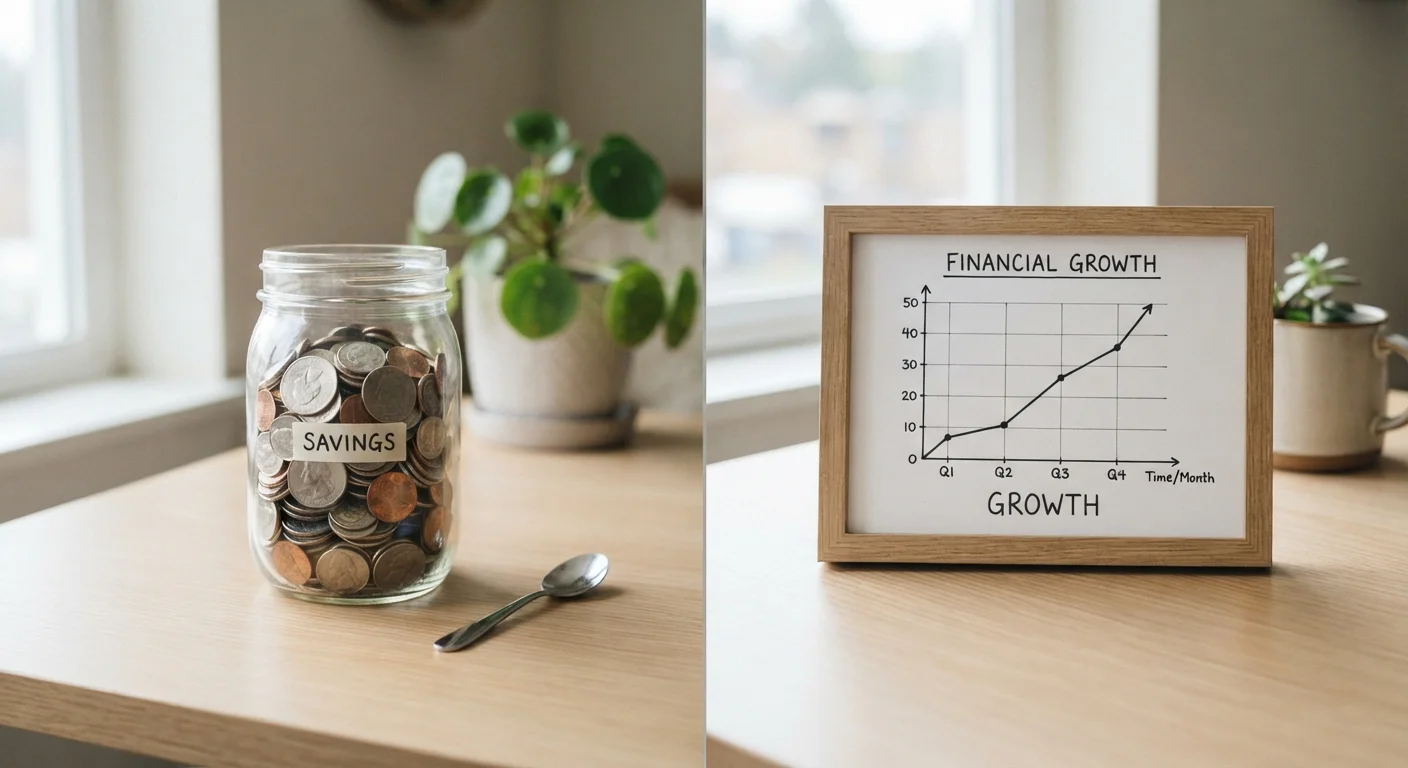
Option A
Emergency Fund
The financial safety net designed for certainty and access.
Best for: Anyone who needs a reliable cash cushion to cover unexpected expenses without disrupting long-term plans.
Option B
Investment Account
The growth-oriented vehicle designed to build wealth over time.
Best for: Those who have stable income, manageable debt, and a cash buffer already in place and want their money to work harder over years or decades.
What Each Account Actually Does
Before deciding where spare money goes, it helps to be clear on what each vehicle is designed to do - because they serve fundamentally different purposes. As our overview on the difference between saving and investing explains, conflating the two can lead to decisions that leave you exposed at the wrong moment.
An emergency fund is a pool of liquid, accessible cash - typically held in a savings or money market account - set aside exclusively for unplanned financial shocks. Think job loss, emergency car repairs, or an unexpected medical cost. Its value isn't growth; it's availability. You need to be able to access it quickly without penalties, and you need its nominal value to be stable.
An investment account is a vehicle through which money is put into assets - such as stocks, bonds, or funds - with the expectation that it will grow over time. That growth potential comes with risk: market values fluctuate, and balances can fall as well as rise. Investments are generally most effective when left untouched for years or decades, which makes them poor candidates for money you might need next month. Key investing terms like liquidity, volatility, and yield matter here and are worth understanding before committing funds.
The Core Trade-Off: Stability vs. Growth
The central tension is straightforward: emergency funds offer stability and access but limited growth, while investment accounts offer growth potential but limited short-term reliability.
| Criterion | Emergency Fund | Investment Account |
|---|---|---|
| Primary purpose | Financial safety net | Long-term wealth growth |
| Typical account type | Savings or money market account | Brokerage or retirement account |
| Liquidity | High - readily accessible | Lower - best left untouched |
| Risk to principal | Very low (cash) | Variable - can lose value |
| Growth potential | Limited (interest only) | Higher over long horizons |
| Inflation impact | Purchasing power can erode | Growth may offset inflation |
| Time horizon | Immediate to short-term | Years to decades |
This trade-off has real consequences. If you invest money that you end up needing urgently, you may be forced to sell at a market low - locking in a loss. Conversely, if you keep too much in cash for too long, inflation quietly erodes its purchasing power. Neither extreme serves most people well.
Understanding this balance also shapes more advanced decisions, such as whether to use tax-advantaged wrappers for investment or how to think about lump-sum versus regular contributions.
Why Most Frameworks Suggest the Emergency Fund First
The general logic behind prioritising an emergency fund comes down to sequence risk - the danger that needing money at the wrong time forces poor financial decisions. Market downturns don't wait for convenient moments. A sudden expense during a period of market weakness could force you to liquidate investments at a significant loss.
The widely cited benchmark for emergency fund size is three to six months of essential living expenses, though the right figure varies by individual circumstances - income stability, dependants, fixed obligations, and risk tolerance all play a role. Those with variable income or fewer financial safety nets often find that a larger buffer makes sense.
How Much Is 'Enough' in an Emergency Fund?
The three-to-six-month guideline refers to essential expenses - rent or mortgage, utilities, food, minimum debt payments - not total income or discretionary spending. For someone with a highly stable job and few financial dependants, three months may be adequate. For a freelancer, someone with variable income, or those supporting others, six months or more may be more appropriate. These are general reference points, not rules. A licensed financial professional can help you assess your specific situation.
Once a sufficient buffer is established, the case for directing additional spare money toward investments becomes much stronger. At that point, the emergency fund is doing its job quietly in the background, and investments can be left to grow without the risk of premature withdrawal. For those ready to build a portfolio, understanding diversification principles is a useful next step, as is reviewing the broader savings and investing topic map.
Running Both in Parallel
The framing of "one or the other" is useful for establishing priorities, but in practice many people reach a point where both goals can be pursued simultaneously. Once a core emergency fund is in place, it becomes reasonable to split spare money - directing a portion toward topping up the cash buffer and a portion toward investments.
The proportions depend on individual circumstances: how close the emergency fund is to its target, how soon retirement or another long-term goal is, and how comfortable the person is with market fluctuations. There is no universally correct split, and a qualified financial adviser can help assess what makes sense for a specific situation.
What matters most is that the decision is deliberate rather than accidental. Money left sitting without a purpose tends to drift toward spending rather than building financial resilience. Whether the immediate priority is the emergency fund or the investment account, having a clear rationale for the allocation is more valuable than any particular ratio.
This article is for general informational and educational purposes only. It does not constitute personalised financial, investment, or tax advice. Consult a qualified financial adviser before making decisions about your own savings, investments, or financial plans.
The content on this site is for informational purposes only and is not a substitute for professional advice. Always consult a qualified professional for guidance specific to your situation.