

Our Verdict
Lump-sum investing and regular contributions are both legitimate, widely used approaches with different mechanical trade-offs. Lump-sum investing tends to benefit from more time in the market, while regular contributions spread timing risk and can be easier to sustain for those without a windfall. Neither method guarantees a better outcome, and both depend heavily on the markets, asset choices, and individual circumstances involved.
| Best for | Recommended |
|---|---|
| Those who have a large sum available and a long investment horizon | Lump-Sum Investing |
| Those who prefer to reduce the emotional weight of market timing | Regular Contributions (Dollar-Cost Averaging) |
| Those investing from a steady income with no large windfall | Regular Contributions (Dollar-Cost Averaging) |
| Those who are comfortable with short-term volatility in pursuit of maximum market exposure | Lump-Sum Investing |
What Sets These Two Approaches Apart
When it comes to putting money to work in the markets, investors broadly follow one of two paths: deploying a large amount all at once, or contributing smaller amounts on a recurring schedule. Both approaches can be used with the same types of investment vehicles - such as index funds, mutual funds, or brokerage accounts - but they differ fundamentally in timing and mechanics.
Before comparing them, it helps to understand what each actually involves. If you're new to the foundational concepts, the difference between saving and investing is a useful starting point. Equally, familiarizing yourself with key investment terms such as volatility and liquidity will help you evaluate the trade-offs described here.
How Lump-Sum Investing Works
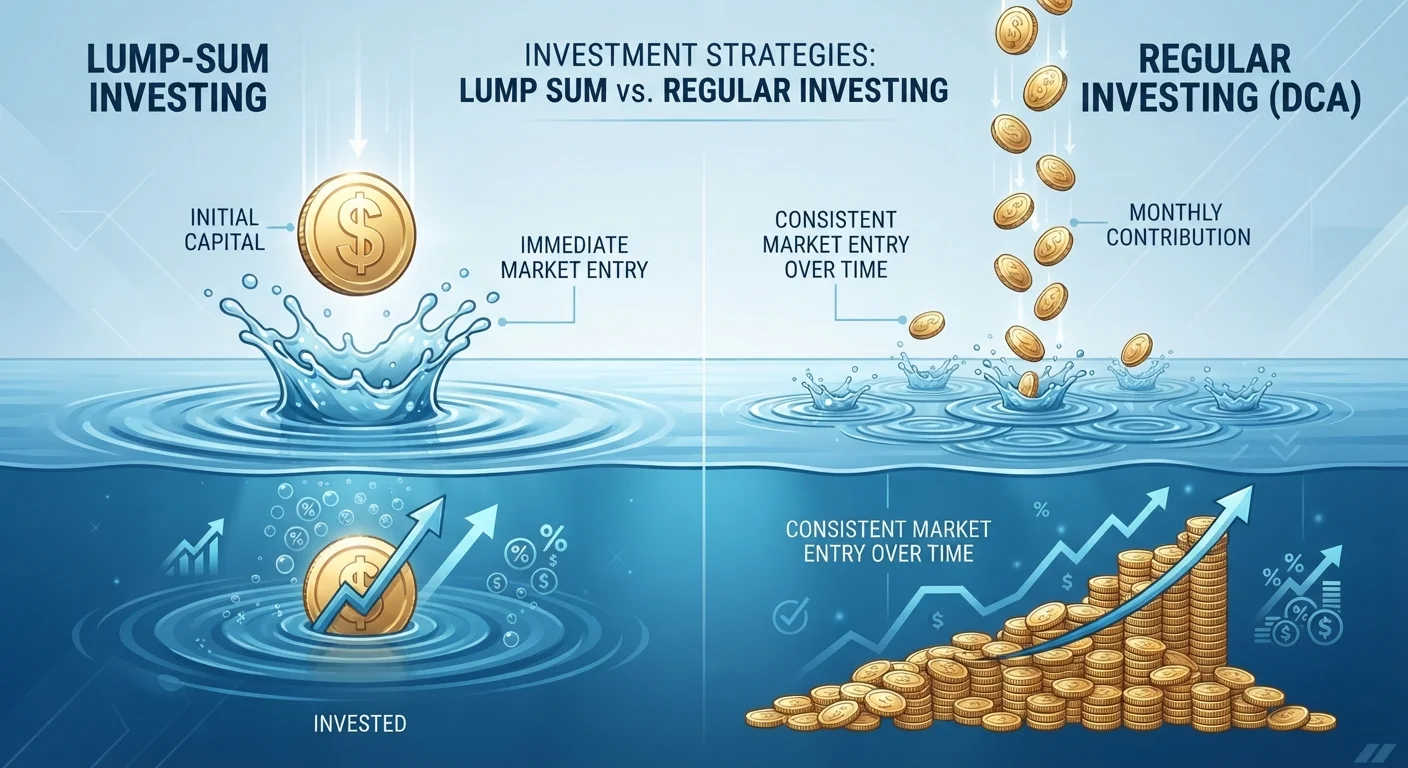
Lump-sum investing means committing all available capital to the market in a single transaction. A person who receives an inheritance, a bonus, or proceeds from a property sale might choose to invest the entire amount immediately rather than holding it back.
The core argument for this approach is time in the market. Historically, markets have trended upward over long periods, meaning that capital invested earlier has more opportunity to participate in that growth. Every day funds sit in cash or a low-yield account is a day they are not compounding alongside market returns.
A widely cited Vanguard analysis found that lump-sum investing outperformed dollar-cost averaging approximately two-thirds of the time across US, UK, and Australian markets - though this finding reflects historical patterns and cannot predict future results. The primary risk is straightforward: if markets decline sharply shortly after investing, the full amount is exposed to that drawdown from the start.
| Lump-Sum Investing | Regular Contributions (DCA) | |
|---|---|---|
| Capital deployment | All at once, immediately | Spread over time in fixed amounts |
| Market timing exposure | High - full amount at one price point | Low - purchases spread across price points |
| Performance in rising markets | Generally stronger | May underperform due to delayed deployment |
| Performance in falling markets | Full drawdown exposure from day one | Later purchases benefit from lower prices |
| Psychological pressure | Higher - single large decision | Lower - smaller, routine decisions |
| Practical applicability | Requires a windfall or saved lump sum | Suits regular income earners |
| Compounding advantage | Maximized - full capital in market sooner | Partial - capital enters gradually |
How Regular Contributions Work
Regular contributions - more formally known as dollar-cost averaging (DCA) - involve investing a fixed amount at consistent intervals, such as monthly or quarterly, regardless of what the market is doing at that moment. Many workplace retirement plans, such as 401(k)s, are structured this way by default, with contributions deducted automatically from each paycheck.
The mechanical effect of DCA is that more units or shares are purchased when prices are lower and fewer when prices are higher. Over time, this can result in a lower average cost per unit compared with buying all at once at a peak price. However, in a consistently rising market, regular contributions mean some capital sits uninvested longer - potentially leaving returns on the table.
DCA is also valued for its behavioral benefits. Making a series of smaller decisions is often less stressful than committing a large sum at a single moment, which can feel particularly daunting during uncertain market conditions. This psychological dimension is real and worth accounting for - an investor who sticks with a regular plan through market swings may fare better than one who makes a lump-sum investment and panic-sells during a downturn.
Key Trade-Offs to Understand
Neither approach is inherently superior in all circumstances. Several factors shape which may be more appropriate for a given investor's situation:
- Market conditions: In a rising market, lump-sum investing generally captures more growth. In a declining or highly volatile market, DCA limits downside exposure.
- Available capital: DCA is often the practical default for investors building wealth from income, since a lump sum simply isn't available. Lump-sum investing requires having a large amount ready to deploy.
- Risk tolerance: Investors with lower tolerance for seeing a large balance drop sharply may find the gradual nature of DCA easier to sustain emotionally.
- Investment horizon: Over a long horizon, the differences between approaches can narrow because markets have more time to recover from any unfavorable entry point.
It's also worth considering how either approach interacts with diversification principles - spreading investments across asset types matters regardless of whether capital enters the market all at once or incrementally. Similarly, the type of fund or vehicle chosen - for example, as explored in a comparison of index funds versus actively managed funds - can influence how either timing strategy plays out in practice.
This article is for general informational and educational purposes only and does not constitute personalized financial, investment, tax, or legal advice. All investing involves risk, including the possible loss of principal. Past market performance does not guarantee future results. Consult a qualified, licensed financial adviser before making decisions based on your individual circumstances.
The content on this site is for informational purposes only and is not a substitute for professional advice. Always consult a qualified professional for guidance specific to your situation.