

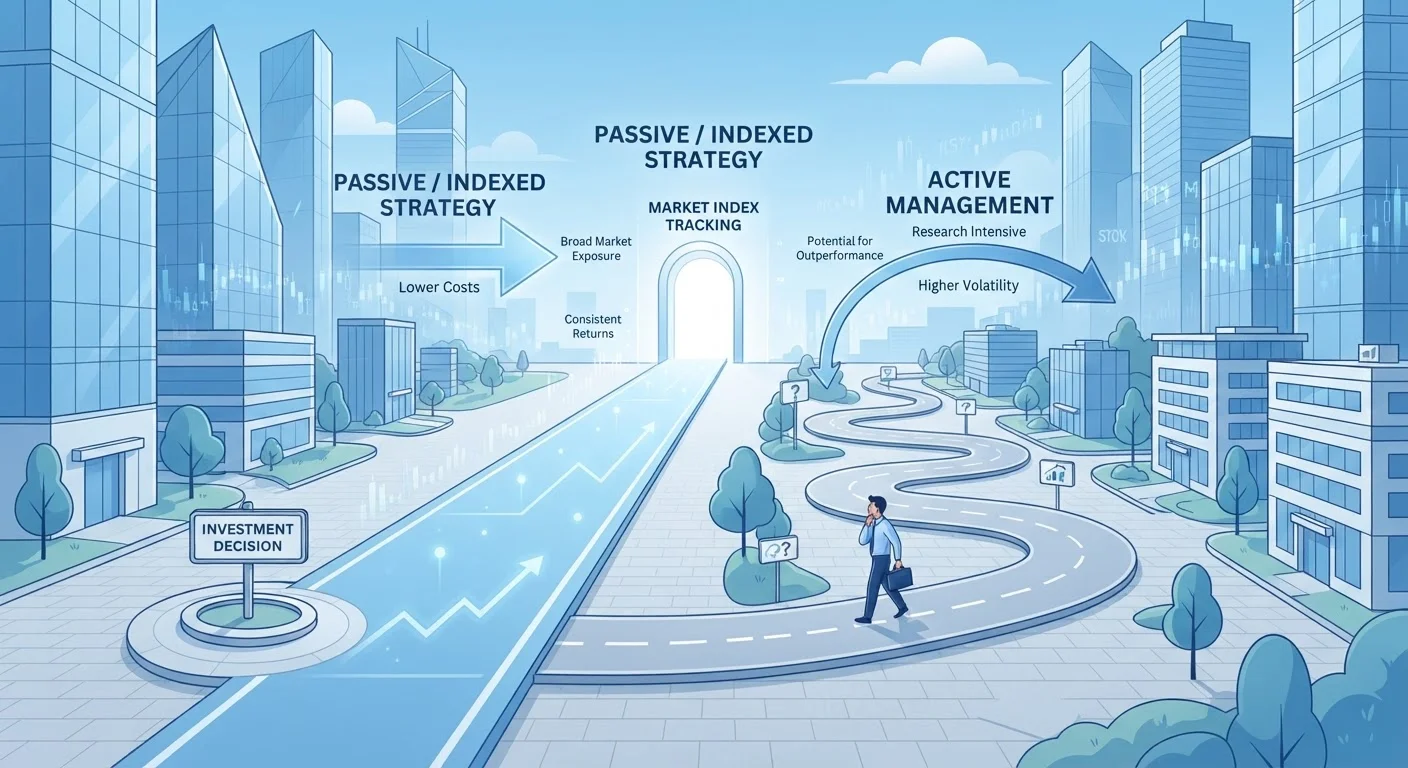
Option A
Index Funds
The rules-based, market-tracking approach.
Best for: Investors who want broad market exposure with predictable methodology and lower ongoing costs.
Option B
Actively Managed Funds
The judgment-driven, manager-directed approach.
Best for: Investors who want a professional team making dynamic decisions in pursuit of a stated investment objective.
How Each Fund Type Is Structured
An index fund is a pooled investment vehicle - available as a mutual fund or an exchange-traded fund (ETF) - designed to replicate the performance of a specific market index. Examples of widely tracked indices include broad stock market benchmarks and sector-specific gauges. The fund holds the same securities, in roughly the same proportions, as the index it tracks. No manager is deciding which stocks to favor; the composition is dictated by the index rules.
An actively managed fund also pools investor money into a diversified portfolio, but a portfolio management team makes deliberate decisions about which securities to buy, hold, or sell. Those decisions are guided by the fund's stated objective - whether that is capital growth, income generation, or a specific risk profile - and are informed by research, economic analysis, and manager judgment.
Both structures give investors access to a diversified basket of assets in a single holding, which is a meaningful advantage over purchasing individual securities. For a broader foundation on what these assets actually are, see our plain-English guide to asset classes.
Cost Differences and Why They Matter
The most consistently cited distinction between the two approaches is cost. Every fund charges an expense ratio - an annual fee expressed as a percentage of assets under management. Because index funds require minimal active decision-making, their expense ratios tend to be substantially lower than those of actively managed funds, which must cover analyst salaries, research infrastructure, and portfolio manager compensation.
| Criterion | Index Funds | Actively Managed Funds |
|---|---|---|
| Management style | Rules-based; tracks an index | Judgment-based; manager-directed |
| Typical expense ratio | Generally 0.03%-0.20% | Generally 0.50%-1.50% or higher |
| Portfolio turnover | Low (changes only when index changes) | Higher (active buying and selling) |
| Tax efficiency (taxable accounts) | Generally higher | Generally lower |
| Performance ceiling | Matches benchmark minus fees | Can exceed benchmark (not guaranteed) |
| Transparency | Holdings mirror a published index | Holdings reflect manager decisions |
This cost gap may appear small in percentage terms, but it compounds meaningfully over time. A difference of even 0.75 percentage points per year, sustained over decades, can result in a materially different ending balance - purely due to the drag of fees, regardless of market performance. This is not a guarantee of superior outcomes for either type; it simply illustrates that costs are a persistent headwind that investors can partially control by understanding what they are paying.
Actively managed funds also tend to trade more frequently, which can generate higher transaction costs within the fund and, in taxable accounts, more frequent capital gain distributions. Index funds' lower turnover typically results in fewer taxable events, a factor worth considering for money held outside tax-advantaged accounts.
Performance: What the Evidence Suggests
A common question is whether active managers consistently outperform their benchmark indices after fees. Research on this topic - including data published by S&P Dow Jones Indices through their SPIVA reports - has generally shown that a majority of actively managed funds underperform their relevant benchmark over longer time horizons when measured net of fees. However, that aggregate picture does not mean every active fund underperforms, nor does it mean index investing is risk-free.
Index funds, by design, will match their benchmark's performance minus their expense ratio. They will not outperform the index, and if the index falls, so does the fund. Actively managed funds have the theoretical ability to outperform - and some do, over meaningful periods - but identifying which funds will do so in advance is genuinely difficult.
The important takeaway is that both approaches carry investment risk. Neither protects against market downturns, and past performance of any fund does not guarantee future results. If you are still working out whether investing is the right step at all, understanding the difference between saving and investing is a useful starting point.
Choosing Between the Two
The choice between index funds and actively managed funds is not purely a question of which is objectively better - it depends on an investor's goals, timeline, tax situation, and comfort with each structure. Some investors hold both types in their portfolio, using index funds for broad core exposure and active funds for specific allocations where they believe manager skill may add value.
Key questions worth considering include: How much am I paying in annual fees, and what am I receiving in return? Is this fund held in a tax-advantaged account (such as an IRA or 401(k)) where tax efficiency is less pressing? Am I comfortable with the possibility that an active manager's decisions may lag the market for extended periods?
How you deploy money into either structure - whether all at once or through regular contributions - is a separate but related decision. Lump-sum investing versus regular contributions explores that trade-off in detail.
This article is for general informational and educational purposes only and does not constitute personalized investment, financial, or tax advice. All investments carry risk, including the possible loss of principal. Consult a qualified financial adviser before making decisions about your own circumstances.
The content on this site is for informational purposes only and is not a substitute for professional advice. Always consult a qualified professional for guidance specific to your situation.