

The Physics Behind the Magic
Wireless charging feels counterintuitive — energy moving through thin air — but the principle is more than a century old. Michael Faraday demonstrated in the 1830s that a changing magnetic field near a wire coil will push electrical current through that coil. Modern wireless chargers apply exactly this insight, scaled down to fit inside a charging pad and a smartphone.
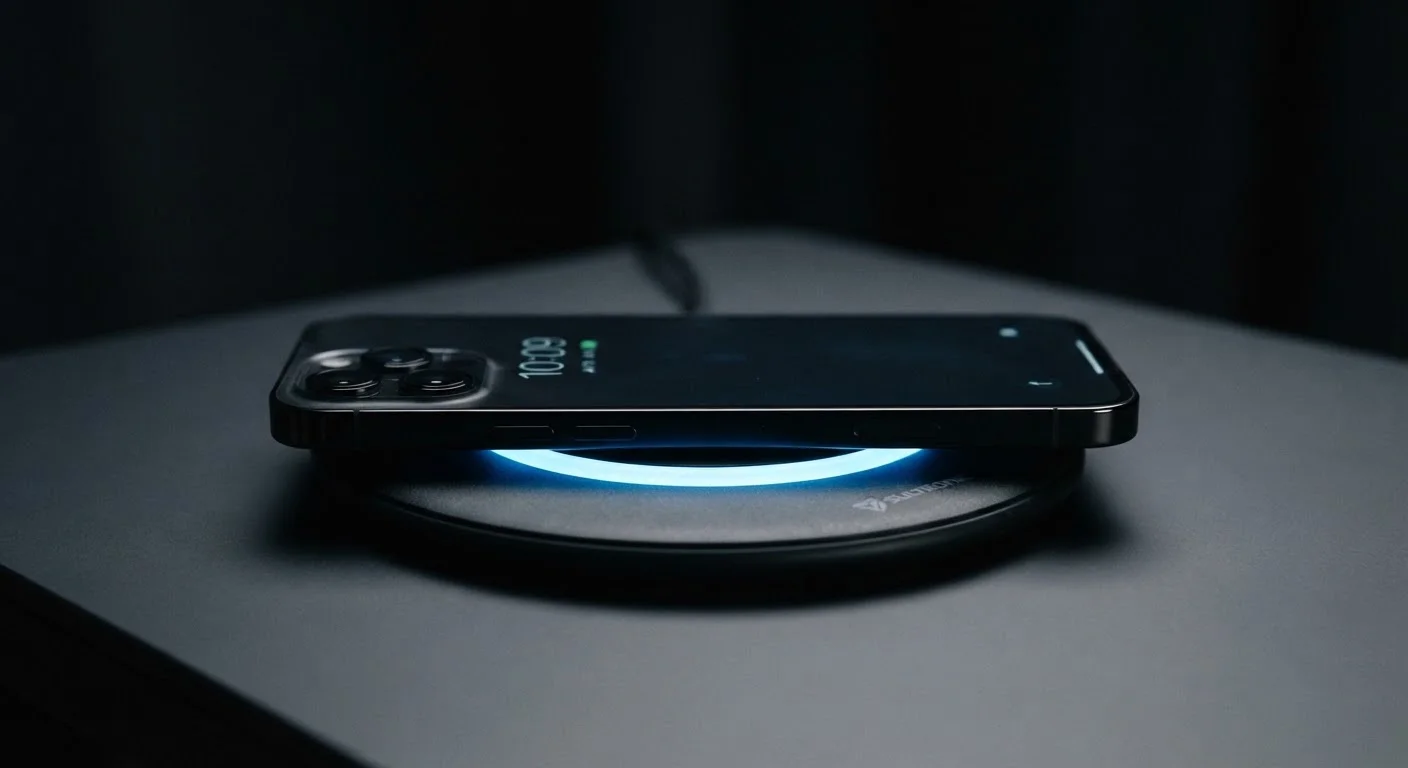
Inside every wireless charger is a transmitter coil — a flat spiral of copper wire. When the charger is plugged in, alternating current flows through that coil, creating a rapidly oscillating magnetic field above the pad's surface. Inside your device sits a receiver coil. When you place the phone on the pad, that magnetic field passes through the receiver coil and induces a current. A small circuit inside the phone then converts this induced current into the direct current your battery needs.
The key word is alternating. A static magnetic field wouldn't induce any useful current. It's the continuous fluctuation — the field switching back and forth many thousands of times per second — that keeps electrons moving in the receiver coil. Think of it like pushing someone on a swing: a steady push does nothing, but a rhythmic push at the right moment builds momentum.
Why 'Wireless' Charging Still Needs a Wire
The charging pad itself must be connected to a power outlet or USB power source. 'Wireless' refers to the absence of a cable between the pad and your device — not the elimination of external power entirely. The pad acts as a cordless intermediary, converting mains electricity into the magnetic field your device harvests.
Standards, Coil Alignment, and Transfer Efficiency
The Qi standard (developed by the Wireless Power Consortium) governs how transmitters and receivers communicate with each other. It isn't just about hardware; Qi-certified devices exchange data signals so the charger knows how much power to deliver and when to stop. This handshake prevents overcharging and allows for variable power levels — the foundation of wireless fast charging.
Alignment matters more than most users realise. Because the magnetic field is strongest directly above the transmitter coil, misplacing a phone even a centimeter off-center can measurably reduce charging speed. Charger pads with multiple overlapping coils, or moving-coil designs, address this by widening the effective charging zone.
70–85%
Typical wireless charging efficiency
Compared to roughly 90–95% for wired charging; the gap manifests as heat generated in both the pad and device.
~5mm
Maximum effective air gap for Qi charging
Standard Qi inductive charging requires the receiver coil to be within a few millimeters of the transmitter, which is why thick cases can interrupt the connection.
15W
Common ceiling for standard Qi fast wireless charging
The Qi 1.x specification supports up to 15W; higher proprietary charging rates require both a compatible device and a manufacturer-specific pad.
Efficiency is the honest trade-off in wireless charging. A wired charger can transfer power at roughly 90–95% efficiency. Wireless systems typically operate at 70–85% efficiency, with the remainder lost as heat. For overnight charging, this difference is small in practical terms. For a quick top-up before leaving the house, a cable will consistently outperform a pad.
How This Differs from Other Wireless Technologies
It's worth distinguishing inductive power transfer from other wireless technologies your devices use. Bluetooth, Wi-Fi, and NFC all transmit information encoded in radio waves. Wireless charging transmits raw energy using a magnetic field — a fundamentally different physical mechanism operating over a much shorter range. Your phone can receive Wi-Fi from across a building, but Qi charging requires near-contact proximity. For a deeper look at how those communication standards compare with each other, see how Bluetooth, Wi-Fi, and NFC each work.
There is also a longer-range variant of wireless power called resonant inductive coupling, used in some charging furniture and automotive applications. It extends the effective range to several centimeters by tuning both coils to the same resonant frequency, allowing energy transfer even when alignment is imperfect. Consumer devices are beginning to incorporate resonant designs, though the Qi standard remains the baseline most buyers will encounter.
What This Means When You're Shopping
Understanding the underlying physics translates into practical decisions. When evaluating a wireless charger, the wattage rating tells you the maximum power the pad can deliver — but your device must also support that wattage on its receiver side. A 15W pad paired with a device that supports only 7.5W will charge at 7.5W regardless.
Coil size and pad design affect usability more than specs sheets suggest. A pad with a narrow single coil demands careful placement every time; a wider or multi-coil pad trades some efficiency for everyday convenience. Material compatibility is also relevant: metal objects placed on a charging pad — including credit cards and key fobs — can interrupt the magnetic field or, in some cases, heat up unexpectedly.
Wireless charging is not universally superior to wired, nor is it a gimmick. It is a mature, well-standardised technology with a clear set of trade-offs: convenience and cable-free placement against slightly lower efficiency and slower peak speeds. Knowing those trade-offs helps you decide whether the feature is worth prioritising on your next device.
Frequently Asked Questions
Yes, in most cases. Qi-compatible wireless charging works through standard plastic or rubber cases up to a few millimeters thick. However, thick cases, metal cases, or cases with built-in card wallets can block or significantly weaken the magnetic field, reducing charging efficiency or stopping it entirely.
Generally, yes. Standard wireless charging typically operates at 5–15 watts, whereas modern wired fast chargers can deliver 30–100+ watts. The gap is narrowing with higher-wattage wireless standards, but wired charging remains faster for most devices in most situations.
Current evidence does not show wireless charging causes meaningfully more long-term battery degradation than wired charging. The additional heat generated during wireless charging can affect battery chemistry over years of heavy use, so avoiding charging in hot environments is a sensible precaution regardless of method.
Qi (pronounced 'chee') is the dominant wireless charging standard developed by the Wireless Power Consortium. Most smartphones released in the past several years support it. Checking your device's specification sheet or the manufacturer's website is the most reliable way to confirm compatibility.
Multi-device charging pads exist and can power several Qi-compatible devices simultaneously. Each device has its own receiver coil, and the pad's transmitter must be powerful enough to serve all connected devices — though overall charging speed per device may be reduced.
Some energy is lost as heat whenever electricity is converted from one form to another, and inductive transfer is no exception. The conversion from magnetic field back to electrical current is not perfectly efficient, so both the pad and device can feel warm to the touch. This is normal, though excessive heat may indicate misalignment or an incompatible accessory.
The content on this site is for informational purposes only and is not a substitute for professional advice. Always consult a qualified professional for guidance specific to your situation.