

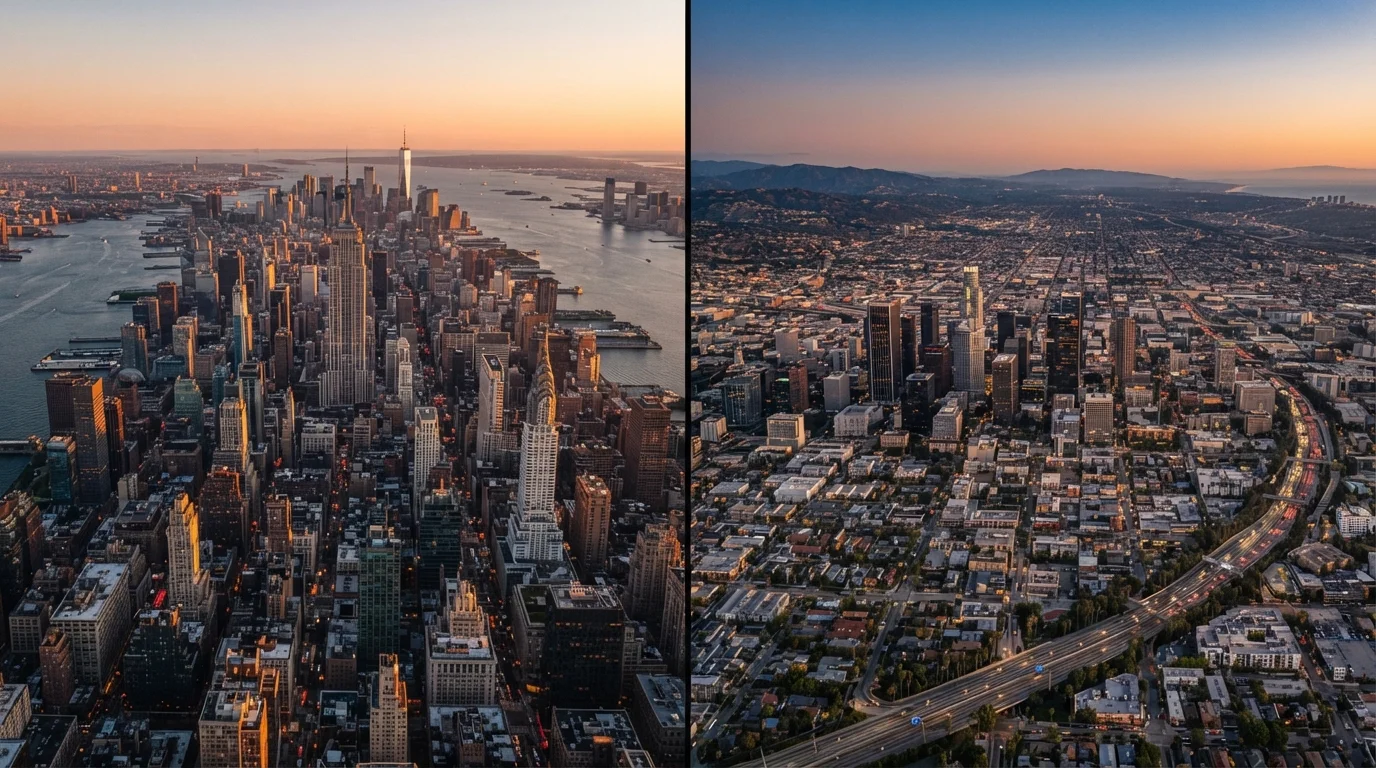
Option A
New York City
The dense, walkable, never-slowing metropolis.
Best for: Travelers who want maximum cultural variety packed into a compact, transit-connected urban core.
Option B
Los Angeles
The sprawling, car-dependent city of neighborhoods.
Best for: Travelers who want sun, outdoor access, and the flexibility to explore distinct areas at their own pace.
Pace and Layout: Dense vs. Sprawling
The most fundamental difference between NYC and LA isn't cultural — it's spatial. New York City is one of the most densely built urban environments in the Western Hemisphere. Manhattan, Brooklyn, and Queens pack enormous variety into tight geography, and the subway system connects most of what visitors want to see. You can walk from the High Line to the Whitney Museum to Chelsea Market without planning a vehicle.
Los Angeles is the opposite. Its metropolitan area covers more than 500 square miles, and its neighborhoods — Koreatown, Los Feliz, Santa Monica, Culver City — feel like distinct cities connected by freeways. Without a car or careful ride-share budgeting, LA's layout works against you. This isn't a flaw, but it does shape how you plan. A well-structured itinerary matters far more in LA than in NYC, where improvisation is easier.
| Criterion | New York City | Los Angeles |
|---|---|---|
| Layout | Compact and dense | Sprawling, 500+ sq miles |
| Getting around | Subway + walking | Car or ride-share essential |
| Climate | Four distinct seasons | Mild and sunny year-round |
| Cultural emphasis | Institutions, Broadway, density | Entertainment industry, outdoor life |
| Beach access | Limited, requires travel | Multiple beaches easily reachable |
| Best trip length | 3–5 days productive | 5–7 days recommended |
| Neighborhood variety | High, within short distances | High, but spread across miles |
Culture, Food, and Entertainment
Both cities are genuine world-class cultural destinations, but they emphasize different things. New York's strength is density of institutions: the Metropolitan Museum of Art, MoMA, Lincoln Center, Broadway, and dozens of independent galleries and music venues are all within the same transit network. The food scene spans every cuisine imaginable, and neighborhood character shifts dramatically block by block.
Los Angeles has a cultural identity anchored in the entertainment industry, visual arts, and an outdoor lifestyle. The Getty Center, LACMA, and the Broad are serious art institutions. The food scene — particularly for Mexican cuisine, Korean food, and farm-to-table dining — is genuinely exceptional. But experiencing it requires moving across the city intentionally. Visitors who treat LA like NYC and stay in one area often leave feeling like they missed the point. This dynamic resembles what happens when travelers leave a city without engaging its real geography.
Weather, Seasons, and Timing
Los Angeles has one of the most consistent climates of any major US city. Temperatures generally stay between 60°F and 85°F for much of the year, with a dry season stretching from late spring through early fall. Coastal areas stay cooler than inland neighborhoods, particularly in the morning — a phenomenon locals call the marine layer.
New York City has four distinct seasons. Summers are hot and humid; winters can be cold with occasional heavy snowfall. Spring and fall are widely considered the most comfortable times to visit, with mild temperatures and lower humidity. That seasonal variation also means NYC's cultural calendar shifts meaningfully by time of year, with different festivals, outdoor programming, and crowd levels throughout. Travelers planning either trip should consult current conditions and verify any event-specific timing with official sources before booking.
302
Average annual sunny days in Los Angeles
According to US Climate Data, Los Angeles averages approximately 302 sunny days per year, compared to around 234 in New York City.
472
NYC subway stations across the system
The MTA reports the New York City Subway operates 472 stations, making it one of the largest rapid transit systems in the world by station count.
~8.3M
NYC population, city proper
The US Census Bureau estimates New York City's population at approximately 8.3 million, while Los Angeles city proper is home to around 3.9 million residents.
Logistics: Getting Around and Getting There
New York City is served by two major airports (JFK and LaGuardia) plus Newark in New Jersey, all with transit or car connections to Manhattan. Once in the city, the subway runs 24 hours and covers the vast majority of visitor destinations. Taxis and ride-shares fill gaps. You can realistically complete an entire NYC trip without renting a car.
Los Angeles is served primarily by LAX, with additional regional airports including Burbank, Long Beach, and Ontario offering alternatives. Transit exists — the Metro Rail system has expanded significantly — but coverage remains uneven for many tourist areas. Most visitors either rent a car or rely heavily on ride-shares, both of which add meaningful cost and planning complexity. Parking, traffic, and freeway navigation are real logistical factors. Longer trips to LA tend to work better than quick weekend jaunts precisely because the logistics take time to navigate efficiently.
The content on this site is for informational purposes only and is not a substitute for professional advice. Always consult a qualified professional for guidance specific to your situation.