

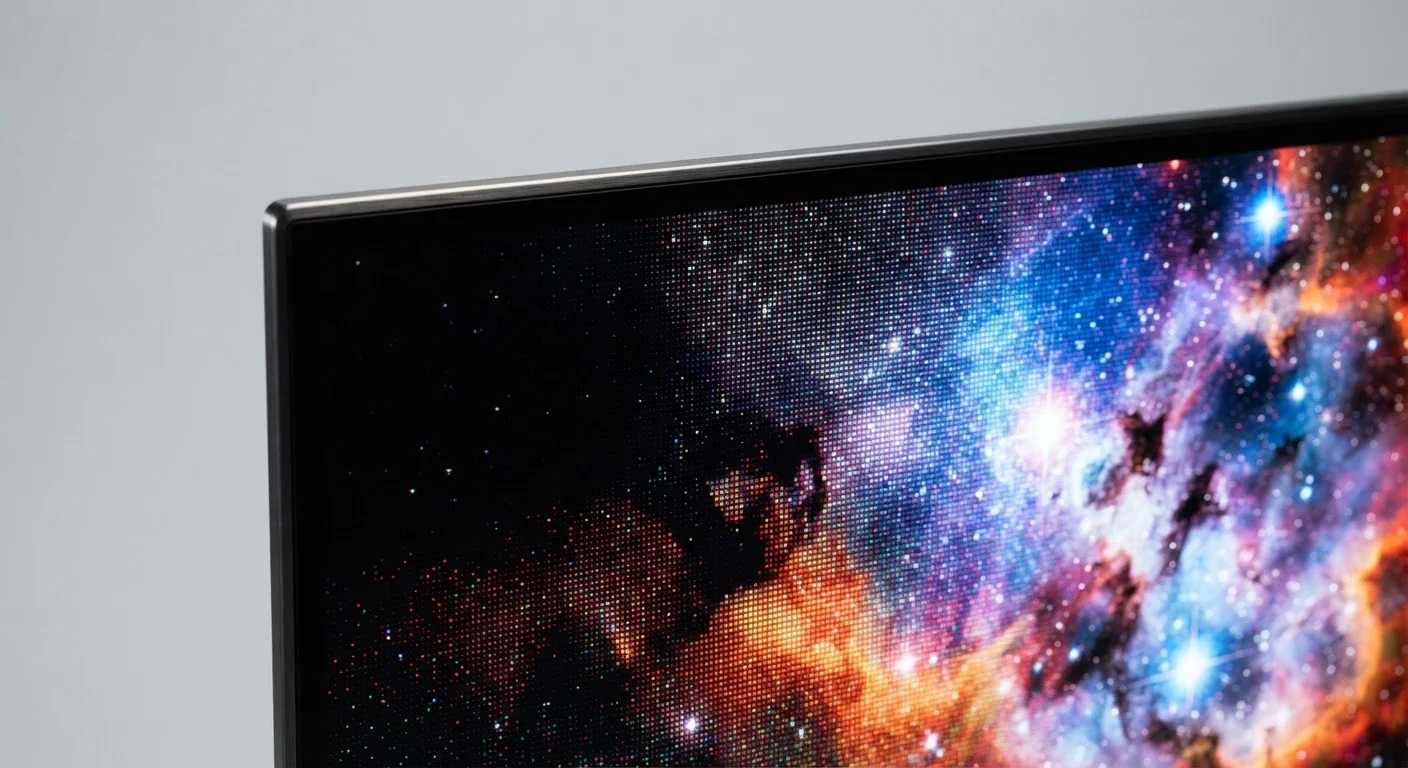
Option A
OLED
The self-lit, pixel-perfect panel.
Best for: Viewers who prioritize absolute black levels, high contrast, and wide viewing angles in darker rooms.
Option B
QLED / LCD
The bright, versatile backlit display.
Best for: Viewers who watch in bright rooms and want strong peak brightness at a range of price points.
The Foundation: How Each Panel Type Creates a Picture
Every TV image is built from millions of tiny pixels. The fundamental difference between panel types is where the light comes from - and that single engineering decision cascades into nearly every quality characteristic you notice on screen.
LCD (Liquid Crystal Display) is the oldest of the three terms and describes the core mechanism: a layer of liquid crystals that can be electrically aligned to block or pass light. Crucially, liquid crystals don't produce light themselves - they need a separate backlight, almost always built from LEDs today. The backlight shines through the crystal layer and color filters to produce the image you see.
QLED stands for Quantum Light-Emitting Diode, though in practice it describes an LCD panel with an added quantum dot layer - a film of microscopic semiconductor particles that convert blue LED backlight into a wider, more precise range of colors. The underlying technology is still LCD; QLED is an enhancement layered on top of it, not an entirely different architecture. For a broader breakdown of terms like these, see the Consumer Tech Glossary for plain-English definitions.
OLED (Organic Light-Emitting Diode) works on an entirely different principle. Each pixel contains organic compounds that emit light when an electric current passes through them. There is no separate backlight - every pixel is its own light source and can be switched off completely and independently.
Head-to-Head: Where Each Technology Wins and Loses
Understanding which panel performs best requires looking at specific picture quality attributes, not just marketing language.
| Criterion | OLED | QLED / LCD |
|---|---|---|
| Light source | Per-pixel self-emission | Dedicated LED backlight |
| Black level / contrast | Absolute black; near-infinite contrast | Dependent on local dimming quality |
| Peak brightness | Moderate; improving in newer panels | High; strong in bright rooms |
| Color volume | Wide, accurate color gamut | Quantum dots improve color precision |
| Viewing angle | Excellent; minimal color shift | Varies; VA panels narrow, IPS wider |
| Burn-in risk | Present with prolonged static images | Not a concern |
| Typical price range | Mid to premium | Entry to premium |
| Size availability | Growing but more limited | Very wide range of sizes |
Contrast and black levels are where OLED's architecture delivers its clearest advantage. When a pixel turns off entirely, it produces a black that registers as near-zero light output. LCD panels, even with advanced local dimming - a technique that dims backlight zones behind dark areas of the image - still emit some residual light, producing what's often called "black crush" or a gray haze in dark scenes.
Peak brightness swings the other way. Because LCD panels use a powerful dedicated backlight, high-end QLED sets can hit significantly higher peak brightness levels than current OLED panels. In a sunlit room, this translates to a punchier, more visible image.
Burn-in is a legitimate consideration for OLED. If a high-contrast static element - a channel logo, a game HUD, a news ticker - stays on screen for many hours repeatedly, the organic compounds in those pixels can degrade faster than surrounding ones, leaving a faint ghost image. Manufacturers have introduced pixel-shifting and screen-saver features to reduce this risk, but it remains a structural characteristic of the technology. LCD panels are not affected by burn-in.
What This Means When You're Choosing a TV
Panel type is a meaningful but not exclusive factor in TV quality. Equally important are the TV's image processor, local dimming implementation, HDR format support, and refresh rate - the same way a laptop's display quality depends on more than just screen resolution, as explored in Inside a Laptop.
A few practical considerations worth keeping in mind:
- Room lighting matters. OLED's contrast advantage is most perceptible in controlled or dark lighting. In bright rooms, a well-implemented QLED can look equally compelling.
- Viewing position. OLED panels generally maintain consistent color and brightness at wide angles. VA-type LCD panels - common in mid-range TVs - can show noticeable color shift when viewed from the side.
- Screen size availability. OLED manufacturing has historically been more constrained in very large sizes and at lower price points, though this has been changing as the technology matures.
- Content type. Cinematic content with varied dark scenes benefits most from OLED's contrast. Sports and broadcast content, often watched in bright rooms, may benefit more from QLED brightness.
No panel type is objectively superior across all conditions - the right choice depends on your room, your viewing habits, and the balance of trade-offs you find acceptable.
The content on this site is for informational purposes only and is not a substitute for professional advice. Always consult a qualified professional for guidance specific to your situation.