

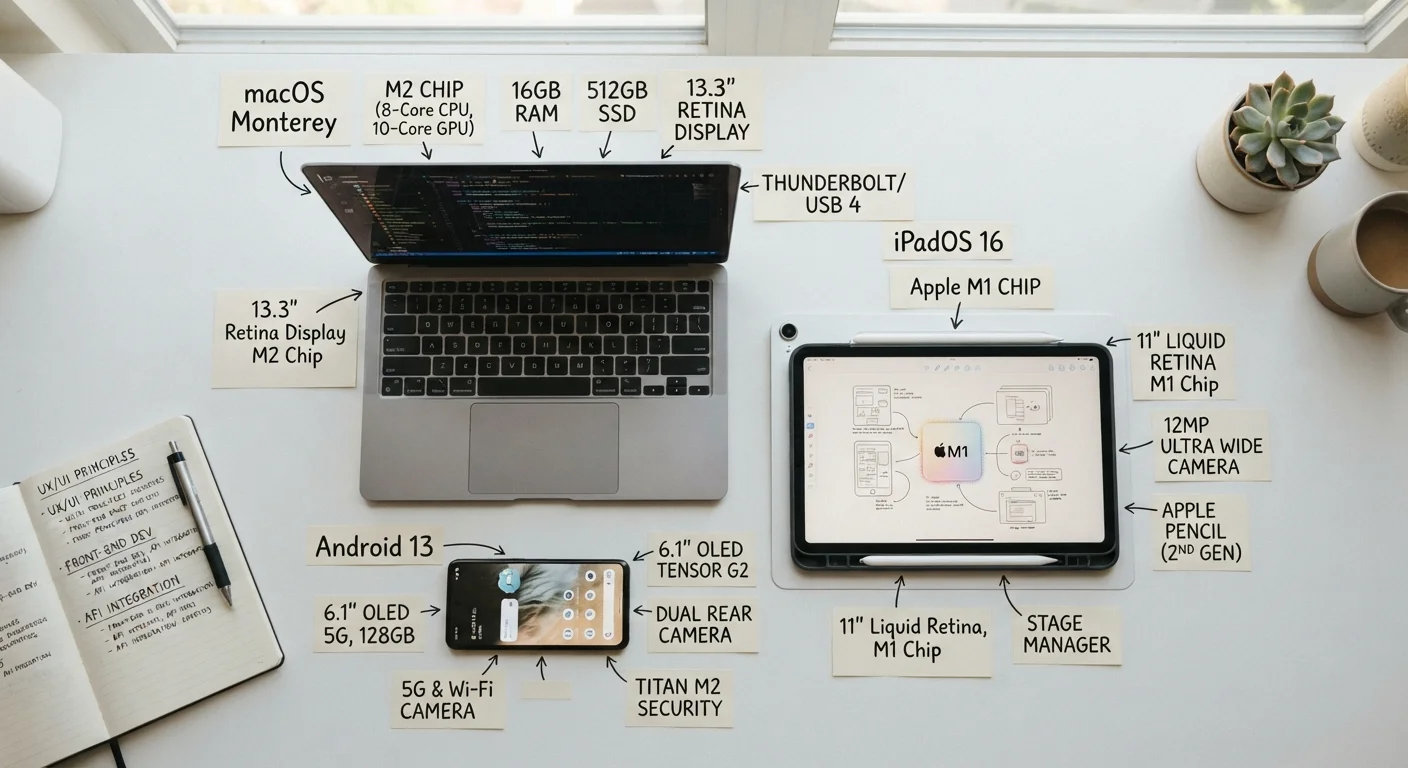
Why Spec Sheets Feel Like a Foreign Language
Every device listing - from a $200 tablet to a high-end laptop - arrives wrapped in a wall of abbreviations, frequencies, and architectural buzzwords. Manufacturers write these specs for engineers, not consumers, which means the numbers that most affect your daily experience are often buried among figures that matter far less.
This glossary covers 40 of the most common terms you'll encounter, grouped by category. For a deeper dive into how these parts work together, see our guide on what's inside a laptop and our smartphone components explainer. When you're ready to apply this vocabulary, reading a spec sheet without getting lost walks you through which numbers genuinely matter.
SoC (System on a Chip)
A single chip integrating the CPU, GPU, memory controller, and often wireless modems. Common in smartphones and tablets, it reduces size and power consumption compared to separate components.
RAM
Random Access Memory - the short-term working space your device uses while running apps. More RAM allows more tasks to run simultaneously without slowdown, but unused RAM beyond a device's typical workload provides no benefit.
NVMe SSD
A type of solid-state storage using the NVMe protocol over a PCIe connection. It is substantially faster than older SATA-based drives, resulting in quicker boot times and file transfers.
Refresh Rate (Hz)
The number of times per second a display redraws its image. Higher rates (90 Hz, 120 Hz) produce smoother motion when scrolling or playing video, though the benefit depends on the content being displayed.
HDR (High Dynamic Range)
A display and content standard supporting a wider range of brightness levels from dark shadows to bright highlights. The visual benefit is only realized when both the screen and the content are HDR-compatible.
TDP (Thermal Design Power)
Expressed in watts, this figure represents the maximum sustained heat a processor generates. It reflects how demanding a chip's cooling requirements are and correlates with power consumption under load.
IP Rating
Ingress Protection rating - a two-digit code certifying a device's resistance to dust (first digit) and water (second digit). IP68, for example, indicates full dust protection and submersion resistance under manufacturer-specified conditions.
MU-MIMO
Multi-user, multiple input, multiple output - a Wi-Fi technology allowing a router and device to manage multiple simultaneous data streams. It improves network efficiency when several devices are connected at once.
UFS (Universal Flash Storage)
A flash storage standard used in smartphones, faster than the older eMMC standard. Higher version numbers (UFS 3.1, UFS 4.0) indicate greater read/write speeds for tasks like loading apps and transferring files.
PPI (Pixels Per Inch)
Pixel density - the number of pixels packed into one inch of screen. Higher PPI produces sharper images and text, though the perceptible improvement diminishes at typical viewing distances beyond roughly 300 PPI.
Thunderbolt
A high-bandwidth port protocol developed by Intel, using USB-C connectors. It supports fast data transfer, video output, and powering docks - but a USB-C port is not automatically Thunderbolt-capable.
MIL-SPEC (MIL-STD-810)
A U.S. military testing standard for durability covering shock, vibration, humidity, and temperature extremes. Manufacturers select which tests to apply, so MIL-SPEC certification does not guarantee a uniform level of protection.
Processors, Memory, and Storage
These terms describe the compute engine and working space inside your device - the specs most directly tied to speed and responsiveness.
- CPU (Central Processing Unit): The general-purpose processor that runs the operating system and applications. Core count and clock speed (GHz) are its most-cited metrics.
- GPU (Graphics Processing Unit): Handles rendering images, video, and increasingly, AI tasks. May be integrated (sharing memory with the CPU) or discrete (its own dedicated chip and VRAM).
- SoC (System on a Chip): A single silicon package combining CPU, GPU, memory controller, and often a modem. Common in smartphones and tablets.
- RAM (Random Access Memory): Short-term working memory. More RAM allows more apps or browser tabs to stay active simultaneously without slowing down.
- LPDDR (Low-Power Double Data Rate): The RAM standard used in mobile devices; the version number (LPDDR4, LPDDR5) indicates generation and speed.
- Storage capacity (GB / TB): Total space for your files, apps, and OS. Gigabytes (GB) and terabytes (TB) measure how much data a device can hold.
- NVMe SSD: A fast solid-state drive using the NVMe protocol over a PCIe bus - significantly quicker to read and write data than older SATA SSDs.
- eMMC: Embedded MultiMediaCard storage, common in budget devices. Slower than NVMe but lower cost and power consumption.
- UFS (Universal Flash Storage): A mobile storage standard faster than eMMC; higher version numbers (UFS 3.1, UFS 4.0) indicate greater throughput.
- Cache: A small, extremely fast memory layer built into the CPU that stores frequently accessed data to reduce processing delays.
Display Specifications
Display specs directly affect what you see every day - yet they're among the most misused numbers in marketing.
| Standard HD resolution | 1920 × 1080 pixels |
| Standard refresh rate | 60 Hz |
| High refresh rate range | 90-144 Hz |
| Typical indoor brightness threshold | 400-500 nits |
| Outdoor readability threshold | 1,000+ nits |
| PPI perceptibility limit (typical distance) | ~300 PPI |
- Resolution (e.g., 1920×1080): The number of pixels across width and height. Higher resolution means more detail, but only meaningfully so relative to screen size.
- PPI (Pixels Per Inch): Pixel density. A higher PPI generally means sharper text and images; the benefit becomes less visible beyond roughly 300 PPI at typical viewing distances.
- Refresh rate (Hz): How many times per second the display redraws its image. 60 Hz is standard; 90-144 Hz produces smoother scrolling and motion.
- OLED / AMOLED: Display technologies where each pixel emits its own light, enabling true black levels and high contrast. AMOLED is Samsung's branded OLED variant.
- IPS LCD: A liquid crystal display type offering accurate colors and wide viewing angles, though contrast ratios are lower than OLED.
- HDR (High Dynamic Range): A display capability supporting a wider range of brightness levels, producing more detail in highlights and shadows when the content is HDR-encoded.
- Nits: A unit of display brightness. Higher peak nit values improve outdoor readability; 400-500 nits suits most indoor use, while 1,000+ nits aids direct sunlight visibility.
- Color gamut (sRGB / DCI-P3): The range of colors a display can reproduce. sRGB is the web standard; DCI-P3 is wider and used in professional video and HDR content.
Connectivity and Wireless Standards
These terms govern how your device communicates - with the internet, with peripherals, and with other gadgets. For fuller context on wireless generations, see our explainer on mobile data from 3G to 5G, and visit our Internet & Connectivity hub for related coverage.
- Wi-Fi 6 / Wi-Fi 6E (802.11ax): The current mainstream Wi-Fi standard. Wi-Fi 6E adds access to the 6 GHz band, reducing congestion in dense environments.
- Bluetooth version: Higher versions (5.0, 5.3) offer lower power consumption, greater range, and the ability to connect multiple audio devices simultaneously.
- USB-C: A reversible connector standard. The port shape alone doesn't define speed - check the USB version (USB 3.2, USB4) and wattage supported for charging.
- Thunderbolt (3 / 4 / 5): Intel's high-bandwidth protocol using USB-C connectors. Supports fast data transfer, external displays, and docks. Not all USB-C ports are Thunderbolt.
- 5G Sub-6 vs. mmWave: Sub-6 GHz 5G offers broad coverage similar to 4G LTE. mmWave delivers much higher speeds but with very limited range and poor building penetration.
- NFC (Near Field Communication): Short-range wireless used for contactless payments and quick device pairing, typically active within a few centimeters.
- UWB (Ultra-Wideband): A precision location and ranging technology enabling centimeter-accurate spatial awareness, used in features like precise device finding.
- MU-MIMO: Multi-user, multiple input, multiple output - allows a Wi-Fi router and device to handle multiple data streams simultaneously, improving throughput in busy networks.
Smart home devices introduce their own vocabulary. Our guide to smart home protocols explains how standards like Zigbee, Matter, and Thread fit together.
Battery, Performance, and Build Terms
The final cluster of terms covers power, sustained performance, and physical construction - areas where marketing language often obscures practical trade-offs. Our article on trade-offs in thin laptops shows how these specs interact in real product decisions.
- mAh (milliampere-hour): A measure of battery capacity. Higher mAh generally means longer runtime, though actual life depends on screen brightness, processor efficiency, and workload.
- Watt-hour (Wh): A more precise battery capacity metric used in laptops. Two batteries with the same Wh but different voltages will deliver the same energy.
- TDP (Thermal Design Power): The maximum heat (in watts) a processor generates under sustained load - a proxy for both power draw and the cooling system required.
- Turbo / Boost clock: A processor's maximum short-burst frequency above its base clock, sustainable only when thermal headroom allows.
- IP rating (e.g., IP68): Ingress Protection rating. The first digit rates dust resistance (6 = fully dust-tight); the second rates water resistance (8 = submersible beyond 1 meter, per manufacturer spec).
- Gorilla Glass / sapphire: Display cover materials. Gorilla Glass is chemically strengthened; sapphire is extremely scratch-resistant but heavier and more brittle.
- Anodized aluminum: A surface treatment for metal chassis that hardens the exterior layer, improving scratch resistance while maintaining electrical grounding properties.
- MIL-SPEC (MIL-STD-810): A U.S. military durability test standard. Devices advertised as MIL-SPEC have passed certain shock, vibration, and temperature tests - though manufacturers choose which subset of tests to apply.
For software-side terminology that appears alongside hardware specs, the software jargon guide and the broader Software & Apps hub provide useful companion reading.
The content on this site is for informational purposes only and is not a substitute for professional advice. Always consult a qualified professional for guidance specific to your situation.