

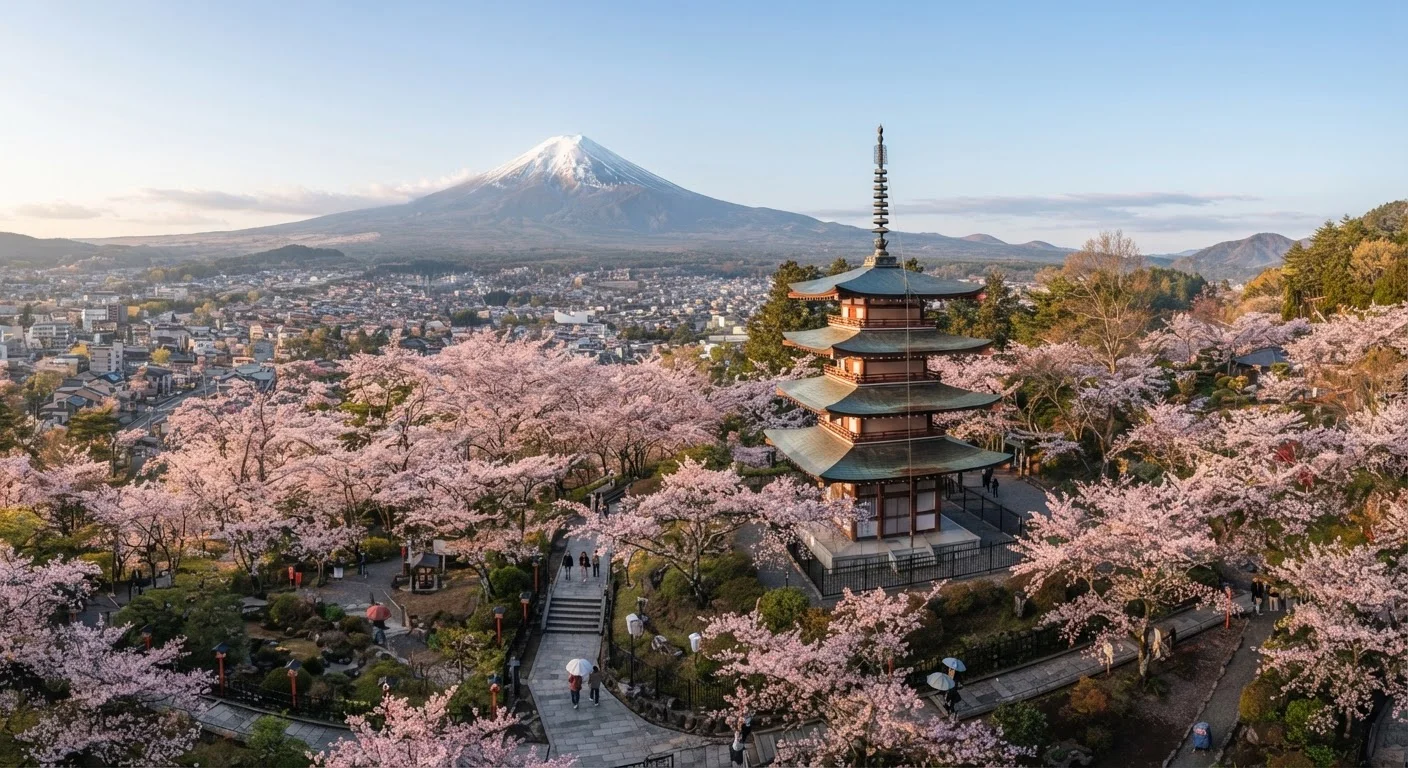
Start With Season: Everything Flows From This Choice
Before you research accommodations or draft an itinerary, pick your travel window — and understand exactly what you're choosing. Japan's seasons are genuinely distinct, and each carries a different set of trade-offs.
Spring (late March–early May) brings cherry blossoms, mild temperatures, and the highest domestic and international visitor volumes. Booking accommodations three to six months out is not excessive during peak bloom weeks. Autumn (late October–mid-November) delivers vivid foliage, cooler air, and a comparable crowd surge. Summer (July–August) is hot, humid, and punctuated by regional festivals — manageable if you're heat-tolerant and plan indoor breaks. Winter offers sparse crowds, excellent snow sports in northern regions like Hokkaido, and a very different aesthetic for temples and gardens.
Each season also affects pricing. High-demand periods — particularly cherry blossom season — push accommodation rates up sharply in Kyoto and Tokyo. Traveling just before or after peak windows can offer a similar experience with meaningfully lower stress. See our guide on trip length trade-offs for help matching your window to your available time.
Rail Pass or Point-to-Point: Make This Call Early
The Japan Rail (JR) Pass is one of the most discussed topics in Japan trip planning — and one of the most frequently misapplied. The pass grants unlimited travel on most JR-operated trains, including the Shinkansen bullet train network, for a fixed number of days.
It makes financial sense when you're covering significant ground: Tokyo to Kyoto to Hiroshima to Osaka, for example. For shorter trips or those centered in a single city, point-to-point IC card travel (using a rechargeable transit card like Suica or Pasmo) is typically cheaper and more flexible. Run the actual fare math against the pass cost before purchasing.
One practical note: the JR Pass must be purchased outside Japan (though this rule has been adjusted periodically — verify current policy through official JR sources before your trip). Reserve Shinkansen seats as soon as your pass activates; reserved cars fill quickly during high-season travel.
For a broader framework on organizing the logistics layer of any trip, the full trip planning strategy guide covers booking sequencing and contingency thinking.
City-Rural Balance: Resisting the All-Cities Itinerary
Japan's cities — Tokyo, Osaka, Kyoto, Hiroshima — are genuinely compelling, and it's tempting to fill every day with urban exploration. But the country's rural and smaller-city experiences are where many travelers find the most memorable moments.
The Nakasendo trail between Kyoto and Tokyo passes through preserved post towns like Magome and Tsumago. The Noto Peninsula in Ishikawa Prefecture offers a working coastal Japan largely untouched by mass tourism. The mountain town of Nikko, accessible by train from Tokyo, contains some of the country's most elaborate shrine architecture. Overnight stays in traditional ryokan inns — with kaiseki dining and communal baths — are far more accessible outside major tourist corridors.
A practical structure: anchor two or three nights in a major city for museums, neighborhoods, and food density, then allocate one or two nights in a smaller or rural destination nearby before moving on. This rhythm prevents the itinerary from becoming a checklist of famous spots. Our Tokyo neighborhood guide shows how this applies specifically to the capital.
Etiquette and Entry: What to Understand Before You Land
Japan has well-documented social customs, and while visitors are rarely expected to be perfect, a basic working knowledge prevents genuine discomfort — for you and for locals.
Key areas to review: removing shoes when entering homes, ryokan, and some traditional restaurants; not eating while walking in most contexts; keeping voices low on public transit; and handling cash carefully (passing money with both hands, not directly into another person's palm). Tipping is not practiced and can cause confusion.
On the logistics side: Japan remains significantly cash-reliant in rural areas and at many smaller establishments, even as card acceptance has grown in urban settings. Carrying yen is not optional — plan accordingly. ATMs at 7-Eleven and Japan Post locations reliably accept foreign cards.
Entry requirements — including any visa conditions applicable to US passport holders — should be verified through official government sources well before booking, as policies can change. For a grounded starting framework on pre-trip documentation, see the trip planning from scratch guide.
Once you've locked in the foundational decisions above, building a day-by-day structure becomes much more straightforward. The anatomy of a well-organized itinerary explains how to sequence and pace what you've planned without overloading each day.
The content on this site is for informational purposes only and is not a substitute for professional advice. Always consult a qualified professional for guidance specific to your situation.