

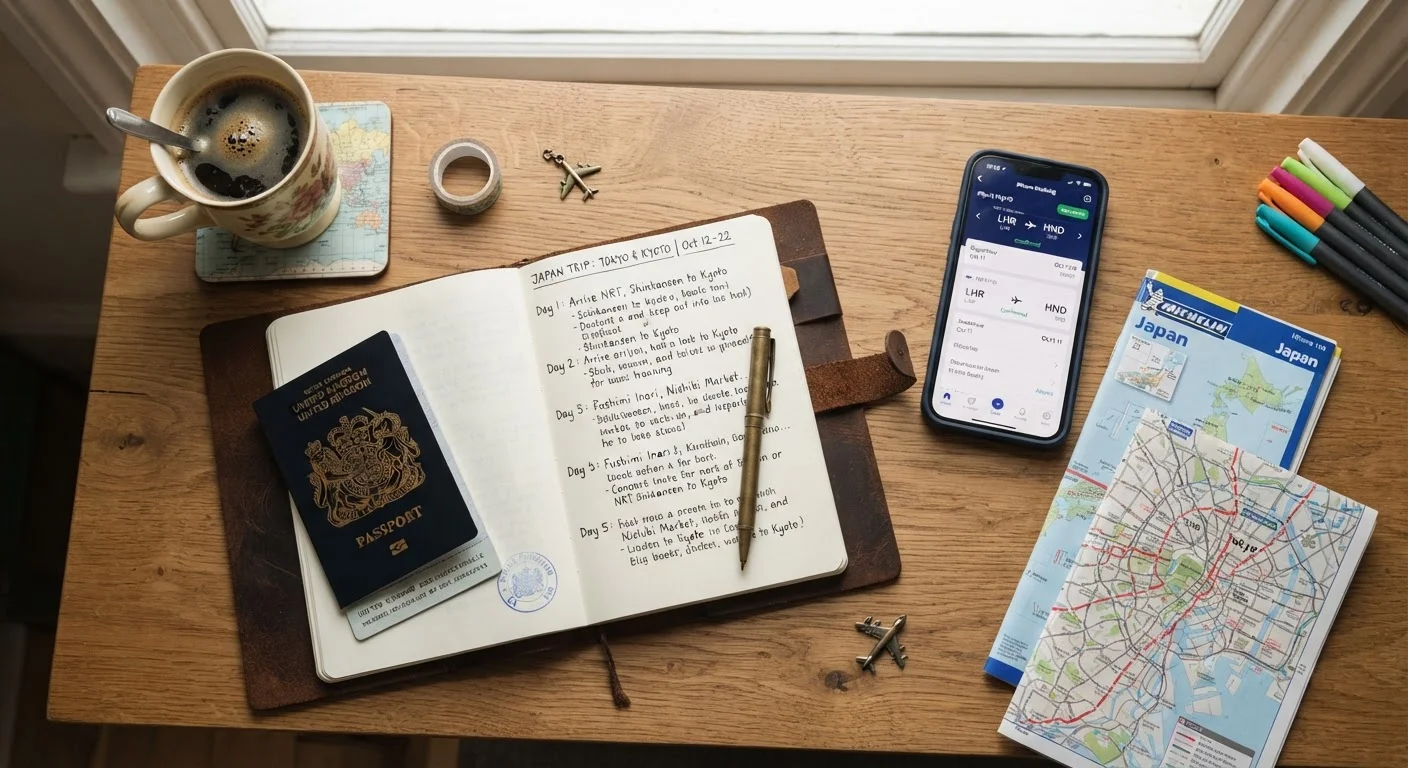
Start With Intent: Defining Your Trip's Purpose
The most overlooked step in trip planning happens before any research begins: deciding what you actually want from the trip. Relaxation, cultural immersion, adventure, family bonding, and urban exploration each pull your planning in different directions. Without a clear intent, itineraries tend to become over-stuffed, budgets drift, and the trip fails to satisfy on any dimension.
Start by writing down two or three concrete priorities. If you're traveling to a culturally dense destination, consider what depth of engagement you're after. Our guide to Tokyo's neighbourhoods and seasons illustrates how defining your interests — food culture, architecture, nightlife — shapes which districts and timing make sense. The same logic applies everywhere.
Intent also determines trip length, travel pace, and the balance between pre-booked structure and spontaneity. A recovery-focused trip calls for fewer daily commitments; an urban exploration trip may justify a tight, neighbourhood-by-neighbourhood schedule.
Write your trip's purpose in a single sentence before opening any booking site. If you can't articulate it clearly, your itinerary will reflect that ambiguity in ways that are hard to fix later.
Experienced trip planners consistently find that intent-setting before research reduces itinerary revision time and improves satisfaction with the final experience.
When researching entry requirements, go directly to the destination country's official embassy or immigration portal rather than relying on aggregated travel sites — rules change and third-party summaries lag behind.
Entry requirement errors are among the least forgiving travel mistakes; an outdated summary from a travel blog carries no authority at the border.
Building a Realistic Travel Budget
Underestimating travel costs is one of the most consistent sources of post-trip regret. A functional budget accounts for more than flights and hotels — it tracks every spending category likely to arise.
- Transportation: Flights and intercity trains are visible, but local transit, taxis, and airport transfers add up quickly.
- Accommodation: Price per night multiplied by stay length, plus any resort or city taxes often billed separately.
- Food and drink: Budget a daily per-person estimate based on realistic dining habits, not just what you hope to spend.
- Activities and entry fees: Museums, tours, national parks, and cultural experiences all carry costs that are easy to undercount during research.
- Currency exchange and fees: Foreign transaction fees and unfavorable exchange rates can erode a budget silently.
- Emergency buffer: A contingency reserve of 10–15% of total budget accounts for delays, unexpected costs, or itinerary changes.
For trips that mix urban and rural destinations — like a visit that combines cities with cultural complexity — see our look at how engagement with a place affects what you spend and experience. Deeper engagement often costs less than surface-level tourism.
10–15%
Recommended emergency budget reserve
Travel finance advisors generally recommend holding back 10–15% of total trip budget as a contingency buffer for unexpected costs.
6 months
Passport validity required by many countries
Many destinations require at least six months of passport validity beyond your intended departure date — a commonly missed requirement.
Research, Booking Order, and Timing
There's a logical sequence to locking in travel arrangements that minimizes conflict and wasted spend. Booking out of order — securing a tour before confirming where you'll sleep, for example — creates unnecessary rigidity and rework.
- Anchor bookings first: Flights and accommodations set your travel window. Book these before anything else.
- Confirm ground transportation: Rail passes, car rentals, or intercity buses should be arranged once your arrival and departure dates are fixed.
- Book high-demand experiences: Popular museums, guided tours, and ticketed attractions often sell out weeks in advance. Secure these early.
- Leave flex time: Avoid booking every hour. Unstructured time lets you follow local recommendations, recover from travel fatigue, or simply linger somewhere unexpected.
Research quality matters as much as booking order. Reliable sources include official tourism boards, national park websites, and embassy portals. For a comprehensive reference on the terminology and concepts you'll encounter while planning, the travel planning glossary covers booking concepts, document types, and trip categories in plain language.
Documents, Safety, and Entry Requirements
Entry requirements are among the highest-stakes elements of travel planning because errors are rarely recoverable at the border. Every traveler should verify the following through official government sources — not travel blogs or third-party summaries:
- Passport validity: Many countries require six months of validity beyond your travel dates. Check your passport now, not two weeks before departure.
- Visa requirements: Visa-on-arrival, e-Visa, and advance visa requirements differ by destination and nationality. The U.S. Department of State and destination country's embassy websites are authoritative sources.
- Health and vaccination requirements: Some destinations require proof of specific vaccinations. Consult a travel medicine professional or your healthcare provider for personal guidance.
- Travel advisories: Government-issued advisories reflect current safety conditions. They should inform — though not necessarily dictate — your decision-making.
Make digital and physical copies of all critical documents: passport, itinerary, accommodation confirmations, and insurance policy. Store copies separately from the originals.
Travel insurance deserves serious consideration, not just as a financial tool but as a contingency enabler. Understand what your policy covers — cancellation, medical evacuation, lost baggage — and what it excludes before you buy. For broader travel skills and safety practices, the Travel Know-How hub covers logistics and on-the-road habits worth reviewing before any trip.
Day-Of Logistics and Contingency Habits
Good planning doesn't end when you board the flight. A set of consistent day-of habits can be the difference between a manageable disruption and a derailed trip.
Before each travel day: Confirm reservations the evening prior. Check transport status — flight delays, rail disruptions, and road closures often have advance notice. Save offline copies of maps and confirmation numbers; cellular service is never guaranteed.
During transit: Keep essential items — medications, chargers, a day's change of clothes — in carry-on luggage rather than checked bags. If driving, review our driving safety practices before navigating unfamiliar roads, especially in regions where traffic laws or road conditions differ significantly from home.
Contingency mindset: Identify your fallback for the two or three most likely disruptions: flight cancellation, accommodation problem, illness. Knowing the nearest urgent care, the airline's rebooking line, and the local emergency number in advance costs nothing and saves significant time under pressure.
Travelers who plan with contingencies built in — not added as afterthoughts — consistently report lower stress and greater satisfaction, regardless of whether anything goes wrong. The plan is a scaffold, not a script.
The content on this site is for informational purposes only and is not a substitute for professional advice. Always consult a qualified professional for guidance specific to your situation.