

Our Verdict
No single connectivity method is universally superior — each suits a different traveler profile and trip type. Local SIMs reward budget-conscious travelers comfortable with a bit of setup, eSIMs suit frequent travelers who want flexibility without physical hassle, and carrier roaming fits short or business trips where simplicity outweighs cost.
| Best for | Recommended |
|---|---|
| Budget travelers on longer stays | Local SIM card |
| Frequent or multi-destination travelers wanting convenience | eSIM |
| Short trips or travelers prioritizing zero setup | Carrier roaming add-on |
| Travelers visiting remote or rural areas | Research local carrier coverage maps before choosing any option |
How Each Connectivity Option Actually Works
When you travel internationally, your home carrier's network generally doesn't extend to the destination country. To stay connected, you have three main paths: purchasing a local SIM card, activating an eSIM plan, or enabling a roaming add-on through your existing carrier. Each operates on a different underlying model.
Local SIM cards are physical chips you buy at your destination — at airport kiosks, convenience stores, or carrier shops. You remove your home SIM, insert the local one, and your device connects to a local network. Data allowances and call credits are prepaid.
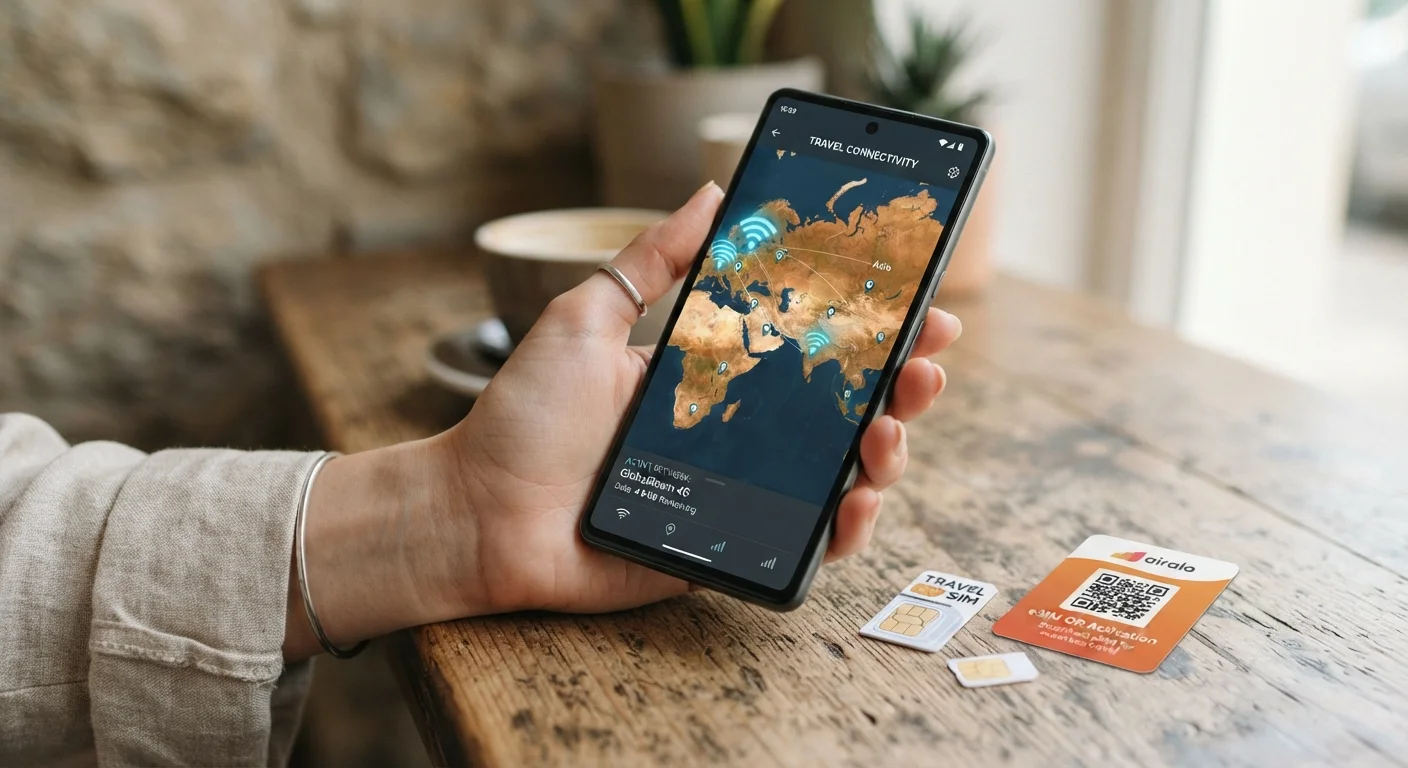
eSIMs (embedded SIMs) are digital profiles stored inside compatible devices. Instead of swapping hardware, you scan a QR code or download a profile from a travel eSIM provider, and your phone connects to a partner network abroad. Some phones support dual SIM, meaning you can keep your home number active while using the eSIM for data. For a deeper look at how mobile network generations affect the speeds you'll experience, see our explainer on mobile data technologies.
Carrier roaming add-ons work by keeping your existing SIM active and paying your home carrier to extend service internationally. Your number stays the same, and your device automatically connects to a partner network in the destination country — no new SIM or profile needed.
Comparing Cost, Setup, and Flexibility
These three options differ meaningfully across cost, convenience, and control.
| Local SIM Card | eSIM | Carrier Roaming Add-On | |
|---|---|---|---|
| Setup required | Buy & swap card on arrival | Download profile before departure | Activate via carrier app or call |
| Phone requirement | Unlocked device | eSIM-compatible device | Any phone on your carrier plan |
| Home number access | Lost while SIM is swapped | Retained if dual SIM supported | Fully retained |
| Typical cost per GB | Generally lowest | Low to moderate | Generally highest |
| Convenience | Moderate — physical setup | High — fully digital | Highest — no new setup |
| Multi-country flexibility | One card per country | Regional plans available | Depends on carrier agreements |
| Coverage control | Choose local carrier directly | Depends on provider's partners | Depends on carrier agreements |
Local SIMs generally deliver the lowest cost per gigabyte, particularly on longer stays, but they require an unlocked phone — a device not tied to a specific carrier. If your phone is still locked to your home carrier, the local SIM won't activate. You'll also lose access to your home number while the local SIM is inserted, which matters if you're expecting calls or two-factor authentication codes sent via SMS.
eSIM plans occupy a middle ground: setup happens before you leave, your home number can remain active on a physical SIM simultaneously, and there's no risk of losing a small card. The trade-off is that not all phones support eSIM, and coverage depends on which local networks the eSIM provider has partnered with — something worth checking per destination.
Carrier roaming add-ons are the path of least resistance. You activate a plan through your carrier's app or website, and the phone handles everything. The downside is cost: roaming plans commonly charge more per gigabyte than local alternatives, and daily or weekly fees can accumulate quickly on longer trips. These hidden costs are worth factoring into your overall travel budget — our piece on underestimated trip costs covers this in detail.
Coverage, Security, and Practical Considerations
Check Coverage Maps Before You Commit
Before purchasing any plan, look up the specific local network your option will connect through — not just the reseller's branding. Coverage maps are usually available on the local carrier's official website. In mountainous regions, rural areas, or island destinations, network reach can vary significantly between carriers operating in the same country.
Coverage quality is one factor travelers frequently overlook. A plan's price and data allowance are only meaningful if the underlying network reaches where you'll actually be. Each option — local SIM, eSIM, or roaming — connects you to a local carrier in the destination country. The networks vary in rural versus urban reach, and one plan's partner network may have significantly weaker coverage than another's in the same country.
Before committing, look up coverage maps for the local carriers your option will use, not just the reseller's marketing page. Government tourism resources and independent traveler forums often surface reliable real-world feedback.
Security considerations are worth a moment's thought too. Public Wi-Fi remains an alternative when mobile data isn't available, but it carries risks if used for sensitive tasks like banking or accessing personal accounts. Pairing a connectivity plan with good habits — such as using a VPN on public networks and protecting your devices — matters. Our guide on keeping sensitive documents and payments safe while travelling covers the digital security side of travel alongside the physical.
Finally, confirm these practical details before your trip:
- Whether your phone is unlocked (for local SIM use)
- Whether your device supports eSIM (check manufacturer specs)
- Whether your carrier's roaming add-on auto-renews or caps usage
- Whether SMS-based two-factor authentication will still work on your home number
Choosing the Right Option for Your Trip
The right choice depends on your trip length, destination, device, and how much friction you're willing to accept at setup.
For a weekend city trip where simplicity matters most, a roaming add-on through your existing carrier may be worth the premium. For a two-week stay in a single country, a local SIM typically pays for itself quickly in data savings. For multi-country itineraries or frequent travelers who want a ready-to-go solution, a travel eSIM plan — particularly a regional one covering multiple countries — often offers the best balance of convenience and cost.
If you're traveling as part of a group, connectivity planning interacts with broader logistics like shared navigation and group messaging — something our comparison of solo versus group travel explores from a broader planning perspective.
Whatever option you choose, verify entry and network conditions through official sources close to your departure date, as carrier partnerships and local regulations can change. No connectivity plan is a guarantee of coverage — treating it as a strong probability rather than a certainty will set realistic expectations for your trip.
The content on this site is for informational purposes only and is not a substitute for professional advice. Always consult a qualified professional for guidance specific to your situation.