

Our Verdict
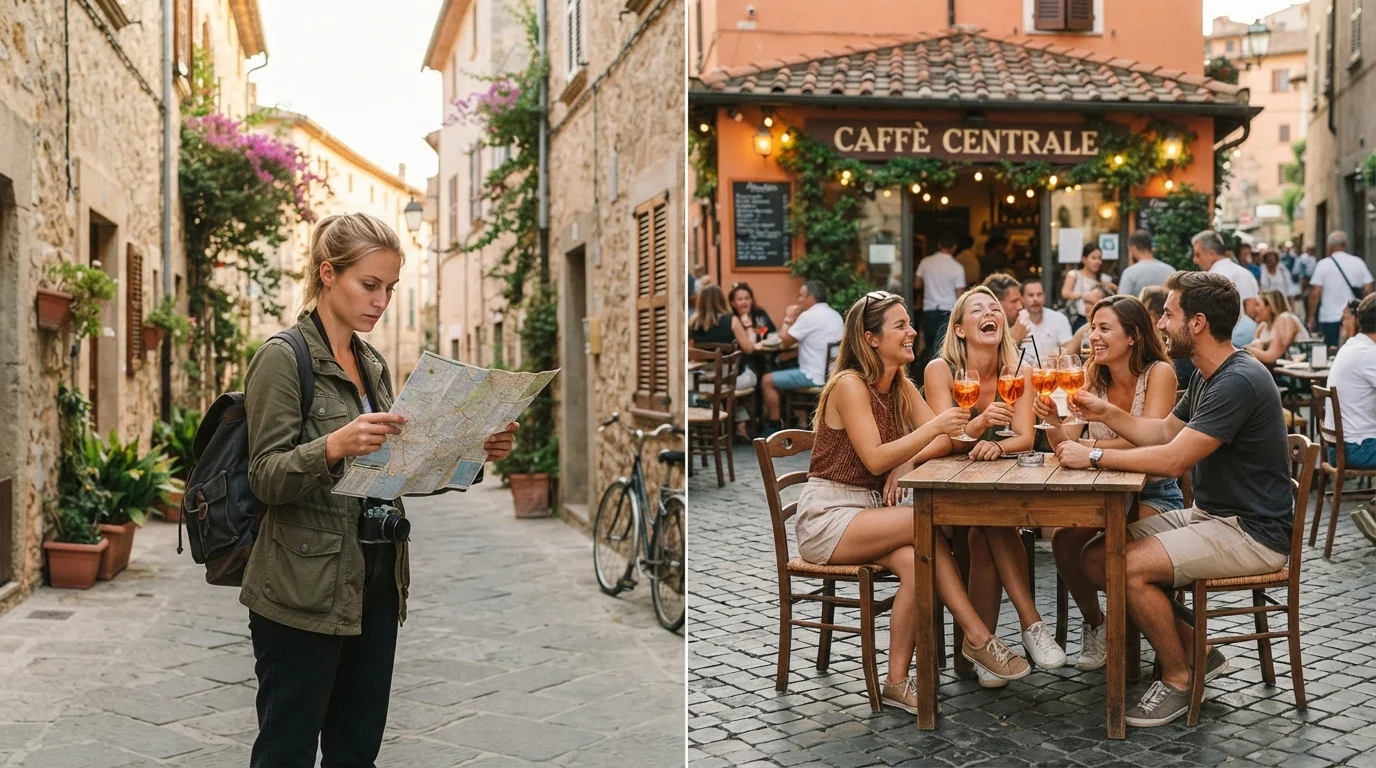
Solo travel suits those who prioritize personal freedom, self-set pacing, and immersive local experiences — and who are prepared to manage higher per-person costs and greater logistical responsibility. Group travel works best when budget efficiency, shared decision-making, and built-in social connection outweigh the trade-off of reduced flexibility. For most travelers, the honest answer is situational: neither format dominates across all trip types.
Solo travel is best for self-directed, experienced travelers; group travel is better suited to first-timers, budget-conscious travelers, or those visiting regions where safety in numbers is a genuine consideration.
The Core Trade-off: Freedom vs. Shared Resources
The fundamental difference between solo and group travel isn't just about company — it's about who controls the decisions and who shares the costs. Solo travelers hold every key: when to wake up, what to skip, how long to linger. Group travelers exchange some of that control for shared logistics, split expenses, and a built-in support network.
Understanding which trade-off matters most to you is the most useful first step in choosing a format. For more on how trip format intersects with overall planning strategy, see the full picture of trip planning.
Complete control over itinerary and daily pace
Solo travelers make every decision independently — no negotiating restaurant choices, activity timing, or rest days. This makes it far easier to pursue niche interests or adjust on the fly.
Stronger incentive for local interaction
Traveling alone removes the social buffer of companions, which tends to push solo travelers toward conversations with locals, fellow travelers, and hosts more readily than group dynamics allow.
Shared costs lower per-person expenses significantly
Group travelers split accommodation, ground transport, and sometimes food costs, making destinations and accommodation categories accessible that would strain a solo budget.
Built-in mutual support and problem-solving
When logistics break down — missed trains, language barriers, medical concerns — a group provides immediate support capacity that a solo traveler must arrange independently.
Easier to access group-rate experiences
Private tours, vehicle rentals, and guided excursions often have per-person rates that decrease meaningfully with group size, unlocking options that don't scale down for solo travelers.
Cost: Where the Numbers Actually Land
Group travel has a structural cost advantage in several categories. Accommodation is the clearest: shared rooms, rental houses, or multi-occupancy lodging dramatically reduce per-person nightly costs. Ground transportation — taxis, rental vehicles, private transfers — splits evenly. Travelers in groups of four or more can access vehicle rental tiers and private guide rates that solo travelers cannot.
Solo travel, by contrast, carries a single-occupancy premium almost everywhere. Many hotels charge a flat room rate regardless of occupancy. This surcharge is a real and persistent cost that solo travelers need to account for honestly. Building a travel budget that holds up walks through how to factor in these kinds of structural differences before you book.
~52%
Solo travelers who are women
Solo Female Travelers' surveys consistently find women represent a majority of solo travelers globally, reflecting how widespread the format has become beyond a niche demographic.
2–4x
Accommodation cost multiple for solo vs. shared
Depending on destination and lodging type, solo travelers often pay two to four times more per night for equivalent accommodation compared to travelers sharing a room or rental property.
Solo travelers pay a consistent single-occupancy premium
Hotels and many lodging types charge a flat room rate regardless of how many guests occupy it. This cost cannot be engineered away and adds up significantly over multi-week trips.
Group itineraries require constant consensus
Decisions that take a solo traveler seconds — where to eat, when to leave, what to skip — require agreement across multiple people with different preferences and energy levels.
Solo travelers carry full logistical responsibility
Every contingency — missed connections, illness, navigation failures — rests on one person. There is no built-in backup when things go wrong.
Group dynamics can generate interpersonal friction
Spending extended time with travel companions in unfamiliar, sometimes stressful environments tests relationships. Pace mismatches and spending differences are among the most common friction points.
Safety and Risk Management
Safety calculus differs meaningfully between the two formats. Group travelers benefit from mutual oversight — someone notices if you don't return, and there's collective problem-solving capacity when things go wrong. This is especially relevant in destinations with limited English-language support, complex transportation networks, or areas where petty crime is a documented concern.
Solo travelers face greater exposure in those same scenarios but tend to develop sharper situational awareness and more deliberate contingency planning as a result. Many solo travelers — particularly those visiting regions flagged in government travel advisories — rely on digital tools, check-in protocols with contacts at home, and well-researched accommodation choices to compensate. See staying connected abroad for a breakdown of reliable connectivity options that matter more when you're on your own.
For broader safety habits and on-the-road skills, the Travel Know-How hub covers logistics and risk mitigation across a range of travel scenarios.
Government Travel Advisories Are a Starting Point
Before finalizing any trip format — solo or group — check your government's official travel advisory for your destination. The U.S. Department of State publishes country-level advisories at travel.state.gov. These advisories don't replace personal risk assessment, but they flag conditions — civil unrest, health risks, entry restrictions — that should factor into your planning regardless of how you're traveling.
Flexibility, Pacing, and the Social Experience
Flexibility is where solo travel has its clearest advantage. Changing plans mid-trip — staying an extra day somewhere unexpected, skipping an overrated stop, adjusting for weather or energy — is straightforward when you're accountable only to yourself. Group itineraries, by contrast, require consensus. The more travelers involved, the more friction arises around even small decisions.
That said, group travel provides something solo travel structurally cannot: spontaneous shared experience. Meals, unexpected discoveries, and moments of difficulty are qualitatively different when processed collectively. This matters more on some trip types than others. A remote hiking itinerary through Iceland or a multi-island Greek island route — where logistics are complex and conditions variable — may feel genuinely isolating solo, while a city break to Rome or Lisbon offers enough ambient social texture to offset that. For destination-specific context, see Rome in a weekend and coastal Greece considerations.
Trip length also interacts with format. Longer trips often reward the flexibility of solo travel; shorter breaks may benefit from the pre-agreed structure a group provides. Planning a long trip vs. a short break covers how trip duration changes the planning logic across the board.
The content on this site is for informational purposes only and is not a substitute for professional advice. Always consult a qualified professional for guidance specific to your situation.