

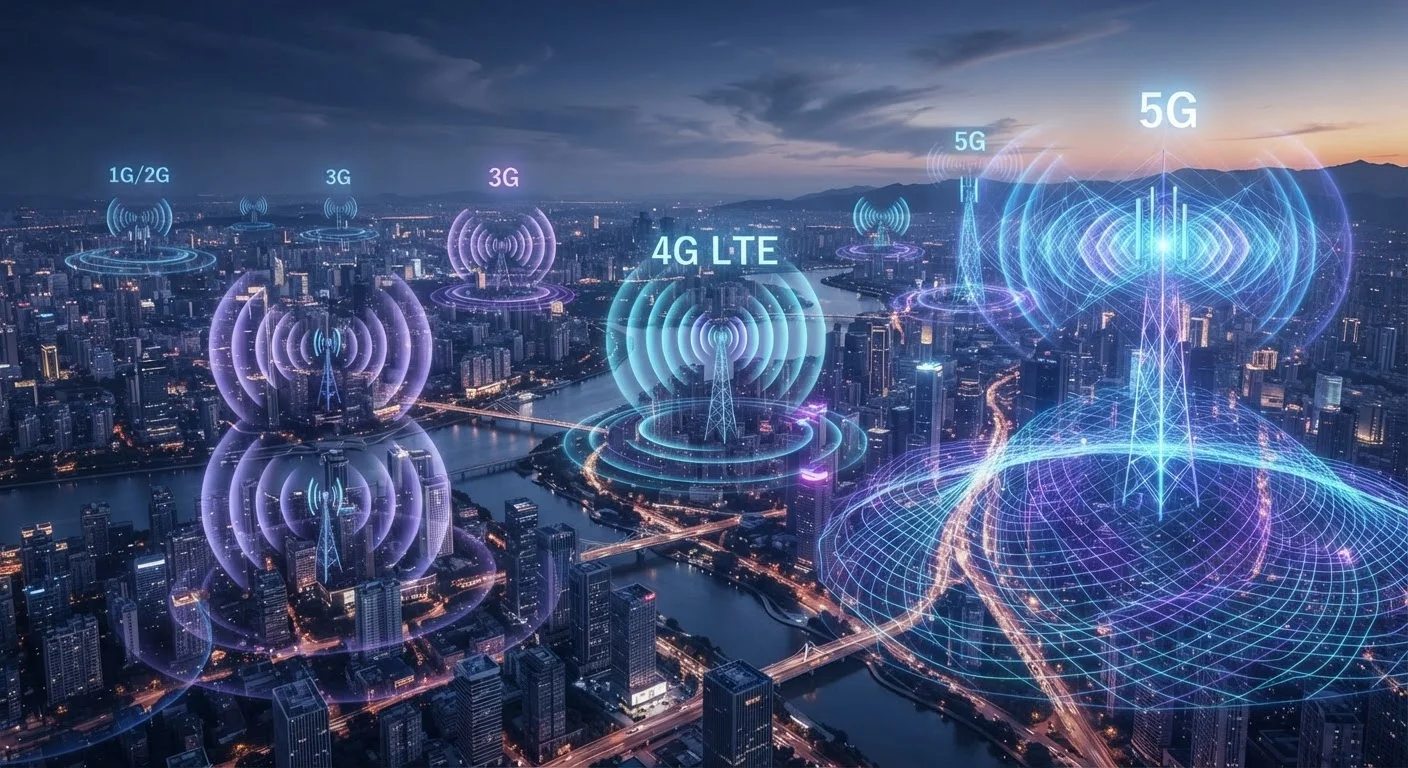
3G: The First Practical Mobile Internet
Before 3G, mobile phones could send text and carry voice calls, but data connections were painfully slow — think dial-up modem speeds on a handset. The 3G era, which began rolling out commercially in the early 2000s, introduced the UMTS (Universal Mobile Telecommunications System) standard and later additions like HSPA and HSPA+. These protocols pushed theoretical download speeds from kilobits per second into the low megabits-per-second range.
The architectural shift that mattered most: 3G moved from a purely circuit-switched model — where a dedicated line was held open for the duration of a call or session — to a hybrid that added packet-switched data. Packets allowed data to share network capacity more efficiently. This made checking email, loading basic web pages, and early-era app downloads practical rather than theoretical.
One limitation persisted: voice calls still traveled on the older circuit-switched infrastructure, and the radio technology used relatively narrow frequency bands, capping throughput. That ceiling drove the development of 4G. For a broader look at the hardware that processes these signals inside your handset, see what's actually inside a smartphone.
4G LTE: The Architecture Overhaul That Made Streaming Possible
4G — specifically the Long Term Evolution (LTE) standard ratified by 3GPP — was not a speed upgrade bolted onto 3G. It was a ground-up redesign. The key change: 4G eliminated the circuit-switched voice layer entirely and moved everything, including voice calls (via VoLTE), onto an all-IP packet network.
That architectural purity removed latency introduced by legacy switching equipment. Real-world download speeds in well-covered areas typically range from 10 Mbps to over 100 Mbps — sufficient for HD video streaming, video calls, and cloud-based apps. Equally important was reduced latency: 4G LTE brought round-trip data delays down to roughly 30–50 milliseconds in typical conditions, compared to 100+ ms on 3G.
~30–50 ms
Typical 4G LTE round-trip latency
Compared to 100+ ms on 3G networks, this reduction made real-time applications like video calling and mobile gaming broadly practical.
10–100+ Mbps
Common 4G LTE real-world download range
Actual speeds vary by tower load, signal strength, and device capability; peak theoretical rates are considerably higher but rarely achieved in everyday conditions.
200–400 Mbps
Typical mid-band 5G real-world speeds
Industry testing and consumer speed-test aggregators consistently show mid-band 5G delivering this range in well-deployed urban areas under normal load.
Later enhancements — marketed as LTE-A (LTE Advanced) and LTE-A Pro — layered on techniques like carrier aggregation, which combines multiple frequency bands to increase effective bandwidth. These are refinements within the 4G standard, not new generations, despite how some carriers have labeled them.
5G: Three Networks Inside One Label
5G is perhaps the most misunderstood generation precisely because it is not one network — it is three distinct spectrum tiers operating under a common brand:
- Low-band 5G (sub-1 GHz): Excellent geographic coverage, often indistinguishable in speed from advanced 4G. This is the tier most consumers experience in suburban and rural areas.
- Mid-band 5G (1–6 GHz): The practical sweet spot. It offers meaningfully faster speeds than 4G — often 200–400 Mbps in real-world use — with reasonable building penetration and coverage radius. Most urban 5G deployments lean on this tier.
- Millimeter wave (mmWave, 24 GHz+): Capable of multi-gigabit speeds but with a range measured in hundreds of meters and poor ability to pass through walls. Useful in dense, outdoor venues like stadiums and transit hubs.
The underlying radio technology also changed. 5G uses NR (New Radio) standards and relies heavily on techniques like Massive MIMO, which uses large arrays of antennas to serve multiple users simultaneously on the same frequency. This improves network capacity — meaning more devices can maintain fast connections at once — not just peak speed for a single user.
Latency targets for 5G go as low as 1 millisecond under ideal conditions, though real-world figures are higher. The low-latency goal is aimed at emerging use cases — autonomous vehicles, remote industrial controls — more than typical consumer apps. For comparison, Wi-Fi operates on its own frequency logic; see how Wi-Fi bands differ for a parallel explanation of spectrum trade-offs.
What Actually Determines Your Experience
The generation label on your phone's status bar is only one variable. Several factors shape what you actually experience:
- Your modem: The cellular modem chip inside your phone — part of the system-on-chip or a discrete component — determines which bands and generations are supported. Not all 5G phones support mmWave; many support only sub-6 GHz 5G. Spec-sheet terms like 'sub-6 GHz' and 'mmWave' are explained in the tech glossary if you want the full breakdown.
- Network congestion: A 4G tower serving few users will often outperform a congested 5G small cell during peak hours.
- Distance from the tower and obstructions: Signal strength drops with distance and through building materials, particularly for higher-frequency bands.
- Carrier deployment choices: Which bands a carrier has licensed and deployed in your area varies significantly by region and provider.
Check Your Phone's Supported Bands
Before assuming you'll get fast 5G, look up your specific phone model's modem specifications and compare them against your carrier's deployed bands in your area. Manufacturer spec pages and carrier band lists are both publicly available. A phone that supports mid-band 5G but is on a carrier that only deployed low-band 5G in your region will not deliver mid-band performance — regardless of what the status bar shows.
Understanding the generation your device supports — and which spectrum tier is actually deployed in your area — gives you a clearer picture than the marketing language on a carrier's coverage map. The Devices Decoded hub covers more of the hardware concepts behind these decisions.
Frequently Asked Questions
It stands for 'generation.' Each generation represents a new set of technical standards for how mobile data is transmitted — not simply an incremental speed boost. These standards are agreed upon internationally before carriers build networks around them.
No. 5G coverage — especially the high-speed millimeter wave variety — is concentrated in dense urban areas. Low-band 5G has broader geographic reach but delivers speeds closer to advanced 4G LTE. Coverage maps from individual carriers are the most reliable way to check your area.
Yes. Your phone must contain a 5G-compatible modem to access 5G networks. Older 4G devices will continue to work on 4G LTE but cannot connect to 5G infrastructure regardless of your carrier plan.
Phones automatically select the strongest available signal. If 5G coverage is weak or congested at your location, the device will fall back to 4G LTE to maintain a reliable connection. This fallback behavior is by design.
3G networks used a mix of circuit-switched and packet-switched technology, which limited throughput and introduced latency. 4G moved entirely to an IP-based architecture, removing that bottleneck and making video streaming and real-time apps viable.
Major regulatory and scientific bodies — including the World Health Organization and national health agencies — have not identified evidence that 5G radio frequencies at regulated exposure levels cause harm. The frequencies used are non-ionizing, meaning they do not carry enough energy to break chemical bonds.
The content on this site is for informational purposes only and is not a substitute for professional advice. Always consult a qualified professional for guidance specific to your situation.