

Start here
Why Car Fluids Matter More Than Most Drivers Realize
Core knowledge
The Six Essential Fluids in Your Vehicle
Hands-on skills
How to Check Your Fluids at Home
Stay alert
Warning Signs That a Fluid Needs Immediate Attention
Make it a habit
Building Fluid Checks Into Your Routine
Why Car Fluids Matter More Than Most Drivers Realize
A modern vehicle relies on multiple fluid systems working in parallel. Remove or degrade any one of them and you get friction, heat, corrosion, or hydraulic failure - often without much warning until the damage is done. The good news: fluid problems are among the easiest maintenance issues to catch early, because most checks take less time than filling a gas tank.
Unlike worn brake pads or a failing alternator, low or contaminated fluid rarely triggers a dramatic symptom right away. That slow bleed of protection is exactly why routine checks matter. See our seasonal maintenance checklist for a broader view of the inspections worth scheduling throughout the year.
The Six Essential Fluids in Your Vehicle
Each fluid below has a specific role. Understanding what it does makes it easier to act when something looks or smells wrong.
Viscosity
A measure of how thick or thin a fluid is. Engine oil thins as it heats up; the right viscosity grade ensures adequate lubrication across your engine's operating temperature range.
Hygroscopic
A substance that absorbs moisture from the surrounding air over time. Brake fluid is hygroscopic, which is why old fluid has a lower boiling point and can compromise braking performance.
DOT Grade
A classification system for brake fluid set by the US Department of Transportation. Common grades are DOT 3, DOT 4, and DOT 5.1; each has different boiling point specifications and compatibility rules.
Coolant Flush
A service where old coolant is fully drained and the system is refilled with fresh fluid. It removes degraded inhibitors and built-up scale that can cause corrosion and overheating.
Master Cylinder
The hydraulic pump in your braking system that converts pedal pressure into hydraulic force. The brake fluid reservoir sits directly on top of it.
OAT / HOAT Coolant
OAT (Organic Acid Technology) and HOAT (Hybrid OAT) are coolant formulations with different corrosion inhibitor packages. Mixing types can reduce their protective properties.
Engine Oil
Oil lubricates moving parts inside the engine, reduces heat from friction, and carries debris to the filter. Over time it oxidizes and loses viscosity. Most vehicles need an oil change every 5,000-10,000 miles, but the right interval depends on the oil type and your driving conditions - consult your owner's manual rather than a fixed rule. For more on outdated oil-change assumptions, see common car maintenance myths.
Coolant (Antifreeze)
Coolant circulates through the engine and radiator to regulate operating temperature, preventing both overheating in summer and freeze-up in winter. It also inhibits internal corrosion. Coolant degrades chemically over years; most manufacturers recommend a flush every 30,000-50,000 miles or every 3-5 years, whichever comes first.
Brake Fluid
Brake fluid is a hydraulic fluid that transfers the force of your foot on the pedal to the brake calipers. It's hygroscopic - meaning it absorbs moisture from the air over time - which lowers its boiling point and can cause spongy braking. The DOT grade stamped on your reservoir cap tells you which type to use; never mix grades.
Transmission Fluid
This fluid lubricates and cools the transmission's gears and clutch packs. Automatic and manual transmissions use different fluid types. Degraded transmission fluid is a leading contributor to premature transmission failure, an expensive repair covered in more detail in overlooked maintenance tasks.
Power Steering Fluid
Hydraulic power steering systems use this fluid to reduce the effort needed to turn the wheel. Many newer vehicles use electric power steering and don't have this reservoir at all - check your owner's manual if you're unsure. Low fluid typically causes a whining noise when turning.
Windshield Washer Fluid
The only fluid on this list you can top off with a consumer product at any gas station. Use a formula rated for your climate - plain water freezes and can crack the reservoir in winter.
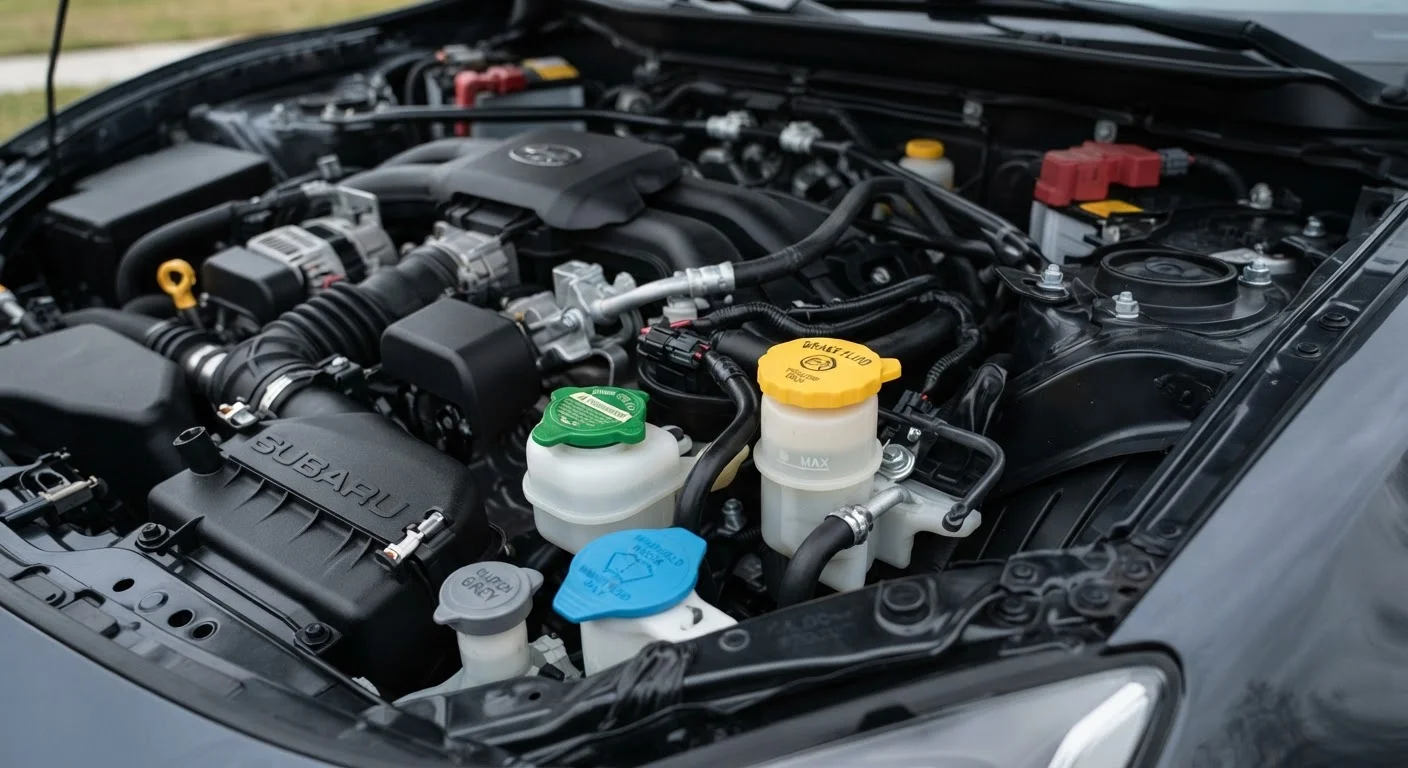
How to Check Your Fluids at Home
Park on level ground and let the engine cool before checking most fluids - a hot engine can give inaccurate dipstick readings and poses a burn risk when opening pressurized reservoirs. Most reservoirs are translucent with MIN and MAX markings visible from the outside, so you often don't need to open anything.
- Engine oil: Pull the dipstick, wipe it clean, reinsert fully, then withdraw again. The oil film should sit between the two marks and appear amber to dark brown. Black, gritty oil is overdue for a change.
- Coolant: Check the translucent overflow reservoir - never open the radiator cap on a hot engine. The level should be between MIN and MAX. Healthy coolant is typically green, orange, or pink depending on type.
- Brake fluid: The reservoir is usually on top of the master cylinder near the firewall. Level and color are visible through the casing. Dark brown fluid warrants a professional inspection.
- Transmission fluid: Some vehicles have a dipstick (often checked with the engine warm and running); others are sealed and require a workshop lift to inspect. Check your manual.
- Power steering fluid: Small reservoir near the drive belt. Check cold; the cap dipstick or side markings show the level.
Take a Photo Before You Close the Hood
Snapping a quick photo of the dipstick or reservoir levels after each check creates an easy visual record. If you notice a faster-than-usual drop next month, you'll have a baseline to compare against. It also gives a mechanic useful context if you bring the car in.
Warning Signs That a Fluid Needs Immediate Attention
Between scheduled checks, your car gives signals worth knowing. Dashboard warning lights are the most direct - learn what each one means with our guide to dashboard warning lights. Beyond the dashboard:
- Puddles under the car: Bright green or orange liquid is coolant; oily dark patches are likely engine oil or transmission fluid; clear fluid near the rear could be water from the AC condensate (normal) or brake fluid (not normal).
- Burning smell: Oil or coolant contacting hot engine components produces distinctive acrid smells. Don't ignore these.
- Spongy brake pedal or increased steering effort: Both suggest fluid loss or degradation in those systems and warrant immediate professional attention.
- Overheating gauge: Pull over safely and do not continue driving. Running a hot engine accelerates internal damage rapidly.
If your vehicle has high mileage, fluid integrity becomes even more critical. Keeping a high-mileage car running well covers the maintenance priorities that shift as vehicles age.
Building Fluid Checks Into Your Routine
The simplest approach is to tie fluid checks to something you already do. Many drivers check engine oil every other fuel fill-up - it takes 90 seconds and gives early warning of consumption or leaks. A full under-hood check of all reservoirs once a month or before any trip over 200 miles covers most scenarios.
Keep a small notebook or use a notes app to record dates and levels. Spotting a slow downward trend in brake fluid or coolant between services is exactly the kind of pattern that leads to early diagnosis of a developing leak - before it becomes a roadside emergency.
Your owner's manual lists manufacturer-specified service intervals for every fluid. Those intervals are calibrated to your specific engine and driving conditions, making them far more reliable than generic rules of thumb. Use them as your baseline, then adjust based on your actual driving habits - frequent towing, stop-and-go city driving, or extreme climates all accelerate fluid degradation.
Frequently Asked Questions
A quick visual check every month or before any long trip is a reasonable baseline for most drivers. Engine oil deserves the most frequent attention; other fluids like brake and transmission fluid typically change slowly unless there's a leak. Your owner's manual will list manufacturer-recommended inspection intervals.
Driving with critically low oil starves engine components of lubrication, causing metal-on-metal friction. This can lead to scored bearings, damaged cylinder walls, and in severe cases complete engine seizure - a repair that often costs thousands of dollars. Stop driving and check the level as soon as the oil warning light appears.
Mixing coolant types (for example, green OAT with orange HOAT) can cause the additives to react and reduce corrosion protection. For brake fluid, always use the grade specified in your owner's manual (DOT 3, DOT 4, or DOT 5.1); mixing incompatible grades can lower the fluid's boiling point. When in doubt, have a qualified mechanic flush and refill with the correct product.
A small amount of oil consumption is normal, especially in older or high-mileage engines. Consuming more than about one quart per 1,000 miles is generally considered excessive and worth investigating with a mechanic. Regularly checking the dipstick lets you catch a developing problem before it causes damage.
Fresh automatic transmission fluid is typically bright red or pink. As it ages it darkens to a red-brown, and severely degraded fluid can turn dark brown or black with a burnt smell. If the fluid looks or smells burnt, schedule a transmission service with a qualified technician.
EVs eliminate engine oil, transmission fluid, and coolant for an internal combustion engine, but they still require brake fluid, windshield washer fluid, and a coolant circuit for the battery and power electronics. Hybrid vehicles typically need all the fluids of a conventional car plus battery cooling fluid. Check your EV or hybrid owner's manual for the specific requirements.
The content on this site is for informational purposes only and is not a substitute for professional advice. Always consult a qualified professional for guidance specific to your situation.