

What Is Graduated Driver Licensing?
Graduated Driver Licensing - commonly abbreviated as GDL - is a staged system that allows new drivers to gain experience progressively, under lower-risk conditions, before earning unrestricted driving privileges. Every US state has adopted some version of GDL, though the specific rules differ considerably from one state to the next.
The core idea is straightforward: instead of issuing a full license to a 16-year-old with minimal road experience, GDL programs break the licensing process into phases. Each phase unlocks more freedom as the driver demonstrates competency and accumulates supervised practice hours.
| States with GDL laws | All 50 states + D.C. (Governors Highway Safety Association (GHSA)) |
| Typical GDL phases | 3 (Learner's Permit, Provisional, Full License) |
| Common supervised hours required | 40-65 hours (Varies by state) |
| Typical nighttime curfew range | 9 p.m. - midnight (Varies by state) |
| Minimum permit age (lowest) | 14 years old (Select rural states) |
| Minimum full license age (highest) | 18 years old (Select states) |
Research consistently supports the GDL model. The Insurance Institute for Highway Safety (IIHS) has documented that comprehensive GDL laws are associated with meaningful reductions in fatal crash rates among 16-year-olds. That said, the strength of a state's GDL program depends heavily on its specific provisions.
The Three Phases Explained
Phase 1: Learner's Permit
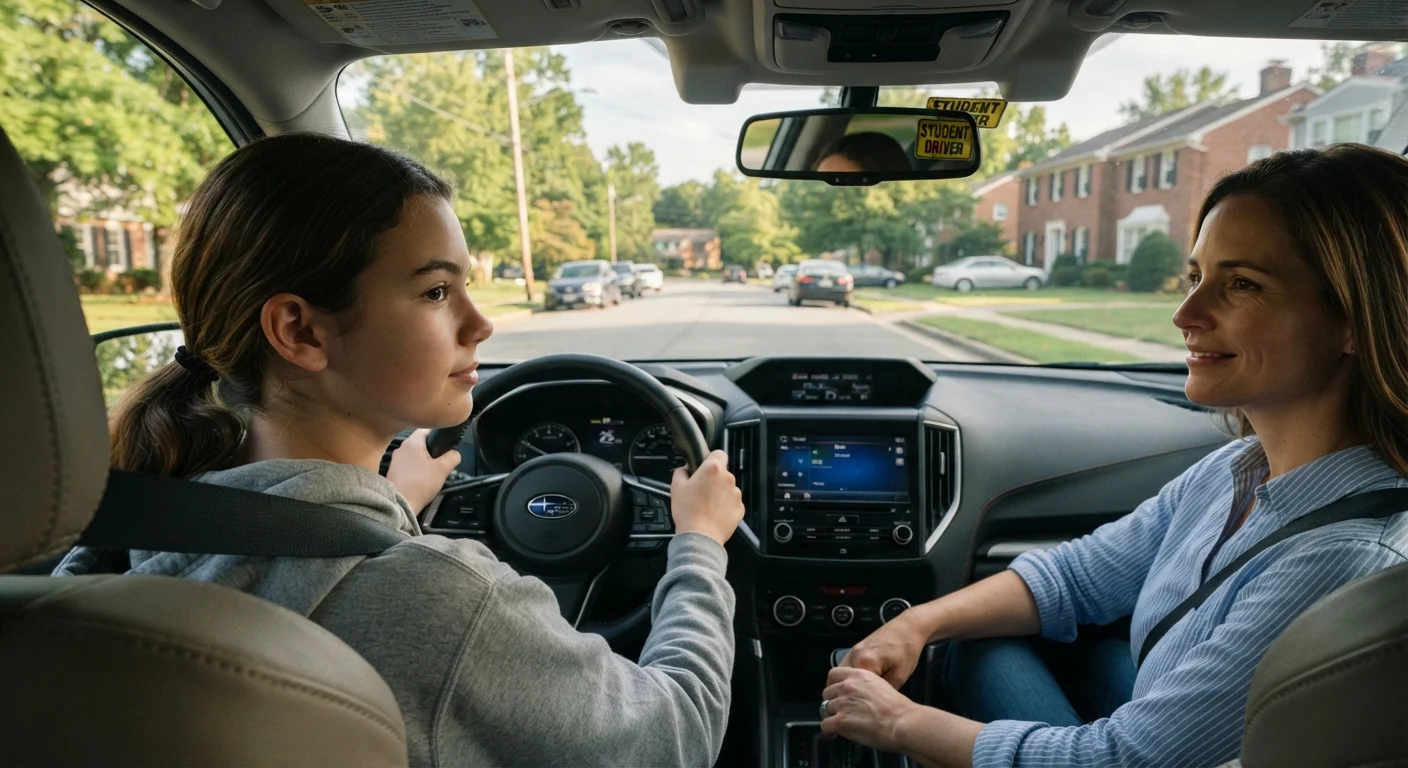
The first stage begins when a teen passes a written knowledge test and receives a learner's permit. At this stage, driving is only allowed with a licensed adult present - typically a parent, guardian, or qualified instructor. Most states require permit holders to log a minimum number of supervised hours (often between 40 and 65) before advancing, and some mandate a specific portion of those hours to occur at night.
Phase 2: Restricted (Provisional) License
Once minimum permit requirements are met, teens can apply for a provisional license. This allows independent driving but with notable restrictions. Common limits during this phase include nighttime driving curfews (often prohibiting unsupervised driving after 9 or 10 p.m.) and passenger restrictions that limit the number of teen passengers allowed in the vehicle without adult supervision. These restrictions exist because data shows that both late-night driving and carrying young passengers significantly elevate crash risk for novice drivers.
Phase 3: Full Unrestricted License
After completing the provisional phase without violations - typically at age 17 or 18, depending on the state - a driver qualifies for a standard license with no GDL-specific restrictions. At this point, defensive driving habits become especially important, since the guardrails of GDL are now gone.
How States Differ: Key Variables
While the three-phase structure is widely shared, the details vary enough to matter in practice. Here are the dimensions where states diverge most:
- Minimum permit age: Ranges from 14 (in a handful of rural states) to 16 in others.
- Required supervised hours: Some states require as few as 30 logged hours; others mandate 65 or more.
- Nighttime restrictions: Curfews typically fall between 9 p.m. and midnight, with earlier cutoffs generally linked to better safety outcomes.
- Passenger limits: Stricter states limit provisional drivers to zero teen passengers; others allow one or two.
- Cell phone rules: Many states impose a blanket ban on handheld and hands-free device use for drivers under 18, even where adult use is otherwise permitted.
- Minimum licensing age: The minimum age for a full unrestricted license ranges from 16 to 18 across states.
Because these rules change and vary, families should verify current requirements directly with their state's DMV or equivalent licensing authority. The Governors Highway Safety Association (GHSA) maintains a regularly updated state-by-state reference that is a useful starting point.
It's also worth noting that GDL violations can affect a teen's insurance rates. Understanding how auto insurance works before a teen gets behind the wheel can prevent financial surprises down the road.
Common GDL Gaps and What Parents Can Do
Not all GDL programs are equally strong. Some states have weaker provisions - higher curfew hours, shorter permit requirements, or no mandatory nighttime practice - that researchers have linked to less pronounced safety benefits. Even in states with robust laws, enforcement at the individual level depends largely on families.
Parents and guardians play a critical role. Studies suggest that teens whose parents set clear expectations and consistently enforce driving rules - even beyond what state law requires - tend to have fewer crashes. Families can voluntarily extend supervised driving beyond the state minimum, set earlier nighttime cutoffs, and limit passengers even when the law doesn't require it.
Building foundational skills matters too. Situations like driving in adverse weather or merging onto a highway are high-stress for any new driver. Deliberately practicing these scenarios during supervised phases - rather than encountering them alone - can meaningfully improve preparedness.
This article provides general educational information about Graduated Driver Licensing programs in the United States. Rules and requirements vary by state and may change. Always verify current laws with your state's official licensing authority.
The content on this site is for informational purposes only and is not a substitute for professional advice. Always consult a qualified professional for guidance specific to your situation.