

What Companion Planting Can Realistically Do
Companion planting sits at an interesting crossroads between traditional agricultural knowledge and modern horticulture research. At its core, it's about intentional plant placement - choosing neighbors that support rather than compete with each other. The benefits generally fall into a few categories: pest deterrence, pollinator attraction, soil enrichment, and space efficiency.
It's worth being honest from the outset: not every pairing you'll find in gardening books has been rigorously tested. Some claims persist simply because they've been repeated for generations. That doesn't mean they're useless - experienced gardeners often observe real results - but it's helpful to distinguish between combinations with a clear biological mechanism and those based mainly on tradition.
As you plan your garden layout, companion planting is most powerful when it complements good fundamentals. Soil health through compost and mulch will always outweigh any companion pairing. Think of companion planting as a strategic layer on top of solid gardening practice, not a workaround for poor soil or overcrowding.
Pairings With Genuine Support
A handful of companion combinations appear consistently in both research and reliable horticultural guidance:
- The Three Sisters (corn, beans, squash): This Indigenous North American polyculture is among the most well-documented examples. Corn provides a climbing structure for beans; beans fix atmospheric nitrogen into the soil, feeding the corn and squash; squash leaves shade the ground, reducing weeds and retaining moisture. Each plant genuinely supports the others through distinct mechanisms.
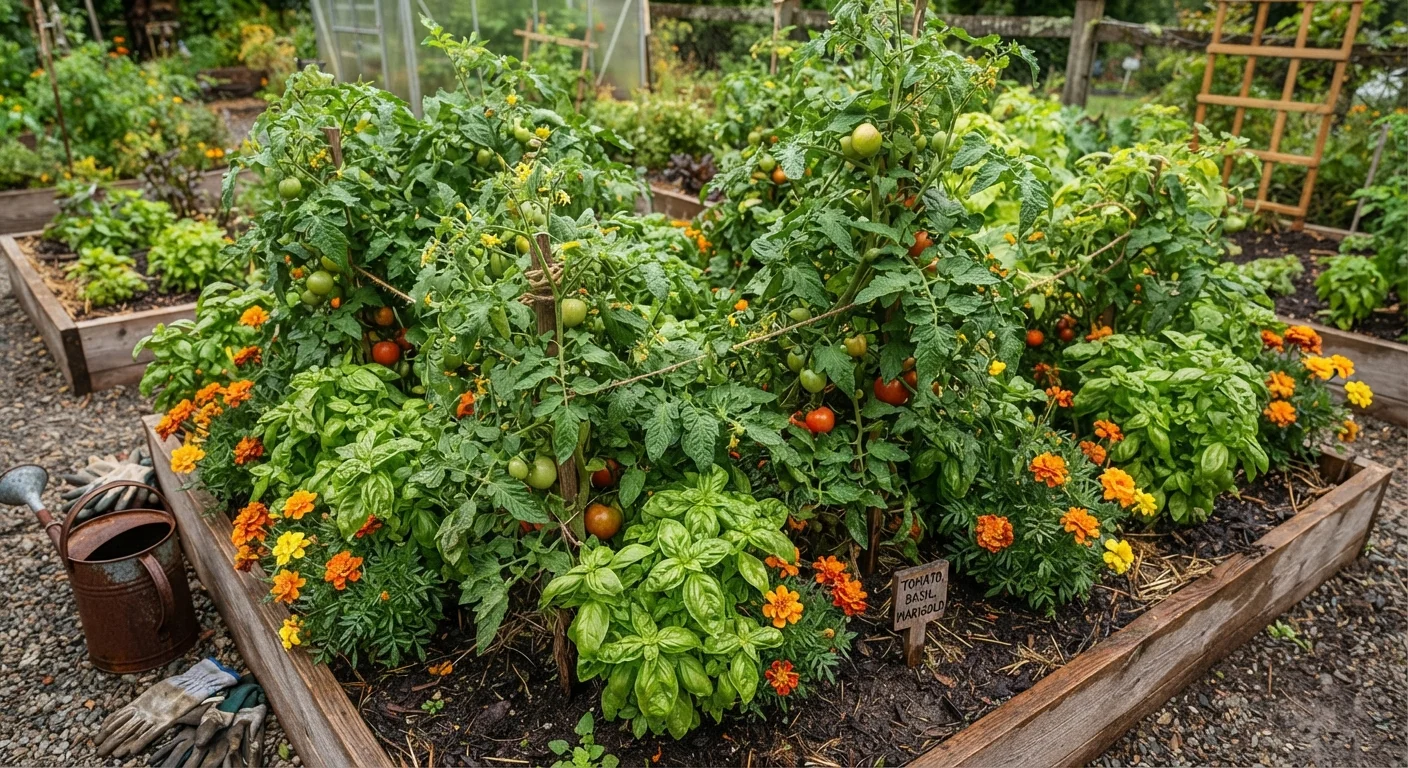
- Tomatoes and basil: Gardeners widely report that basil planted near tomatoes helps deter aphids and thrips. The mechanism is thought to involve basil's volatile aromatic compounds. While controlled studies yield mixed results, the pairing is low-risk and practically useful - and basil thrives in similar sun and water conditions.
- Marigolds and vegetables: French marigolds (Tagetes patula) have demonstrated ability to suppress root-knot nematodes when planted densely as a cover crop before susceptible vegetables. Their effect on above-ground pests like aphids is less conclusive but still commonly observed.
- Nasturtiums as trap crops: Nasturtiums attract aphids strongly, drawing them away from vegetables like beans and brassicas. This works best when nasturtiums are planted at the garden perimeter and checked regularly so aphid populations don't migrate back.
Legumes Enrich Soil for Neighboring Plants
Beans, peas, and clover form partnerships with soil bacteria that capture nitrogen from the air and make it available in the soil. Planting legumes alongside or before heavy-feeding crops like corn or leafy greens can gradually improve fertility. This is one of the most reliable biological mechanisms in companion planting.
Legumes - beans, peas, clover - are broadly useful companions because their roots host bacteria that convert atmospheric nitrogen into a plant-available form. Planting them before or alongside heavy feeders like corn or leafy greens can improve soil fertility over time.
Pairings to Approach With Skepticism
Several well-known companion planting claims don't hold up well under scrutiny. Knowing which ones to question will save you from making planting decisions based on unverified assumptions.
- Carrots and onions: The idea that carrot fly and onion fly mutually repel each other is appealing but weakly supported by research. Physical barriers tend to be far more effective for carrot fly control.
- Chamomile as a universal companion: Chamomile is often listed as beneficial to nearly everything. While it attracts beneficial insects, no strong evidence supports it specifically improving neighboring plant growth.
- Garlic repelling most pests: Garlic sprays have some research backing as a pest deterrent, but simply planting garlic near other crops has limited documented impact on pest populations.
This doesn't mean you should avoid these pairings - many gardeners grow them together successfully. It means you shouldn't rely on them as your primary pest or growth strategy.
If you're designing your whole plot around companion planting principles, a seasonal garden planning checklist can help you map combinations before you plant.
How to Apply Companion Planting in Your Garden
Effective companion planting starts with understanding what you're trying to achieve. Are you trying to manage a specific pest? Improve yields in a small space? Enrich depleted soil? Each goal suggests different pairings and placements.
A few practical principles to guide your layout:
- Match growth habits: Tall plants shouldn't permanently shade low-growing companions unless that's the intended benefit. Think about canopy layers.
- Account for timing: Some companions only help during specific growth phases. Legumes fix nitrogen while actively growing, so timing their planting relative to heavy feeders matters.
- Keep records: Note which pairings you tried, where, and what you observed. Your own garden's microclimate - soil type, local pest pressure, sun exposure - shapes outcomes more than any general guideline.
If you're working with limited outdoor space, companion planting can be especially efficient. Pairing a vertical grower with a ground-covering plant, for instance, makes use of both vertical and horizontal space simultaneously. Our guide on growing food in small spaces covers strategies that pair naturally with companion planting thinking.
Understanding which plants suit your climate also shapes which combinations are even viable where you live. See how plant hardiness zones affect your choices for context before finalizing your layout.
This article is intended for general educational purposes. Results from companion planting vary based on local growing conditions, soil health, and climate. Always observe your own garden over multiple seasons to identify what works best for your specific situation.
Frequently Asked Questions
Some pairings have solid research support, while others are traditional beliefs with little scientific backing. The Three Sisters combination and marigolds near tomatoes are among the more evidence-supported examples. Approaching companion planting as one useful tool - not a guaranteed fix - will lead to the most realistic results.
Certain combinations can compete for the same nutrients, release chemicals that inhibit neighbors, or attract shared pests. For example, fennel is widely noted for suppressing many garden plants, and onions may slow down bean growth. Observing your garden over seasons will help you identify which pairings don't work in your specific conditions.
Proximity matters, but exact distances depend on the specific benefit. Pest-repelling aromatic plants generally need to be within a few feet to have any effect. Plants sharing nutrients through root interactions - like legumes fixing nitrogen - need to be close enough that root zones overlap or are adjacent.
Companion planting can reduce pest pressure, but it rarely eliminates it. It works best as part of a broader integrated approach that also includes crop rotation, physical barriers, and attracting beneficial insects. For a fuller picture, see our guide on <a href="/home-garden/gardening-basics/pest-control-without-reaching-for-chemicals-first">managing pests without chemicals first</a>.
Yes, in limited ways. You can pair herbs with vegetables in the same large container, and aromatic plants nearby can still offer some pest-deterrent effect. Just be mindful that containers restrict root space, which can amplify competition for water and nutrients.
The content on this site is for informational purposes only and is not a substitute for professional advice. Always consult a qualified professional for guidance specific to your situation.