

Our Verdict
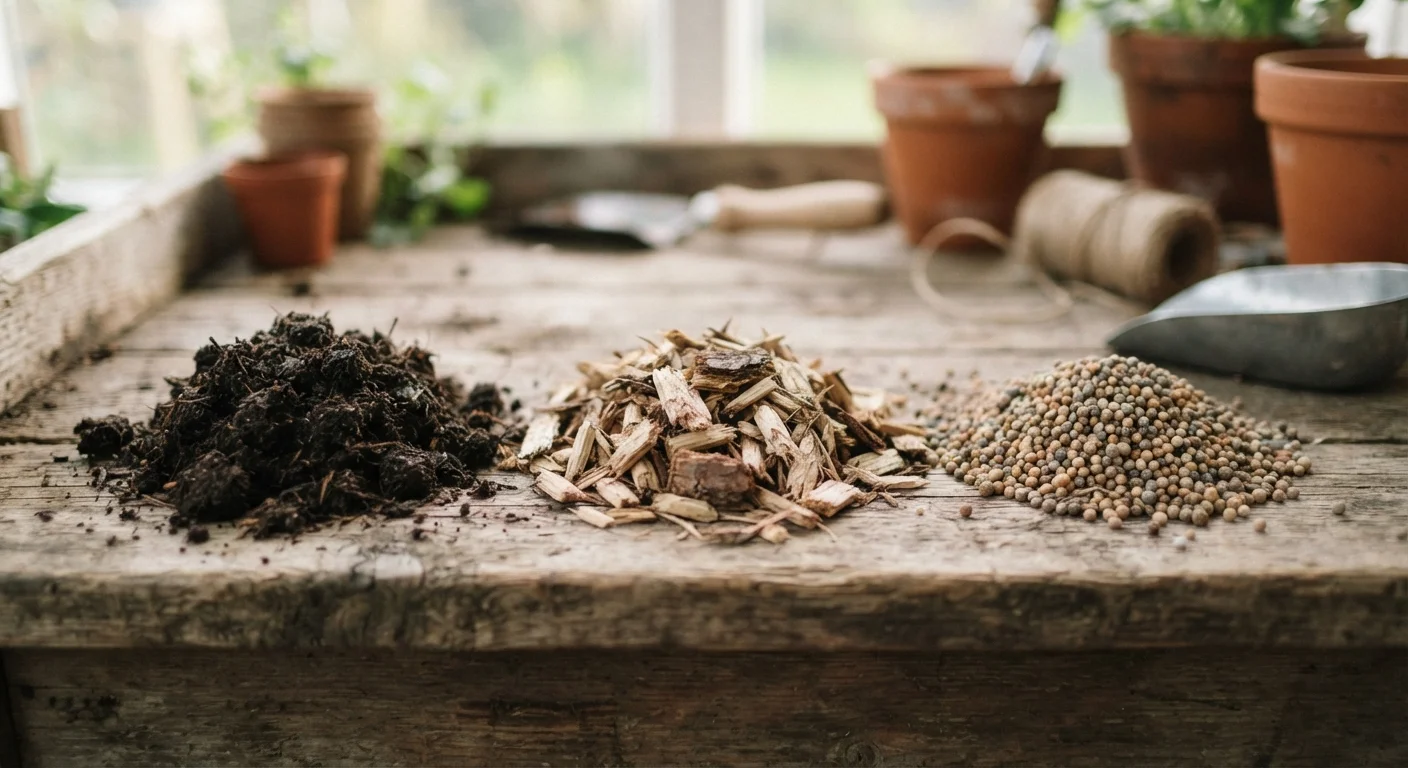
Compost, mulch, and fertiliser are not interchangeable - each solves a different problem. Compost builds lasting soil health, mulch manages the surface environment, and fertiliser addresses specific nutrient deficits. Most gardens benefit from all three used strategically rather than one alone.
| Best for | Recommended |
|---|---|
| Gardeners building new beds or improving poor soil | Compost |
| Conserving moisture and reducing weeding in established beds | Mulch |
| Correcting a specific nutrient deficiency or boosting seasonal crops | Fertiliser |
| Most home garden situations | A combination of all three |
Why These Three Are So Often Confused
Walk into any garden center and you'll find bags labeled compost, mulch, and fertiliser shelved side by side, sometimes with descriptions that overlap. It's easy to assume they're all just ways to "feed your garden" - but each one works through a different mechanism and targets a different problem.
Understanding what each one actually does helps you spend smarter, apply correctly, and avoid the all-too-common mistake of using a short-term fix when your soil needs a long-term solution. This guide unpacks all three clearly, so you can match the right amendment to the right job. For a broader foundation, see our guide to soil types - knowing your soil sets the stage for everything else.
Compost: The Slow Builder
Compost is decomposed organic matter - kitchen scraps, fallen leaves, grass clippings, and garden waste broken down by microbes and worms into a dark, crumbly material. It works primarily by improving soil structure, not just adding nutrients.
When you mix compost into soil, several things happen:
- Clay soils become less compacted and drain more freely.
- Sandy soils develop better water and nutrient retention.
- Beneficial microbial activity increases, which supports healthier root systems.
- Organic matter slowly releases a broad range of nutrients over months.
Compost is not a fast fix. It works on a biological timescale, building the living ecosystem in your soil that makes plants thrive season after season. Typical application is 2-4 inches worked into the top layer of soil before planting, or spread as a top dressing on established beds.
Want to make your own? Our guide to setting up a home composting system walks through the process step by step.
| Compost | Mulch | Fertiliser | |
|---|---|---|---|
| Primary purpose | Improve soil structure & biology | Protect soil surface | Supply specific nutrients |
| Where it goes | Mixed into soil | Laid on top of soil | Applied to soil or leaves |
| Speed of effect | Slow - months to seasons | Immediate physical effect | Fast (synthetic) or slow (organic) |
| Improves soil biology | Yes - significantly | Marginally over time | Minimally or not at all |
| Weed suppression | No | Yes | No |
| Moisture retention | Indirectly, via soil structure | Yes - directly | No |
| Risk of over-application | Low | Low (keep off stems) | Moderate to high |
Mulch: The Surface Manager
Mulch never gets mixed into the soil - it sits on top of it. That distinction matters, because mulch works through physical presence rather than chemical or biological action. Common types include wood chips, straw, shredded bark, and even inorganic options like gravel or landscape fabric.
The main jobs mulch does:
- Moisture retention: A 2-3 inch layer can significantly reduce how often you need to water by slowing evaporation from the soil surface.
- Weed suppression: Mulch blocks light to weed seeds, reducing germination without chemicals.
- Temperature regulation: It insulates roots from summer heat and winter cold.
- Erosion control: Mulch softens the impact of rain and irrigation, keeping soil in place.
Organic mulches like wood chips do break down over time, adding a small amount of organic matter to the soil - but this is a secondary benefit, not their primary function. One important caution: keep mulch a few inches away from plant stems and tree trunks to prevent rot and pest harborage.
Fertiliser: The Targeted Feeder
Fertiliser is a concentrated source of specific nutrients - most commonly nitrogen (N), phosphorus (P), and potassium (K), displayed as an N-P-K ratio on the bag. Unlike compost, fertiliser doesn't improve soil structure. It addresses a specific nutritional need, often quickly.
Fertilisers come in two broad forms:
- Synthetic (inorganic) fertilisers
- Water-soluble and fast-acting. Plants absorb nutrients almost immediately, making these useful for correcting a clear deficiency or pushing growth during peak season. They do not feed soil microbes and can cause fertiliser burn if over-applied.
- Organic fertilisers
- Derived from natural sources such as fish meal, bone meal, or kelp. They release nutrients more slowly and generally support soil biology better than synthetic options, though they act more gradually.
The key principle with fertiliser is that more is not better. Over-fertilising - particularly with nitrogen - can burn roots, encourage excessive leafy growth at the expense of fruit or flowers, and contribute to nutrient runoff into waterways. A soil test, available through many cooperative extension offices, helps you apply only what's actually needed.
Get a Soil Test Before You Fertilise
Many gardeners fertilise by habit rather than need, which can lead to nutrient imbalances and wasted money. A basic soil test - often available through your local cooperative extension service - tells you exactly what your soil is lacking. This makes fertiliser application precise and avoids the common pitfall of adding nitrogen to soil that actually needs phosphorus or potassium.
How to Use All Three Together
The most productive gardens typically use compost, mulch, and fertiliser as a coordinated system rather than relying on any single one. A sensible sequence looks like this:
- Amend your soil with compost before planting season to build long-term structure and microbial life.
- Apply fertiliser if a soil test or plant symptoms suggest a specific deficiency - not as a default every season.
- Mulch the surface after planting to hold moisture, moderate temperature, and keep weeds down through the growing season.
This layered approach reflects how healthy natural ecosystems work: organic matter builds over time, surface layers protect and moderate, and nutrients cycle through living organisms. Understanding the interaction between these amendments and your specific soil type is where the real gains are. Our soil types guide and the gardener's glossary are both useful references as you develop your approach. If you're setting up a new growing space, our comparison of raised beds vs. in-ground planting will help you plan your amendments around your chosen method.
The content on this site is for informational purposes only and is not a substitute for professional advice. Always consult a qualified professional for guidance specific to your situation.