

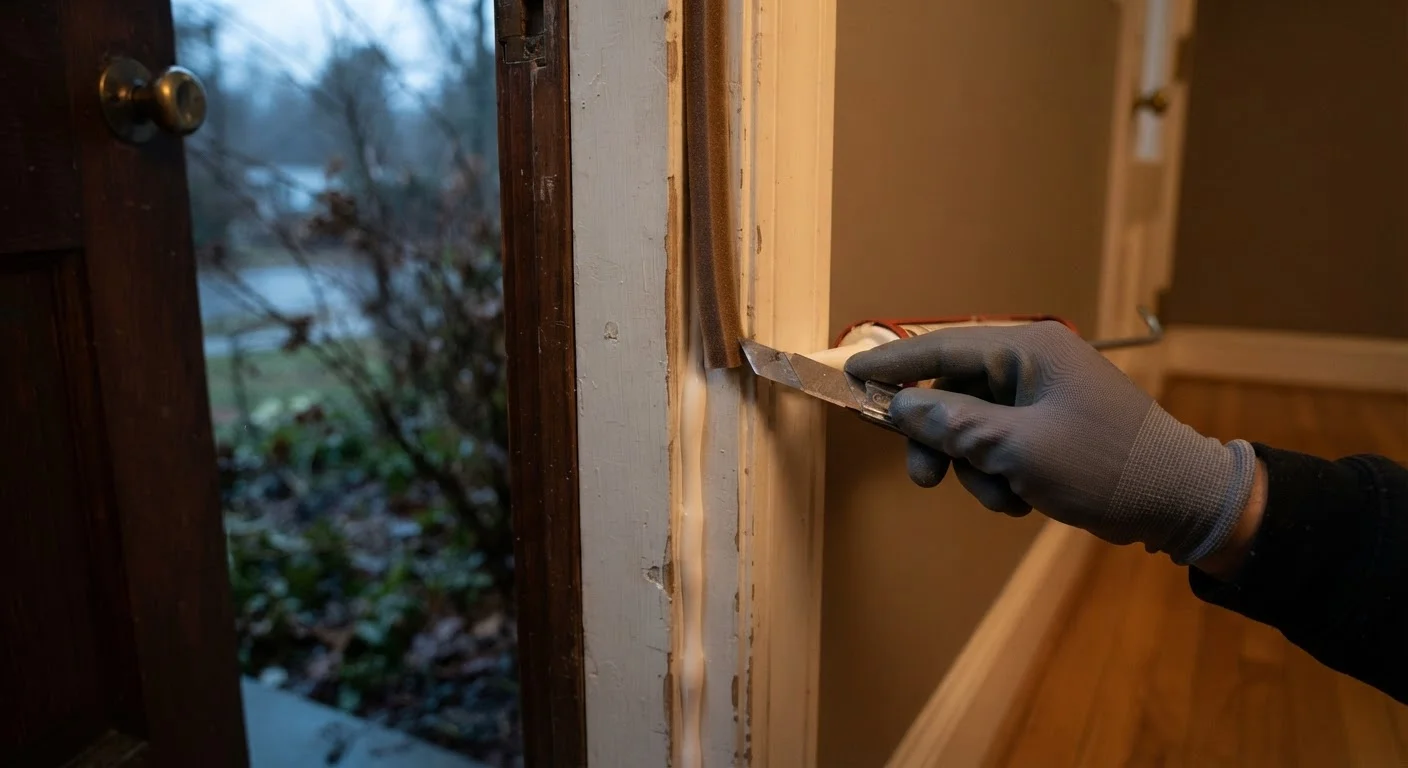
Why the Right Method Matters
Gaps around doors, windows, pipes, and structural joints account for a significant share of home energy loss - and they invite moisture, pests, and drafts before homeowners notice anything is wrong. Sealing those gaps is straightforward preventive maintenance, but only when you match the right product to the right location. Using caulk where compression weatherstripping belongs, or foam backer rod where a door sweep is needed, often means the problem returns within a season.
This reference covers the four most common sealing methods - caulk, foam backer rod, door sweeps, and compression strips - explaining what each one does, where it performs reliably, and where it falls short. For context on moisture-related problems that poor sealing can worsen, see identifying damp types before choosing a fix.
| Caulk - max gap width | Up to ½ inch (unsupported) |
| Foam backer rod - sizing | 25-50% wider than the gap |
| Door sweeps - surface compatibility | Smooth or near-smooth thresholds; brush type for uneven surfaces |
| Compression strip inspection frequency | Annually, before heating season |
| Caulk - not suitable for | Moving joints, continuously wet surfaces, gaps over ½ inch without backer |
| V-strip weatherstripping - best use | Sides of double-hung windows and sliding door channels |
Caulk: Filling Static Gaps
What it does: Caulk is a flexible sealant applied as a paste that cures into a rubbery or firm bead. It bridges narrow, stable gaps - typically under ½ inch wide - between two surfaces that do not move relative to each other after installation.
Where it belongs:
- Along the interior and exterior perimeter of window and door frames where they meet siding, trim, or drywall
- Around pipe and conduit penetrations through walls, floors, and ceilings
- At the joint between a bathtub or shower surround and a tiled wall
- Where baseboards meet flooring in unconditioned spaces
Where it fails: Caulk is not designed for gaps that open and close - such as the gap between a door and its frame as the door swings. It also performs poorly in gaps wider than ½ inch without a backer, and in areas that stay wet continuously. It is worth reading about common maintenance myths, including the widespread misconception that caulk is a universal fix.
Caulk
A flexible, paste-like sealant applied to static gaps between building materials. It cures in place to form a weather- and air-resistant bead and is not designed for joints that move.
Foam Backer Rod
A compressible foam cylinder pressed into oversized gaps before caulk is applied. It controls caulk depth and prevents three-sided adhesion, which would cause the caulk to crack under movement.
Door Sweep
A strip of flexible material fixed to the bottom of a door that presses against or drags along the threshold to seal the gap when the door is closed.
Compression Weatherstripping
Soft strip material installed in a door or window stop so that closing the door or sash compresses it, creating an air and weather seal. It loses effectiveness as the foam or rubber ages and stops rebounding.
Three-Sided Adhesion
A condition where caulk bonds to both sides and the bottom of a joint. This prevents the bead from flexing with movement, causing premature cracking. Backer rod is used to prevent it.
V-Strip (Tension Seal)
A folded strip of metal or plastic installed along the sides of sliding or double-hung window sashes. The V-shape creates a spring tension that presses against the moving surface to maintain a seal.
Foam Backer Rod: Support Before You Seal
What it does: Foam backer rod is a cylindrical foam cord pressed into a gap before caulk is applied. It controls caulk depth, prevents three-sided adhesion (which causes premature cracking), and fills oversized gaps so caulk isn't wasted or structurally stressed.
Where it belongs:
- Wide expansion joints in concrete slabs, driveways, or sidewalks (gaps ½ inch or wider)
- Large gaps around window and door rough openings before the interior is finished
- Between masonry units where significant seasonal movement is expected
Sizing rule: Choose backer rod that is 25-50% wider than the gap so it compresses slightly and stays in place. The caulk bead is then applied over it, bonding only to the two sides of the joint rather than the bottom - allowing it to flex without tearing.
Foam backer rod is often overlooked during projects like adding attic or basement insulation. See inspecting neglected areas like crawl spaces and basements for a broader look at where gaps commonly hide.
Door Sweeps and Compression Strips: Sealing Moving Joints
Unlike caulk, door sweeps and compression strips are designed for joints that move every time a door or window opens and closes. Applying a rigid sealant here will crack or peel quickly.
Door Sweeps
What they do: A door sweep mounts to the bottom edge of a door and drags or presses against the threshold, closing the gap between the door's bottom edge and the floor when the door is shut.
Where they belong: Exterior entry doors, garage-to-house doors, and any interior door where conditioned air loss, sound transmission, or pest entry is a concern. They work best on smooth thresholds; brush-style sweeps tolerate slightly uneven surfaces better than blade-style versions.
Compression Weatherstripping
What it does: Compression strips - typically foam, rubber, or vinyl - are mounted in the door or window stop so that when the door or sash closes, it presses against the strip and forms a seal.
Where it belongs: Door stops on the hinge and latch sides of exterior doors; window sashes where they meet the frame or each other. V-strip (tension seal) weatherstripping is a variant suited to the sides of double-hung windows and sliding surfaces.
Maintenance note: Compression strips compress thousands of times over their lifespan and eventually lose their memory. Inspect them annually - a strip that no longer springs back when released needs replacement. This is a key step in any winterization walkthrough before heating season begins.
Pairing proper door and window sealing with adequate wall and roof insulation amplifies results. Comparing insulation materials is a useful next step once air sealing is addressed.
The content on this site is for informational purposes only and is not a substitute for professional advice. Always consult a qualified professional for guidance specific to your situation.