

Our Verdict
Mineral wool and rigid foam board stand out as versatile, widely available options that perform well in most wall and roof applications. Spray foam is unmatched for air sealing in complex or irregular spaces, while natural materials like sheep's wool suit homeowners who prioritize sustainability and breathability. The right pick depends on where you're insulating, your climate zone, and how you're balancing cost against long-term performance.
| Best for | Recommended |
|---|---|
| Budget-conscious retrofits in standard stud-framed walls | Mineral Wool Batts |
| Flat or low-slope roof assemblies needing thin, high-R layers | Rigid Foam Board |
| Irregular spaces, rim joists, and air-sealing priority areas | Spray Foam |
| Eco-conscious homeowners prioritizing breathability and renewability | Sheep's Wool |
Why Insulation Material Choice Actually Matters
Insulation isn't a one-size-fits-all product. The same material that performs beautifully in an attic floor may be a poor fit inside a cathedral ceiling or a basement rim joist. Each insulation type has a distinct thermal profile, moisture behavior, fire rating, and installation requirement - and mismatching any of these to your project can mean wasted money or reduced effectiveness.
The core performance metric is R-value, which measures thermal resistance. A higher R-value means more resistance to heat flow per inch of thickness. But R-value alone doesn't tell the whole story: air sealing, vapor control, and how the material interacts with moisture all affect real-world performance. If you're also dealing with damp issues in the areas you plan to insulate, it's worth reviewing how to identify damp types before selecting a material, since some insulants are more vulnerable to moisture damage than others.
The Four Main Insulation Types Compared
Here's a practical look at the most common materials used in residential wall and roof insulation projects:
Mineral Wool (Rock Wool / Slag Wool)
Mineral wool batts are dense, semi-rigid, and made from spun volcanic rock or recycled steel slag. They achieve R-values of roughly R-3.0 to R-3.3 per inch, resist fire naturally without added chemicals, and tolerate incidental moisture better than fiberglass. They're also dimensionally stable - they don't sag or compress over time.
Rigid Foam Board
Available in three main types - EPS (expanded polystyrene), XPS (extruded polystyrene), and polyisocyanurate (polyiso) - rigid foam boards provide R-values ranging from about R-3.8 (EPS) up to R-6.5 per inch (polyiso). They're especially useful for continuous insulation layers on the exterior of walls or beneath roofing assemblies, where thermal bridging through studs is a concern. For homeowners weighing roof structure decisions, this connects directly to flat versus pitched roof trade-offs, since each roof type accommodates rigid foam differently.
Spray Foam
Available in open-cell (R-3.5/inch) and closed-cell (R-6 to R-7/inch) formulations, spray foam both insulates and air-seals in one step. Closed-cell foam also acts as a vapor retarder. It's the strongest option for irregularly shaped cavities, rim joists, and anywhere air infiltration is a primary concern. Installation requires professional equipment and proper respiratory protection - this is not a straightforward DIY task for large areas.
Sheep's Wool
A natural, renewable material with R-values around R-3.5 per inch, sheep's wool is breathable, can absorb and release moisture without losing significant thermal performance, and requires minimal processing energy. It's typically sold as batts and is safe to handle without protective gear. The main trade-off is cost - it tends to run noticeably higher per square foot than mineral wool or fiberglass.
| Mineral Wool | Rigid Foam Board | Spray Foam (Closed-Cell) | Sheep's Wool | |
|---|---|---|---|---|
| R-value per inch | ~R-3.0 to R-3.3 | R-3.8 to R-6.5 | R-6 to R-7 | ~R-3.5 |
| Air sealing ability | Low | Moderate (with tape/adhesive) | Excellent | Low |
| Fire resistance | Excellent (non-combustible) | Moderate (varies by type) | Moderate | Good (naturally flame-resistant) |
| Moisture tolerance | Good | Excellent (XPS/polyiso) | Excellent | Good (breathable) |
| DIY-friendly | Yes | Yes | No (large areas) | Yes |
| Relative cost | Low-moderate | Moderate | High | High |
| Sustainability profile | Recycled content | Petroleum-based | Petroleum-based | Renewable, natural |
Matching Material to Location
The installation location should drive your material decision as much as cost does.
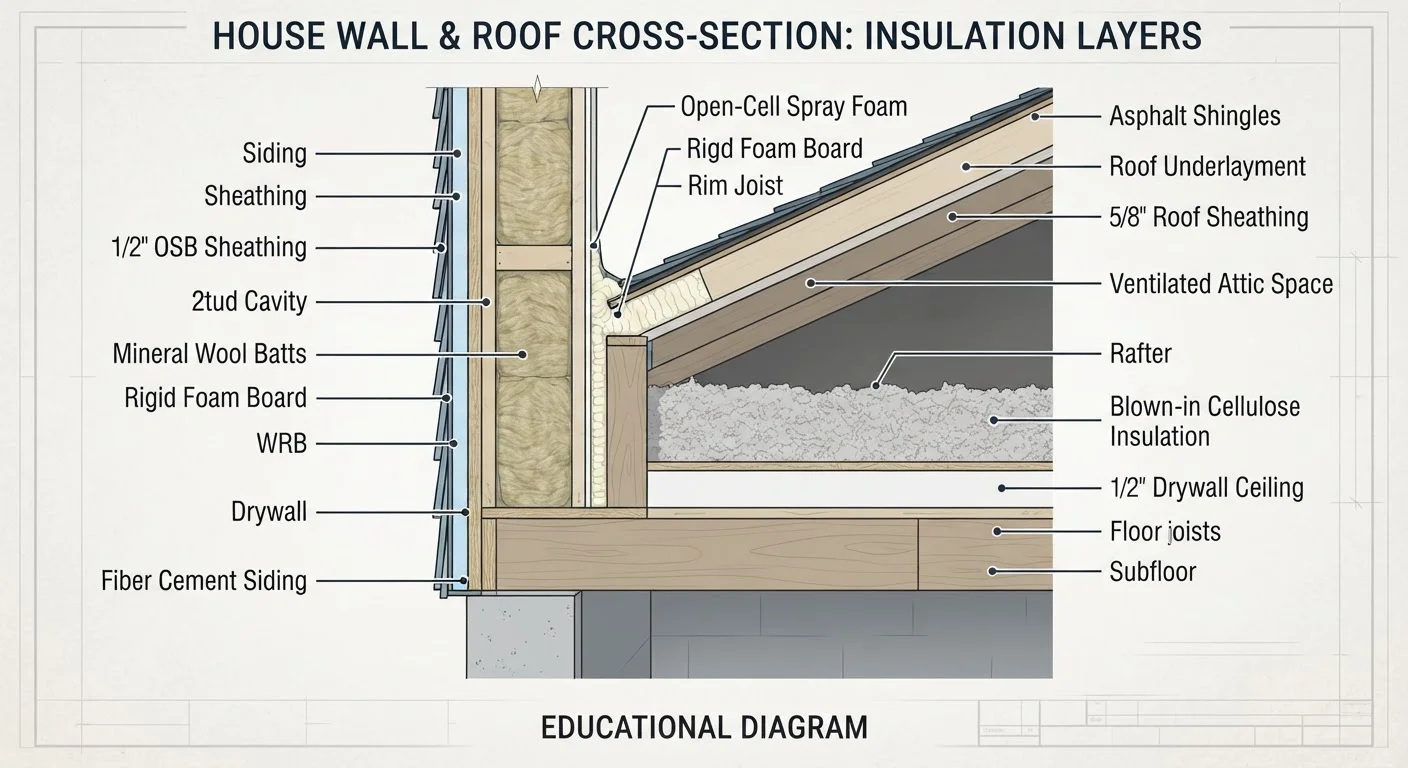
- Exterior walls (stud cavities): Mineral wool or fiberglass batts work well here. If you're adding a continuous exterior layer to reduce thermal bridging, rigid foam board is the standard choice.
- Attics and roof assemblies: Blown-in mineral wool or cellulose suits open attic floors. For sealed, conditioned attics or cathedral ceilings with limited depth, closed-cell spray foam or high-R rigid foam boards are often more practical.
- Crawl spaces, rim joists, and basement walls: Closed-cell spray foam is widely recommended for rim joists due to its air-sealing and moisture resistance. Rigid foam board works well on basement walls. See also common insulation failures in crawl spaces and attics for additional context on these areas.
Regardless of which material you choose, pairing it with proper air sealing at penetrations, joints, and edges significantly improves real-world performance. Sealing and weatherstripping techniques address the gaps that even good insulation can't overcome on its own.
Don't Overlook Thermal Bridging
Insulating only between studs or rafters leaves those structural members as thermal bridges - pathways where heat bypasses the insulation. Adding a continuous layer of rigid foam board over the framing before cladding or sheathing significantly reduces this effect. It's a step that's easier to incorporate during new construction or a full re-clad than as a retrofit, so plan ahead if you're already opening up the wall.
Cost, Availability, and Practical Considerations
Fiberglass batts remain the most widely available and lowest upfront cost option, but mineral wool's durability and fire performance make it increasingly popular as a step up. Rigid foam boards and spray foam both carry higher material or labor costs but can deliver meaningful efficiency gains in the right applications.
Before purchasing any insulation, verify the R-value requirements for your climate zone under current energy codes - the US Department of Energy publishes zone-specific guidelines that spell out minimum values for walls, roofs, and floors. Pulling any necessary permits and working with a licensed contractor for spray foam or structural work helps ensure the installation meets those requirements and is covered by your homeowner's insurance. A well-insulated home also pairs naturally with a broader winterization plan: a room-by-room winter readiness walkthrough can help you prioritize where to start.
This article is for general informational purposes only. Always verify local building codes, permit requirements, and energy standards with your local authority before beginning any insulation project, and consult a licensed contractor for work involving hazardous materials or structural components.
The content on this site is for informational purposes only and is not a substitute for professional advice. Always consult a qualified professional for guidance specific to your situation.