

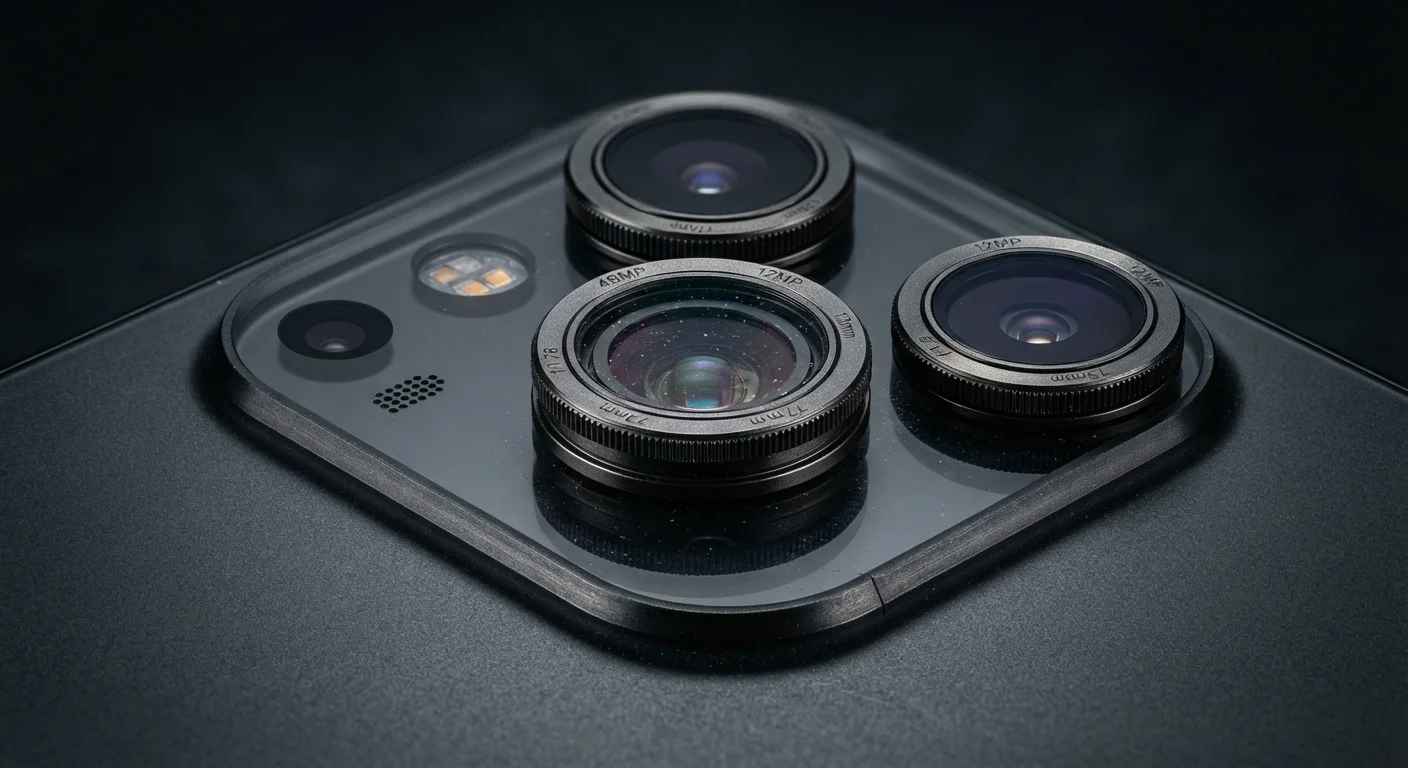
The Three Numbers on Every Camera Spec Sheet
Walk through any phone listing and you'll see figures like "200MP, f/1.7 aperture, 1/1.28" sensor" stacked in a row. Manufacturers present these as evidence of camera quality, but they measure very different things - and a high number in one column can easily be undermined by a weak number in another. Understanding what each spec actually controls is the first step to interpreting them honestly.
| What megapixels measure | Number of pixels captured; affects maximum print/crop size |
| Typical social-media-ready resolution | 8-12MP is sufficient for most screens and sharing |
| Aperture notation | Lower f-number = wider opening = more light |
| Sensor size convention | Expressed as fractions (e.g. 1/1.28"); larger fraction = larger sensor |
| Pixel binning | Merges multiple small pixels into one; trades resolution for light sensitivity |
| Typical phone aperture range | f/1.4 (very wide) to f/2.8 (narrower) across main lenses |
For a broader look at how these components fit inside the device, see what's actually inside a smartphone. And if a term below trips you up, the consumer tech glossary has plain-English definitions for over 40 spec-sheet terms.
Megapixels: Resolution, Not Quality
A megapixel (MP) is one million individual light-capturing points, called pixels, arranged on the sensor. A 12MP sensor captures roughly 12 million pixels per photo; a 48MP sensor captures 48 million. That sounds like a straightforward win for higher numbers - but it isn't.
Megapixel count controls only one thing with precision: the maximum size at which a photo can be printed or cropped before it visibly degrades. For typical social sharing, a 12MP image is already more resolution than most screens can display. Beyond a certain threshold, additional pixels don't improve a photo's appearance on a screen at all.
Where megapixels can hurt rather than help: when you pack more pixels onto the same physical sensor area, each individual pixel must be physically smaller. Smaller pixels collect less light, which means more noise - that grainy, mottled texture you see in low-light shots. Many phones use a technique called pixel binning, which merges four or more small pixels into one larger effective pixel during processing, trading resolution for light sensitivity. A phone advertised at 108MP may actually shoot most scenes using binned 27MP output - which can be the smarter choice.
The practical question isn't "how many megapixels?" but "how large are the individual pixels?" Pixel size is measured in micrometers (μm); larger values generally mean better low-light performance.
Aperture: How Much Light the Lens Lets In
Aperture describes the diameter of the opening inside the lens through which light passes. On spec sheets it appears as an f-number (also called f-stop), written as f/1.8 or f/2.4. The notation is counterintuitive: a lower f-number means a wider opening, which admits more light.
Aperture controls two things simultaneously:
- Light intake: An f/1.7 lens admits roughly twice as much light as an f/2.4 lens, which directly improves low-light performance and allows faster shutter speeds that freeze motion.
- Depth of field: Wider apertures (lower f-numbers) produce a shallower depth of field - the blurred background effect known as bokeh. On phone cameras, the sensor is physically small enough that true optical bokeh is limited; software algorithms simulate it for portrait modes.
One important caveat: most smartphone lenses have a fixed aperture, unlike interchangeable camera lenses that can be adjusted. The aperture listed is the only one the camera ever uses for that lens, so its value matters permanently, not just in specific shooting modes.
Megapixel (MP)
One million pixels. Determines how much resolution a photo contains and the maximum size it can be printed or cropped without visible degradation.
Aperture (f-stop)
The diameter of the lens opening through which light enters. Expressed as an f-number; lower values mean a wider opening and more light admitted.
Sensor size
The physical dimensions of the image sensor chip. Larger sensors gather more light, support better dynamic range, and allow larger individual pixels.
Pixel binning
A processing technique that combines multiple small adjacent pixels into a single larger effective pixel, improving low-light performance at the cost of resolution.
Depth of field
The range of distance in a scene that appears acceptably sharp. Wider apertures produce shallower depth of field, causing backgrounds to blur.
Noise (image)
Random grain or speckle that appears in photos, particularly in low light. Caused by insufficient light reaching small pixels, amplified during sensor processing.
Sensor Size: The Most Underreported Spec
If megapixels are overrated and aperture is frequently misunderstood, sensor size is the spec that gets the least attention despite having arguably the largest effect on image quality. The sensor is the physical chip that actually records light, and its physical dimensions determine how much total light the system can gather.
Sensor size in phone specs is expressed as a fraction in inches - such as 1/1.28" or 1/2.55" - derived from a legacy measurement convention that does not correspond to the sensor's actual diagonal. A larger fraction numerically means a larger sensor: 1/1.28" is significantly larger than 1/2.55".
A larger sensor provides three compounding advantages: it captures more total light (improving dynamic range and reducing noise), it allows physically larger individual pixels even at high megapixel counts, and it produces more natural background separation. When a phone maker touts its camera system, sensor size is frequently the most telling single figure to check - more so than the megapixel headline.
These three specs don't operate independently. A large sensor with a wide aperture can compensate for a modest megapixel count in most everyday shooting situations. A very high megapixel count paired with a small sensor and narrow aperture will often disappoint in anything other than bright daylight. For a structured approach to reading these numbers together, reading a spec sheet without getting lost explains which figures to prioritize and which to treat skeptically.
The content on this site is for informational purposes only and is not a substitute for professional advice. Always consult a qualified professional for guidance specific to your situation.