

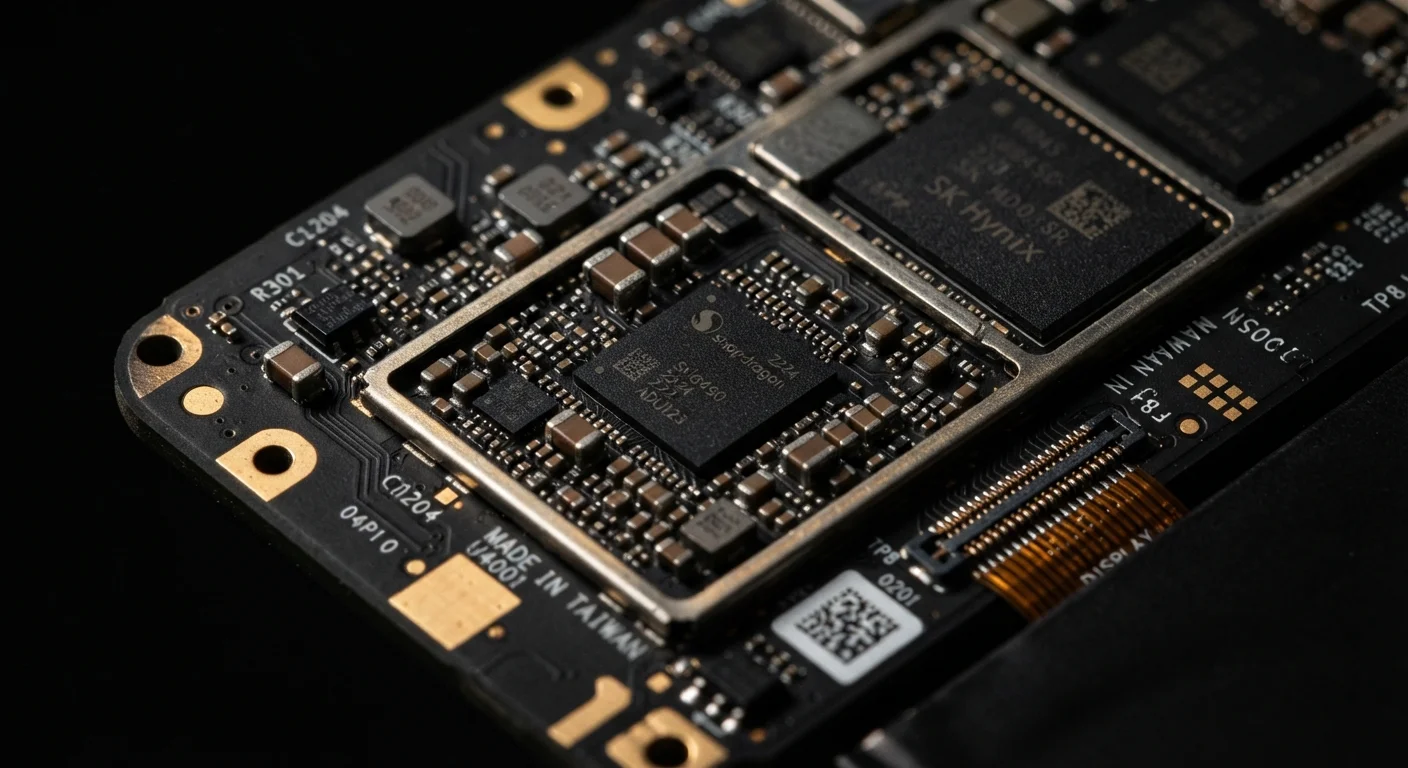
The SoC: One Chip to Rule Them All
If you opened a modern smartphone, the largest chip on the logic board is almost certainly the System on a Chip (SoC). Rather than scattering separate processors across the board the way a desktop PC does, a SoC bundles the CPU, GPU, image signal processor (ISP), AI accelerator, and memory controller into a single package roughly the size of a fingernail.
The CPU handles general computation — running apps, managing the operating system, executing logic. The GPU renders graphics, including video playback and games. The ISP processes raw data from the camera sensors before it ever becomes a photo you can view. The AI accelerator (sometimes called a neural processing unit, or NPU) runs machine-learning tasks like voice recognition and real-time photo enhancement locally, without sending data to a server.
Clock speed, expressed in GHz, is only one dimension of SoC performance. Core count, architecture efficiency, and manufacturing process (measured in nanometers) all shape how quickly — and how coolly — the chip runs. For a deeper look at why GHz alone can mislead, see our explainer on processor speed.
Read the SoC Name, Not Just the Speed
When comparing phones, look up the SoC model name rather than relying solely on GHz figures. Chip generations and architectures vary considerably, and a newer-generation SoC at a lower clock speed often outperforms an older one running faster. Manufacturer comparison pages and independent hardware review sites typically publish benchmark data that makes this easier to evaluate.
RAM, Storage, and Why Both Matter
RAM (Random Access Memory) is your phone's short-term workspace. When you open an app, its code loads into RAM so the CPU can access it almost instantly. More RAM lets the phone keep more apps open simultaneously, reducing the need to reload them from slower storage each time you switch. Typical mid-range phones ship with 6–8 GB of RAM; flagship devices may carry 12 GB or more.
Storage — often listed as 128 GB, 256 GB, or higher — is the long-term warehouse for apps, photos, videos, and documents. It persists when the phone is off. Modern phones use UFS or eMMC flash chips; UFS is faster and increasingly standard. The storage standard affects how quickly apps install, photos save, and large files transfer.
The two are not interchangeable. Running low on RAM causes slowdowns and app reloads. Running low on storage prevents you from saving new files. Both limits are worth checking against your actual usage habits before purchasing.
The Modem and Wireless Radios
The modem is the component that connects your phone to the outside world wirelessly. It translates between the digital data your phone produces and the radio signals that cellular towers, Wi-Fi routers, and Bluetooth accessories use. In many modern SoCs, the modem is integrated directly into the chip package, though some manufacturers pair an external modem with their SoC.
A 5G modem supports the sub-6 GHz and mmWave frequency bands used by fifth-generation networks. Whether those bands matter to you depends on carrier infrastructure in your area. For a clear breakdown of what each cellular generation actually delivers, see our mobile data technologies explainer.
Separate radio chips handle Wi-Fi (with standards like Wi-Fi 6 or Wi-Fi 6E determining maximum speeds and congestion handling) and Bluetooth (used for headphones, wearables, and peripherals). An NFC chip enables contactless payments and pairing shortcuts. Each radio is technically distinct hardware, even if they share antenna space on the device's frame. If you're curious how your phone interacts with your home network once it connects over Wi-Fi, our home network explainer walks through the full chain.
Camera Hardware: More Than Just Megapixels
Smartphone cameras involve several discrete hardware elements. The image sensor is the light-capturing surface; its physical size — not its megapixel count alone — determines how much light it can gather. A larger sensor captures more photons, which directly improves low-light performance.
The aperture (the opening through which light enters the lens, expressed as an f-number like f/1.8) controls light intake and depth of field. A lower f-number means a wider opening and more light. The optical image stabilization (OIS) system physically shifts the lens or sensor to compensate for hand movement, reducing blur in photos and video.
Many phones now carry two, three, or four separate camera modules — wide, ultrawide, telephoto, and macro — each with its own sensor and lens. The ISP inside the SoC stitches and processes data from these sensors, often combining multiple exposures in a single frame. For a detailed breakdown of how sensor size, aperture, and megapixels interact, see our camera spec explainer.
Software Shapes What Hardware Can Do
The ISP inside the SoC does much of the heavy lifting for camera quality through computational photography — combining multiple exposures, reducing noise, and adjusting dynamic range in fractions of a second. This means two phones with similar sensor hardware can produce noticeably different photos depending on how well the software is optimized. App updates can also meaningfully change camera behavior over a phone's lifetime — see what happens during an app update for more on that process.
Battery, Display, and Supporting Sensors
The battery is a lithium-ion or lithium-polymer cell rated in milliampere-hours (mAh). Higher mAh means more stored energy, but efficiency of the SoC and display heavily influence how long that energy lasts. Fast-charging support is governed by a separate power delivery chip, not the battery itself.
The display is frequently the component that consumes the most power. Panels are either LCD or OLED; OLED emits light per pixel and can turn off individual pixels for true blacks, saving energy on dark content. Refresh rate (60 Hz, 90 Hz, 120 Hz) determines how many frames per second the screen draws — higher rates feel smoother but drain the battery faster.
Below the screen and scattered around the frame sit supporting sensors: an accelerometer detects orientation and motion; a gyroscope tracks rotational movement for gaming and image stabilization; a barometer measures air pressure for altitude estimates; and a proximity sensor turns off the display when the phone is held to your ear. These sensors feed data to apps and the operating system constantly, often without the user noticing.
Understanding these components together — rather than fixating on any single spec — is what turns a confusing spec sheet into a useful decision-making tool. If you want broader help decoding device terminology, the Consumer Tech Glossary covers 40 common terms in plain English.
Frequently Asked Questions
SoC stands for System on a Chip. It integrates the main processor (CPU), graphics processor (GPU), and often the AI engine and signal processor into a single chip package. This consolidation saves space, reduces power consumption, and allows components to share data faster than if they were separate chips.
RAM (Random Access Memory) is short-term, fast memory that holds apps and data currently in use. Storage (often called internal memory or eMMC/UFS) keeps everything long-term — your photos, apps, and files — even when the phone is off. More RAM lets you multitask smoothly; more storage means room for more content.
The modem translates digital data from your phone into radio signals that cellular towers can receive, and vice versa. It also manages Wi-Fi and Bluetooth connections. A 5G modem supports newer, faster network bands; for more on what those generations mean, see our explainer on mobile data technologies.
Megapixels measure only the resolution of the sensor — how many individual light-capturing points it has. Sensor physical size, aperture, and image signal processing (ISP) software have a larger influence on overall image quality, especially in low light. A larger sensor with fewer megapixels can outperform a smaller, higher-resolution one.
Battery capacity in milliampere-hours (mAh) sets the ceiling, but actual runtime depends on screen brightness, processor efficiency, cellular signal strength, and how aggressively apps run in the background. A phone with a larger battery but an inefficient SoC can underperform one with a smaller battery and tighter software integration.
All smartphones share the same functional categories — SoC, RAM, storage, modem, battery, display, and sensors — but the specific chips and their quality vary widely. Higher-tier devices typically use more advanced SoCs, faster storage standards (UFS 3.1 vs. UFS 2.1), and larger camera sensors.
The content on this site is for informational purposes only and is not a substitute for professional advice. Always consult a qualified professional for guidance specific to your situation.