

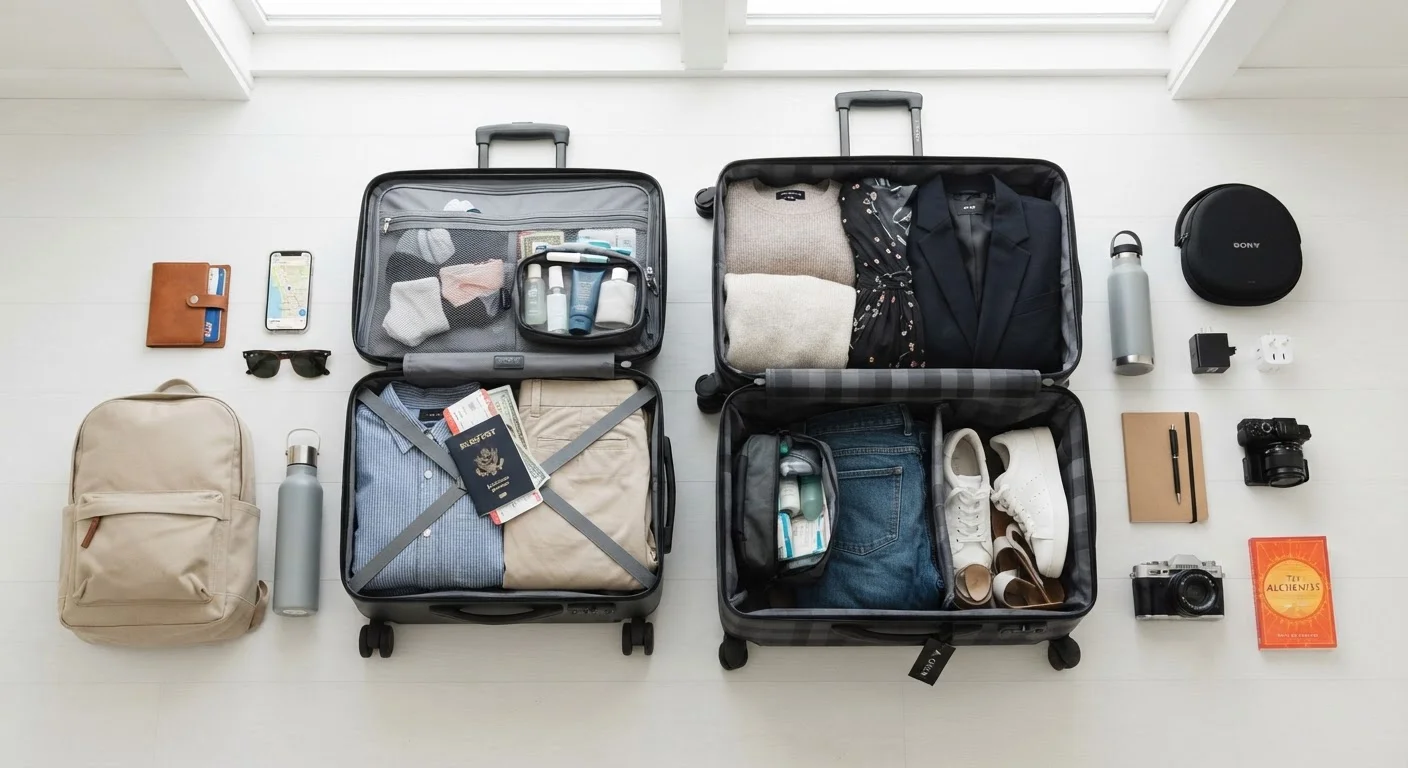
Option A
Carry-On Luggage
The streamlined, airport-efficient choice.
Best for: Short trips, frequent flyers, and travelers who value speed and flexibility over packing volume.
Option B
Checked Luggage
The spacious, trip-length-flexible option.
Best for: Extended trips, group travel, or journeys requiring bulky gear, specialty equipment, or items restricted from cabins.
Why the Rules Are Just the Starting Point
Airline size limits and TSA liquid rules get most of the attention in packing conversations. But those regulations are a floor, not a framework. The real decision — carry-on or checked — comes down to trip logistics, item type, route structure, and how much airport friction you're willing to absorb.
Understanding both options as tools, rather than treating one as a universal default, is the foundation of smarter packing. This is part of the broader thinking covered in comprehensive trip planning strategy — packing decisions connect directly to how your whole journey flows.
| Criterion | Carry-On Luggage | Checked Luggage |
|---|---|---|
| Typical size limit | ~22" x 14" x 9" (varies by carrier) | 62 linear inches combined dimensions |
| Baggage fees | Often included or lower cost | Commonly $30–$60+ per bag, per flight |
| Liquid restrictions | 3.4 oz (100ml) per container, 1-quart bag | No liquid volume restriction |
| Risk of loss or delay | Very low — stays with you | Low but present; misrouting does occur |
| Airport time impact | Faster — no drop-off or claim wait | Adds 20–45 min each direction |
| Best trip length | 1–7 days | 7+ days or multi-climate routes |
| Specialty items | Many items prohibited in cabin | Accommodates most regulated items |
Where Carry-On Has a Genuine Edge
The speed advantage of carry-on travel is substantial. Skipping checked bag drop, avoiding baggage claim, and reducing the risk of lost or delayed luggage are tangible benefits — not just traveler lore. For domestic routes and short international hops, the carry-on approach often saves 30–60 minutes of airport time each way.
Carry-on travel also gives you more control when flights change. If you're rerouted, you move with your belongings rather than coordinating bag transfer through airline systems. For anyone managing a tight connection — say, under 90 minutes at a busy hub — this matters considerably.
The constraint is volume. A standard carry-on (typically 22" x 14" x 9" in US airline policy, though this varies by carrier) holds roughly 35–45 liters. That's workable for four to seven days with deliberate packing, especially if you apply the principles in efficient minimalist packing. Beyond that window, compromises multiply.
When Checked Luggage Makes More Practical Sense
Checked bags remove the volume ceiling. For trips spanning two or more weeks, or itineraries that cross significantly different climates, that ceiling matters. A heavy winter coat, hiking boots, and formal wear for an event simply don't compress into a 40-liter bag without leaving something behind. For guidance on managing multi-climate itineraries specifically, see packing for multiple climates in a single trip.
Checked luggage is also the practical choice when you're carrying items that cannot travel in the cabin — certain sporting equipment, full-size toiletries, tools, or liquids exceeding the 3.4 oz (100ml) limit. Families traveling with children often find the volume and flexibility of a checked bag reduces the mental load of packing significantly.
The trade-offs are real: baggage fees vary widely by airline and fare class, handling time adds to both departure and arrival, and bags occasionally travel separately from their owners. These are manageable risks with awareness, not reasons to avoid checking bags altogether.
Airline Policies Vary — Always Verify
Carry-on size limits, checked bag fees, and weight allowances differ meaningfully between airlines and even between fare classes on the same carrier. Budget carriers in particular often enforce stricter dimensions and higher fees than full-service airlines. Always review the specific baggage policy for your ticket before you pack — policies are published on airline websites and are subject to change.
Making the Call for Your Specific Trip
The most useful question isn't "carry-on or checked?" in the abstract — it's what does this specific trip require? A four-day city break and a 12-day multi-country journey are entirely different logistical problems that happen to share an airport.
A practical framework: if you can pack everything in a carry-on plus a personal item without meaningful compromise, do it. If packing within that limit requires leaving behind items you'll actually need — or spending the trip improvising replacements — check a bag. The fee is usually less disruptive than the gap.
For pre-trip preparation that connects your packing decisions to the rest of your departure plan, the pre-departure checklist provides a structured walkthrough. Packing is one piece; confirming documents, digital backups, and logistics together prevents the avoidable problems that derail even well-packed trips.
More trip planning fundamentals are organized in the Trip Planning Tips hub, covering budgeting, packing, and pre-departure organization in one place.
The content on this site is for informational purposes only and is not a substitute for professional advice. Always consult a qualified professional for guidance specific to your situation.