

Start here
What Active Safety Systems Actually Do
Core system #1
Anti-Lock Braking System (ABS)
Core system #2
Electronic Stability Control (ESC)
Core system #3
Blind-Spot Monitoring
Apply it
Limitations, Warning Lights, and Driver Responsibility
What Active Safety Systems Actually Do
Modern vehicles are equipped with multiple layers of electronic safety technology designed to assist drivers in critical moments. Unlike passive safety features - such as airbags and seatbelts, which protect occupants after a crash - active safety systems intervene in real time to help prevent a crash from occurring in the first place.
Three of the most common and consequential active systems are ABS (Anti-Lock Braking System), ESC (Electronic Stability Control), and blind-spot monitoring. Each addresses a different type of hazard, and each has meaningful limitations. Understanding how they work - and what they cannot do - is as important as knowing they exist.
Wheel lock-up
When a braking wheel stops spinning entirely while the vehicle is still moving, causing a skid and removing the driver's ability to steer.
Yaw
The rotational movement of a vehicle around its vertical axis - essentially, the rear swinging out to one side during a skid.
Wheel-speed sensor
A small sensor at each wheel that measures how fast that wheel is rotating, feeding data to ABS and ESC control modules.
Blind spot
The area alongside and slightly behind your vehicle that is not visible in your mirrors and requires a physical head-check to see.
Radar/ultrasonic sensor
Electronic hardware mounted in bumpers or mirrors that emits and receives signals to detect nearby vehicles or objects.
Anti-Lock Braking System (ABS)
ABS prevents wheels from locking up during hard or sudden braking. When a wheel locks, it skids rather than rolls, which eliminates your ability to steer around obstacles - even if you're still pressing the brake pedal.
ABS works by monitoring wheel-speed sensors at each corner of the vehicle. If a wheel decelerates much faster than the others - a sign it's about to lock - the system rapidly pulses brake pressure to that wheel, many times per second, keeping it on the edge of grip rather than sliding.
What to expect when ABS activates: You'll typically feel a pulsing or juddering sensation through the brake pedal, and you may hear a grinding noise. This is normal. The key instruction from safety experts is to maintain firm, steady pressure on the pedal and let the system work - do not pump the brakes, as you would in an older vehicle without ABS.
One important nuance: on loose surfaces like gravel or deep snow, ABS can actually increase stopping distance slightly. Its primary value is maintaining steering control under hard braking, not necessarily stopping in the shortest distance on all surfaces.
Electronic Stability Control (ESC)
ESC helps prevent skids and loss of directional control - situations where the vehicle goes where physics dictates rather than where the driver intends. It's particularly relevant during sudden swerves, tight cornering on slippery roads, or overcorrection after a lane change.
The system compares what you're asking the vehicle to do (measured via the steering wheel angle and accelerator) with what the vehicle is actually doing (measured via yaw sensors and wheel speeds). When a significant discrepancy appears - indicating a skid developing - ESC selectively applies braking to individual wheels and may reduce engine power to bring the vehicle back in line.
Federal Mandate: ABS and ESC
The National Highway Traffic Safety Administration (NHTSA) required ABS and ESC on all new light passenger vehicles sold in the US starting with the 2012 model year. If you drive a vehicle built before this mandate, you may not have ESC at all - worth confirming in the owner's manual or vehicle documentation.
ESC is especially effective at countering two common instability events: understeer (the front wheels losing grip, causing the car to push wide in a corner) and oversteer (the rear wheels losing grip, causing the rear to swing out). Neither is something most drivers can react to fast enough on their own.
For more context on how driving habits interact with vehicle stability, see our article on defensive driving habits.
Blind-Spot Monitoring
Blind-spot monitoring (BSM) uses radar or ultrasonic sensors - typically mounted in the rear bumper or side mirrors - to detect vehicles traveling in the zones alongside and behind your car that mirrors don't fully show.
When another vehicle enters your blind zone, the system triggers a visual alert, usually an icon lit in or near the corresponding mirror. If you activate your turn signal while a vehicle is detected in that zone, many systems add an audible warning or a more prominent flashing alert.
Check Your Owner's Manual First
Every manufacturer implements these systems slightly differently. Your vehicle's owner's manual explains exactly how its specific ABS, ESC, and blind-spot system behave - including what warning indicators look like and whether any settings are adjustable. Five minutes with the manual can clear up a lot of confusion.
What BSM does not do: Standard blind-spot monitoring alerts you - it does not steer or brake for you. Some vehicles pair it with active lane-change assist that can apply a brief steering correction, but this varies by make, model, and trim level. Checking your owner's manual is the only reliable way to know what your specific system provides.
BSM performance can also degrade in certain conditions. Heavy rain, snow, ice on sensors, towing a trailer, or being in heavy construction zones can affect detection accuracy. Physical checks - mirrors properly adjusted combined with a head-check over your shoulder - remain essential. When evaluating a vehicle for purchase, test driving with safety features in mind can help you assess how well BSM integrates into the driving experience.
Limitations, Warning Lights, and Driver Responsibility
All three systems operate within the laws of physics. Driving too fast for conditions, following too closely, or distracted driving can create situations where no electronic system can prevent a crash. Safety technology reduces risk - it does not eliminate it.
Safety Tech Does Not Replace Attention
No current active safety system makes up for distracted or impaired driving. ABS, ESC, and blind-spot monitoring all operate within physical limits - they cannot defy the laws of physics on ice or at excessive speed. Over-relying on these systems is a recognized safety risk in itself.
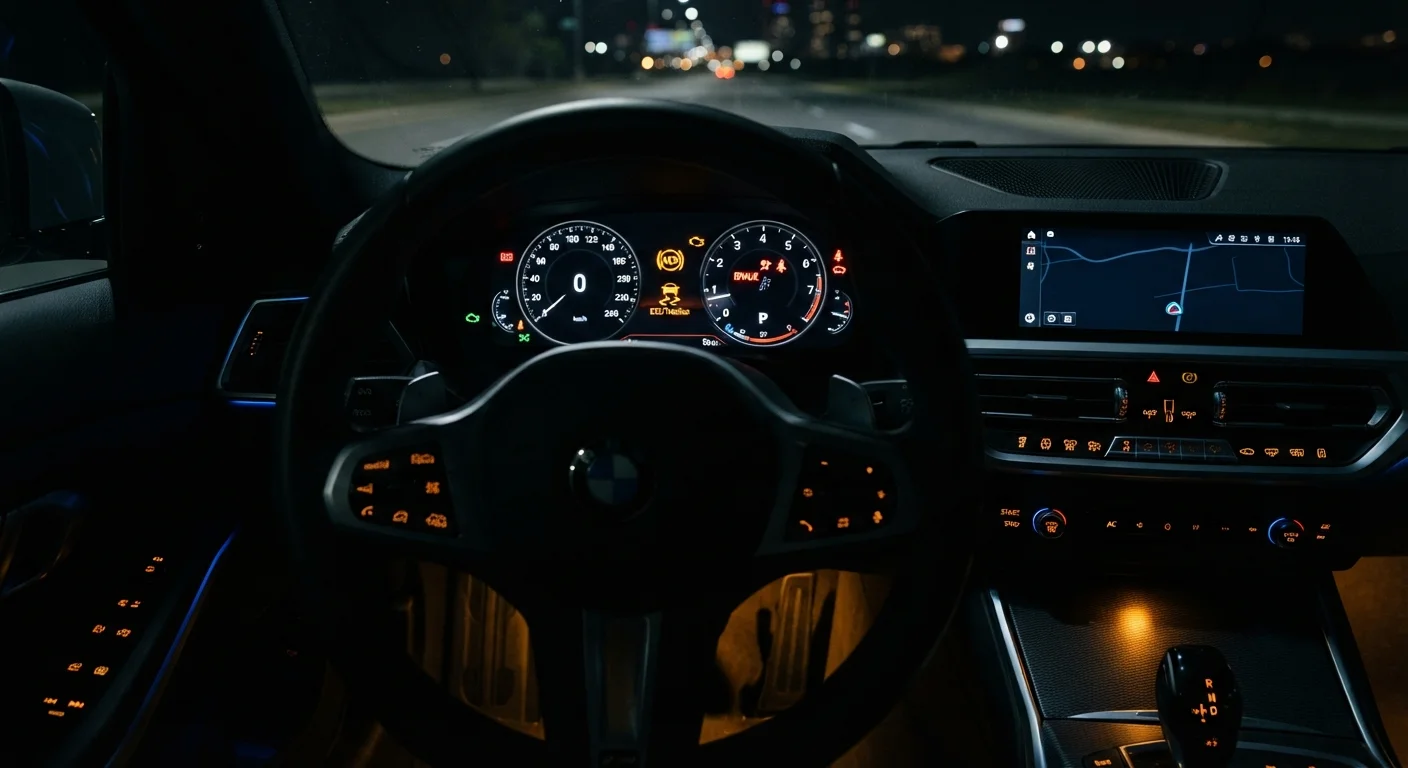
When any of these systems detect an internal fault, a warning light will appear on your dashboard. An ABS or ESC warning light that stays on after startup typically means the system is offline and you should seek a mechanic's diagnosis. Our article on car warning lights explains what dashboard indicators mean and when to act quickly.
Routine care also matters. Wheel-speed sensors can accumulate rust or debris; BSM sensors need to be kept clean and unobstructed. Before any significant drive, a basic pre-trip safety check is a good habit regardless of what technology your vehicle carries.
For a broader look at how these systems factor into overall vehicle safety evaluations, understanding NHTSA and IIHS safety ratings provides useful background on how each rating body tests and scores vehicles.
The most effective safety system in any vehicle remains an informed, attentive driver.
Frequently Asked Questions
Not always. ABS is designed to maintain steering control during hard braking, not necessarily to stop the car in a shorter distance. On loose gravel or deep snow, stopping distance can actually be longer - the key benefit is that you can still steer around an obstacle while braking hard.
Most vehicles allow you to partially or fully disable ESC via a dashboard button. For everyday driving on public roads, there is rarely a good reason to do so. ESC deactivation is sometimes used by experienced drivers on closed tracks, but on public roads it removes an important safety net.
They're related but distinct. Blind-spot monitoring detects vehicles in your blind zone and alerts you. Lane-change assist can add active intervention - such as a brief steering correction - if you signal and move toward a detected vehicle. Check your owner's manual to understand exactly what your vehicle does.
A continuously illuminated ABS or ESC warning light usually means the system has detected a fault and may be inactive. You should have the vehicle inspected by a qualified mechanic as soon as practical. See our guide on <a href="/cars-auto/car-maintenance/your-cars-warning-lights-decoded">dashboard warning lights</a> for more context.
ABS and ESC have been federally mandated on all new passenger vehicles sold in the US since the 2012 model year. Blind-spot monitoring is not federally required, though it is increasingly standard or available as an option on many newer vehicles.
ABS and ESC rely on wheel-speed sensors that can accumulate debris or wear over time. If a warning light appears, a mechanic can read the fault code and identify the issue. Blind-spot radar sensors should be kept clean and unobstructed - built-up dirt or ice can degrade performance.
The content on this site is for informational purposes only and is not a substitute for professional advice. Always consult a qualified professional for guidance specific to your situation.